

When businesses search for flexible and cost-effective voice solutions, Asterisk software is often one of the first names that appears. As an open-source PBX framework, Asterisk has powered thousands of custom telephony systems worldwide and remains a popular foundation for companies building in-house solutions—often with development partners such as Aristek.
However, as voice systems evolve into mission-critical platforms supporting call centers, distributed teams, and revenue-generating operations, many organizations begin questioning whether building and maintaining an Asterisk-based system is still the optimal path.
This article compares HAPBX and Aristek-built Asterisk solutions across operational model, IT expertise requirements, business suitability, and long-term cost—helping decision-makers choose the right approach.
Understanding the Two Approaches
What Is Aristek in the Context of Asterisk?
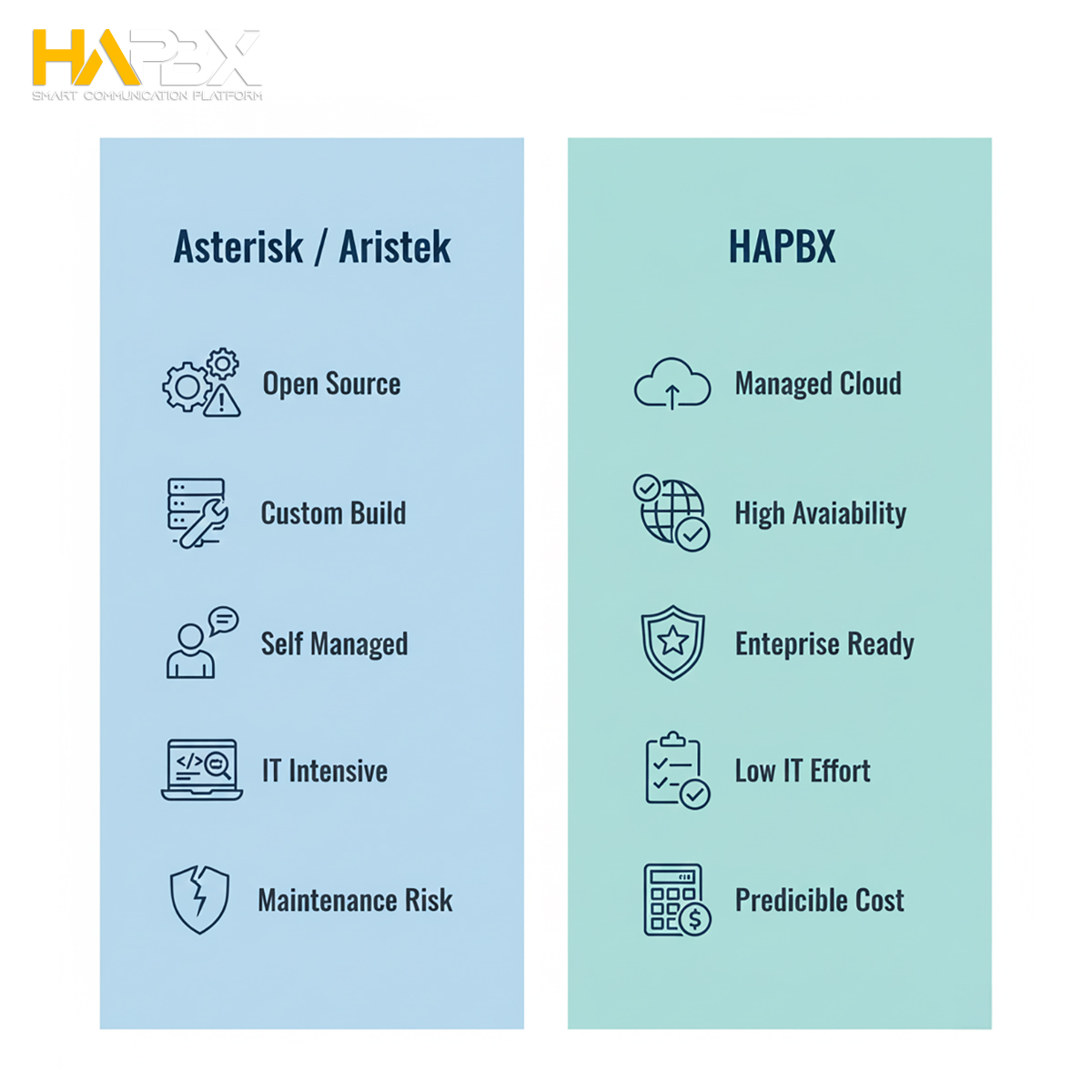
Aristek is a software development and consulting company that builds custom telephony and communication systems, often using Asterisk software as the PBX core. In this model, Asterisk is not a ready-to-use product but a toolkit that must be architected, configured, secured, and operated by skilled IT teams.
This approach offers flexibility but shifts responsibility for performance, stability, and scalability entirely to the organization.
What Is HAPBX?
HAPBX is an Cloud PBX platform designed to solve three core challenges in modern PBX operations:
- Fast deployment
- Stable operation
- Long-term cost optimization
Instead of building a PBX from scratch using Asterisk software, HAPBX delivers a ready-to-run Cloud PBX and Call Center environment, built on GEO-distributed infrastructure with clustering and failover by design.
1. Deployment & Time to Value
Asterisk (Aristek Model)
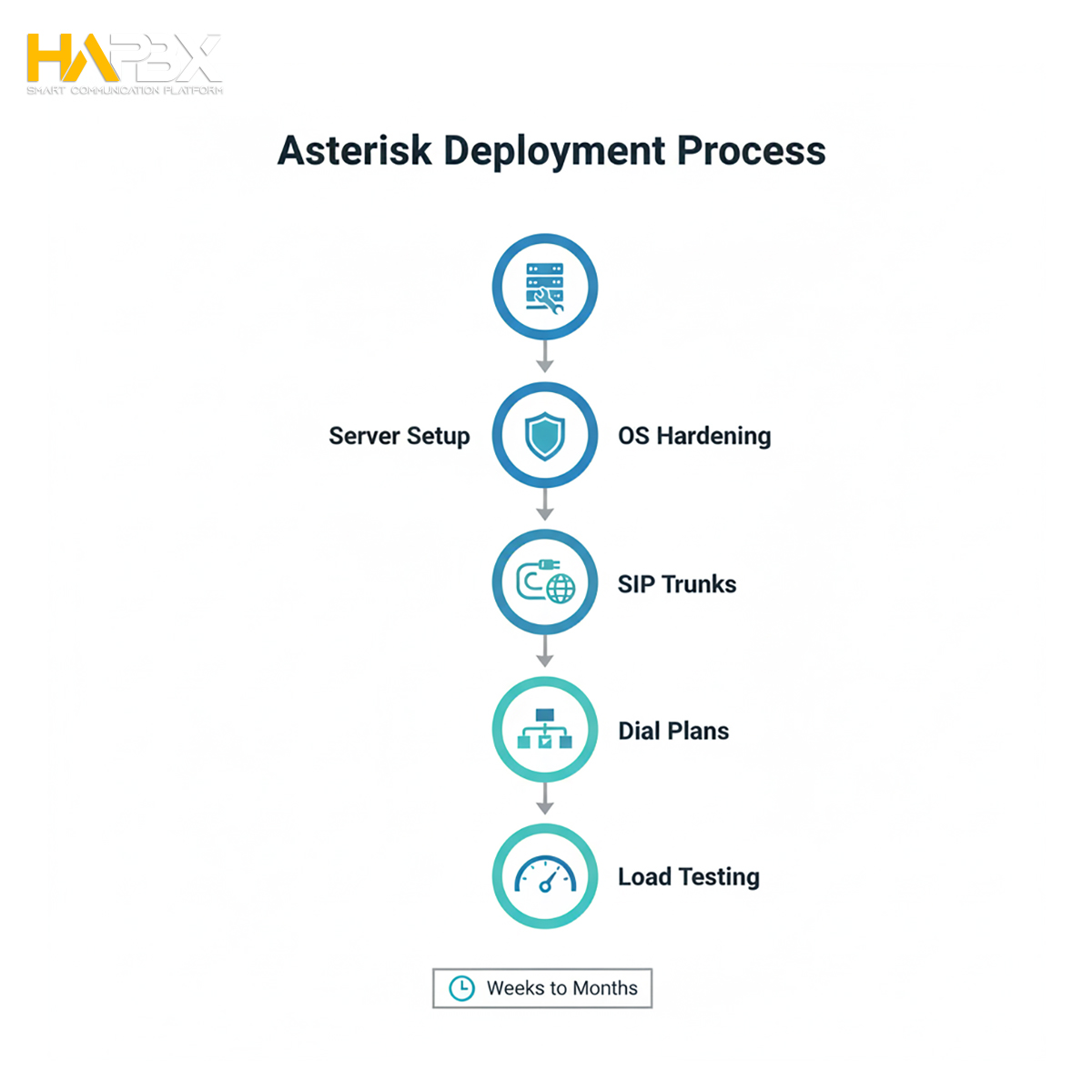
Deploying Asterisk software typically involves:
- Server provisioning
- OS hardening
- SIP trunk configuration
- Dial plan development
- Load testing and tuning
Even with an experienced partner, deployment often takes weeks or months, especially for call center use cases.
HAPBX: Fast Deployment as a Core USP
HAPBX removes deployment complexity entirely. Enterprises can have a fully operational PBX or call center ready in minutes, without infrastructure investment or complex configuration.
Deployment Comparison
| Aspect | Aristek (Asterisk Software) | HAPBX |
| Infrastructure setup | Required | Not required |
| Deployment time | Weeks–months | Minutes |
| PBX configuration | Custom-built | Pre-configured |
| Time to first call | Slow | Immediate |
USP Highlight:
➡️ Fast deployment is not an add-on—it is a core design principle of HAPBX.
2. Operational Stability & Availability
Asterisk Stability: Depends on Expertise
Asterisk software can be stable, but only when:
- HA architecture is correctly designed
- Clustering and failover are custom-built
- Continuous monitoring and tuning are in place
This places a heavy burden on IT teams and introduces operational risk.
HAPBX: Stable Operation by Design
HAPBX is built on GEO-distributed infrastructure with native clustering and automatic failover. Stability is not dependent on internal expertise—it is embedded at the platform level.
Stability Comparison
| Factor | Aristek (Asterisk Software) | HAPBX |
| High availability | Custom implementation | Built-in |
| Failover | Manual design | Automatic |
| GEO redundancy | Optional | Native |
| Downtime risk | Team-dependent | Minimized |
USP Highlight:
➡️ HAPBX ensures continuous operation even during node, zone, or regional failures.
3. IT Expertise & Operational Burden
Asterisk Requires Specialized Skills
Running Asterisk software long-term requires:
- VoIP protocol expertise
- SIP troubleshooting skills
- Linux system administration
- Security hardening knowledge
Organizations without a strong VoIP team often struggle to maintain consistent performance.
HAPBX: Control Without Complexity
HAPBX is designed for IT teams that want control and visibility, without managing PBX infrastructure.
IT teams retain:
- SIP trunk and routing control
- Dial plans and policies
- Full logs, CDRs, and recordings
- API-based automation
But avoid:
- Server management
- HA engineering
- Core PBX troubleshooting
IT Requirement Comparison
| Area | Asterisk Software | HAPBX |
| VoIP expertise required | High | Low |
| Infrastructure management | Mandatory | Not required |
| Operational workload | Continuous | Minimal |
| Visibility & control | Full | Full (logical layer) |
4. Business Fit & Use Cases
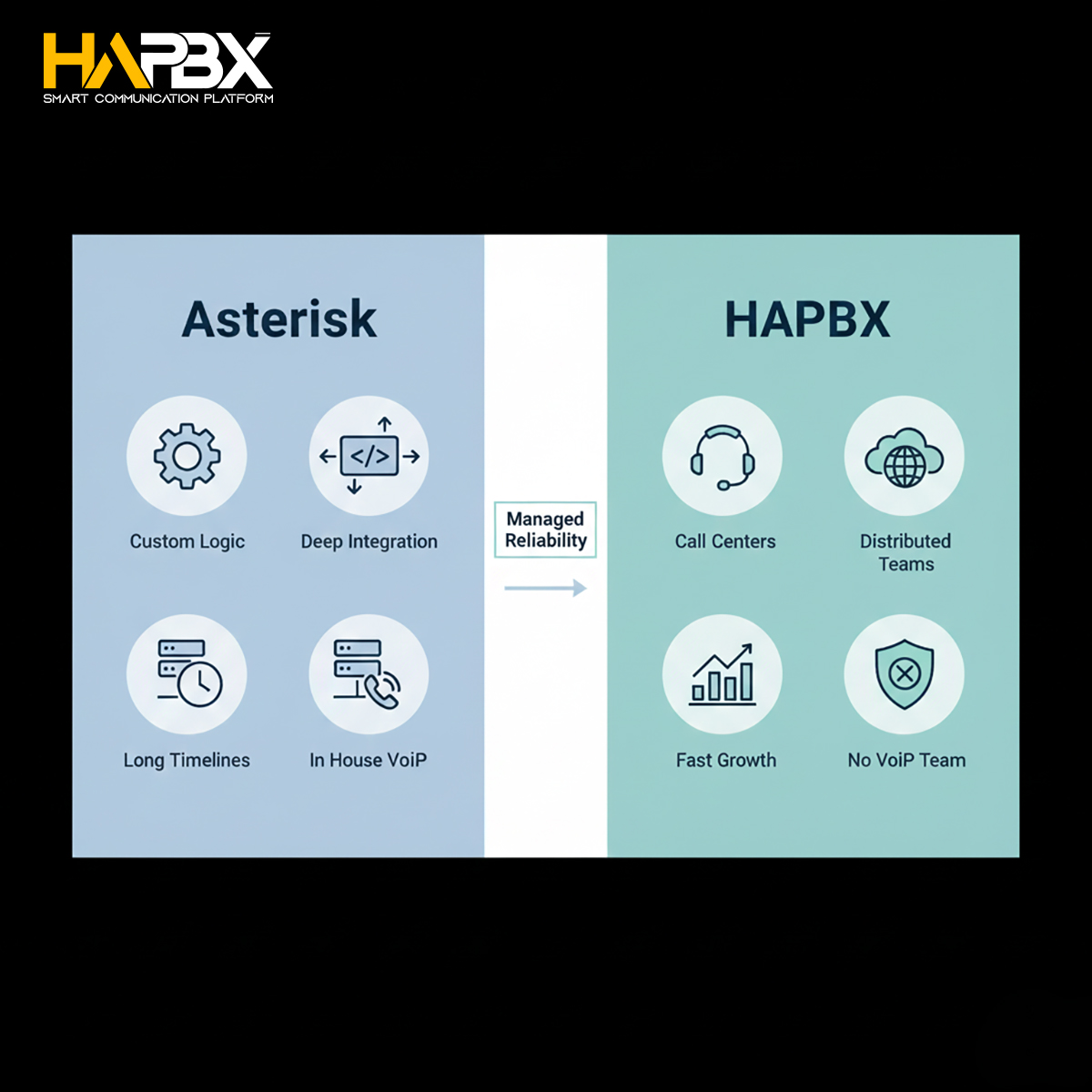
When Aristek (Asterisk) Makes Sense
- Highly customized communication logic
- Deep integration into proprietary systems
- Strong in-house VoIP engineering team
- Long development timelines acceptable
When HAPBX Is a Better Fit
HAPBX is designed for businesses where downtime directly impacts revenue or customer experience, such as:
- Call centers and contact centers
- Distributed enterprises
- Fast-growing organizations
- Companies without VoIP-specialized IT teams
USP Highlight:
➡️ HAPBX shifts PBX reliability from an internal responsibility to a managed platform.
5. Cost Structure & Long-Term Economics
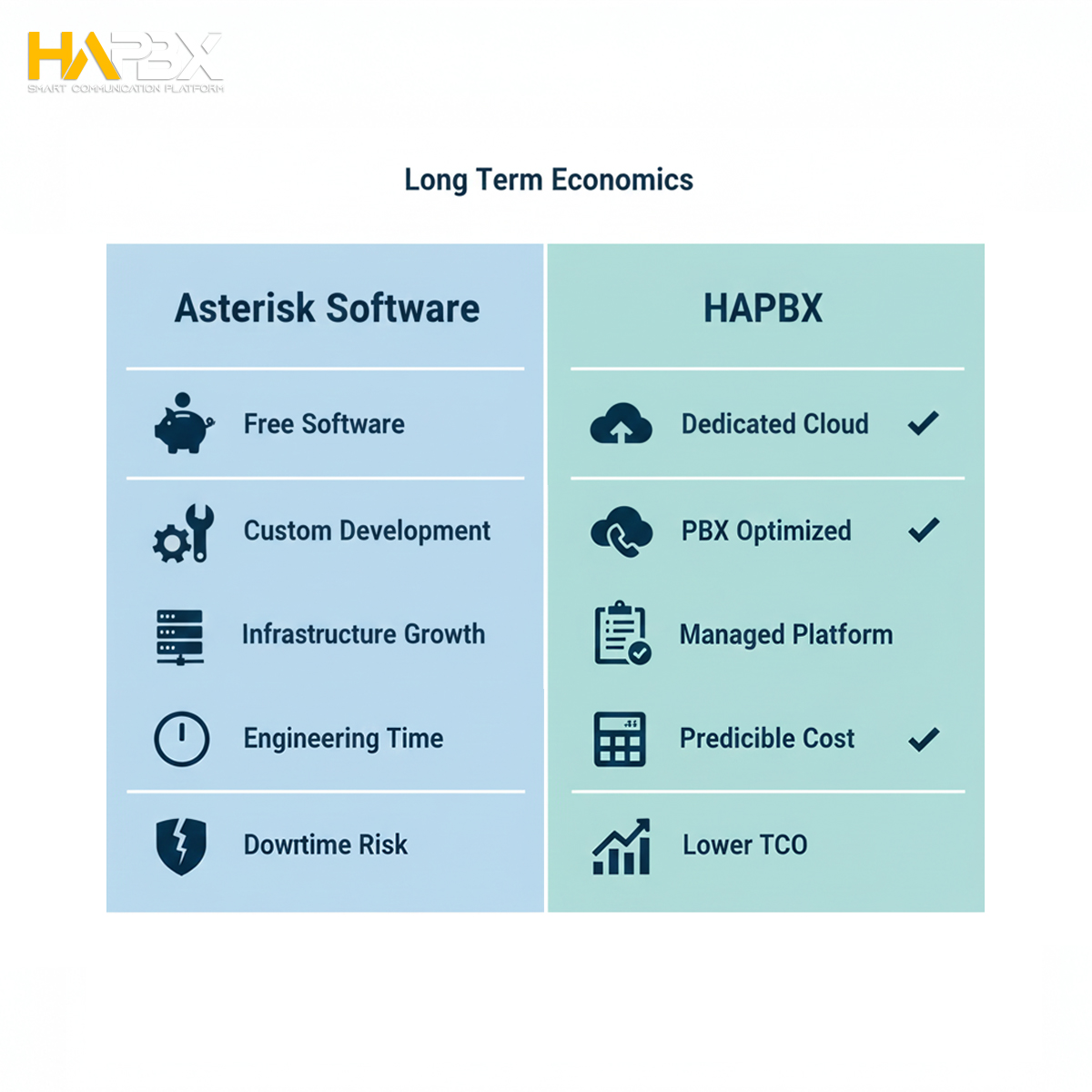
The Hidden Cost of “Free” Asterisk Software
While Asterisk software is open-source, total cost grows through:
- Development and customization
- Infrastructure expansion
- Engineering time
- Downtime and re-architecture during growth
HAPBX: Long-Term Cost Optimization
HAPBX uses a dedicated cloud model optimized for PBX workloads, helping enterprises reduce long-term costs compared to:
- Traditional on-prem PBX
- Self-managed Asterisk deployments
- Generic multi-tenant cloud PBX solutions
Cost Comparison
| Cost Area | Asterisk Software | HAPBX |
| Software license | Free | Included |
| Infrastructure | Separate | Included |
| Engineering cost | High | Low |
| Scaling cost | Unpredictable | Predictable |
| Long-term TCO | Uncertain | Optimized |
USP Highlight:
➡️ HAPBX focuses on predictable, optimized cost over the system’s lifetime—not just initial savings.
6. Strategic Comparison Summary
| Dimension | Aristek (Asterisk Software) | HAPBX |
| Deployment speed | Slow | Fast |
| Operational stability | Expertise-dependent | Built-in |
| IT workload | High | Low |
| Scalability | Custom-built | Native |
| Cost predictability | Low | High |
| Best for | Custom engineering teams | Business-critical operations |
Final Verdict: Build or Platform?
Choosing between Aristek (Asterisk software) and HAPBX is not a debate about open-source versus cloud technology. At its core, this decision is about where responsibility for your voice infrastructure should live.
Asterisk software offers maximum architectural flexibility. With the right expertise, it can be shaped into almost any telephony workflow. However, that flexibility comes with a clear trade-off: responsibility remains entirely with the business. Deployment, scaling, high availability, security hardening, performance tuning, and long-term maintenance all depend on internal IT capabilities or external development partners. Over time, this translates into higher operational complexity, longer change cycles, and increasing total cost of ownership.
HAPBX takes a fundamentally different approach.
Instead of asking enterprises to build and operate a PBX, HAPBX provides a production-ready Cloud PBX platform engineered to meet three core operational requirements of modern businesses:
1. Fast Deployment
HAPBX removes PBX deployment as an IT project. Enterprises can activate a fully functional PBX or call center environment within minutes, without provisioning servers, configuring low-level SIP components, or designing infrastructure from scratch. This allows teams to move from planning to live operations almost immediately.
2. Stable Operation
Operational stability is built into the HAPBX platform. Running on GEO-distributed infrastructure with native clustering and automatic failover, HAPBX ensures continuous service availability even during node, zone, or regional failures. Stability is no longer dependent on internal VoIP expertise—it is delivered as part of the platform itself.\
3. Long-Term Cost Optimization
While Asterisk software may appear cost-effective initially, long-term expenses often grow through infrastructure expansion, engineering effort, and re-architecture as demand increases. HAPBX is designed to optimize total cost of ownership over time, offering predictable pricing, built-in scalability, and reduced operational overhead—without sacrificing performance or control.
The Strategic Difference
In practical terms, Asterisk software turns telephony into an ongoing engineering responsibility.
HAPBX transforms it into a reliable business service.
For organizations where communication uptime directly impacts revenue, customer experience, or operational efficiency, HAPBX allows teams to focus on business growth, customer engagement, and process optimization—instead of maintaining PBX infrastructure.
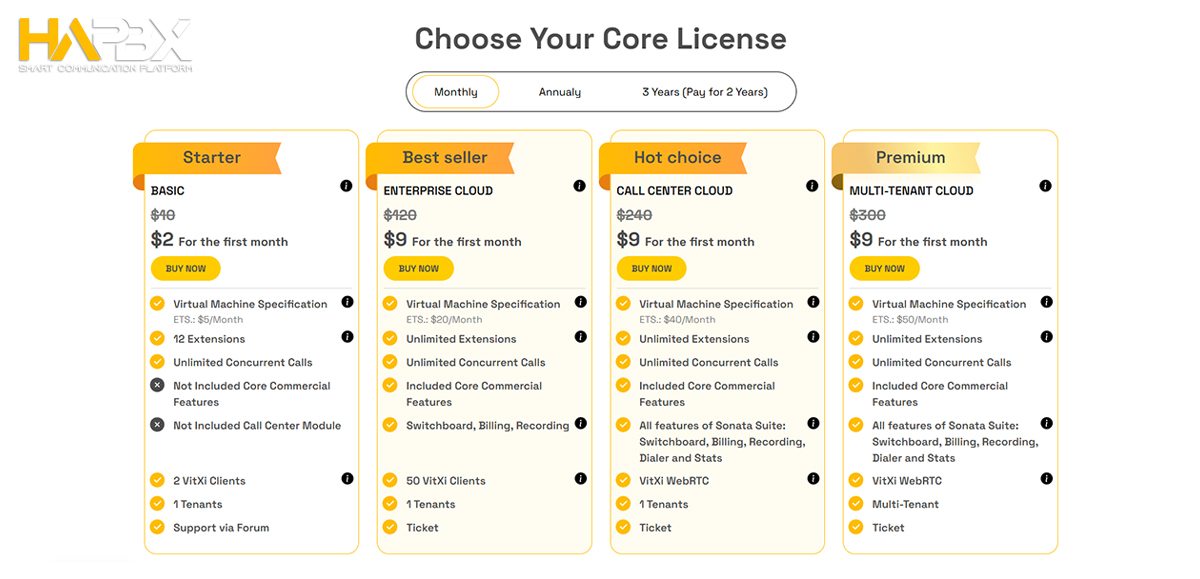
Try HAPBX — Enterprise Cloud PBX Starting at Just $9
Enterprise-grade PBX platforms are often evaluated through long sales cycles, demos, and complex proof-of-concepts.
HAPBX removes that friction.
With a $9 introductory offer for the first month, businesses can experience the full HAPBX platform—not a limited trial, not a shared demo environment, but a real dedicated Cloud PBX instance running exactly as it would in production.
What You Get for $9
- A dedicated PBX instance (no shared CPU, RAM, or IO)
- Enterprise call routing, recording, and switchboard
- Unlimited extensions and call paths
- GEO-distributed infrastructure with clustering and failover
- Full visibility into logs, CDRs, and real-time call performance
- The same architecture used by production enterprises
There are no feature locks, no artificial limits, and no trial shortcuts. See more.
Why This Matters
Most Asterisk-based deployments require:
- Weeks of engineering effort
- Thousands of dollars in setup costs
- Long-term operational commitment before real validation
HAPBX lets your team validate performance, stability, and cost efficiency immediately—with almost zero risk.
From Trial to Production, Seamlessly
If HAPBX meets your expectations:
Continue running the same instance
- Scale resources as needed
- Upgrade to Enterprise or Call Center Cloud plans without migration
- No rebuilds. No reconfiguration. No downtime.
Experience Enterprise Cloud PBX Without Enterprise Risk
Start your HAPBX experience today — from just $9 for the first month.