

In an era where Unified Communications (UC) are the backbone of business operations, the rising costs of “per-user” monthly subscriptions have reached a breaking point for many SMEs. For a growing team of 50, a standard $25/month/user fee results in a $15,000 annual overhead—just for dial tones and basic features.
This financial pressure has led to a massive resurgence in searches for free PBX software and open-source VoIP alternatives. The appeal is obvious: why pay a vendor for a “black box” solution when you can utilize powerful, community-driven software to run your own IP-PBX?
However, in the world of telecommunications, “free” is a relative term. While the software license might cost zero dollars, the Total Cost of Ownership (TCO)—including hosting, security, and the catastrophic cost of downtime—is often higher than businesses realize.
As we explore the contenders for the best free PBX, we must compare them against the modern professional standard: HAPBX. While the DIY systems listed below offer zero-dollar entry points, HAPBX represents the evolutionary next step—a platform that offers the flexibility of a private PBX with the “unbreakable” reliability of a managed global cluster.
What is a Free PBX?
Before downloading an ISO and firing up a virtual machine, it is vital to understand that “free” means different things in the world of telecommunications. Generally, free IP-PBX solutions fall into two categories:
1. Open-Source PBX (GPL/True Freedom)
These are systems where the source code is public. You have the total freedom to modify, scale, and install the software on any hardware without paying a licensing fee.
- Pros: No user limits, total control, huge community support.
- Cons: Requires high technical expertise to secure and maintain; no “official” support desk to call when the phones go silent.
2. Freemium PBX (Proprietary/Limited)
Many commercial vendors offer a “Free Tier” of their professional software.
- Pros: Usually much easier to install and comes with a modern, polished user interface.
- Cons: Heavily restricted. You might be limited to 4 simultaneous calls or 10 users. To unlock “Enterprise” features like call recording or CRM integration, you must eventually move to a paid tier.
While the software is free, you are still responsible for the “Telephony Stack”—the hardware, the SIP trunking (the actual phone lines), and the maintenance. If your business communication is mission-critical, you must decide if you have the internal resources to be your own “Telecom Provider.”
3. The Professional Alternative: Managed High-Availability (HAPBX Model)
This is where HAPBX resides. It isn’t a “free” system in the DIY sense, but it is a Cost-Effective Enterprise Platform. Unlike the first two categories, HAPBX removes the “Single Point of Failure” and the burden of server management. It is designed for businesses that want the unlimited extension benefits of a free PBX but require the 99.99% uptime of a global bank.
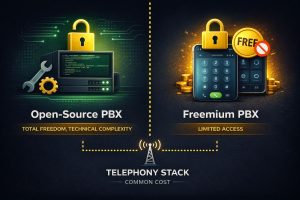
Free PBX types
Top 5 Free PBX Software Recommendations
Based on stability, feature sets, and community activity, here are the top 5 solutions currently dominating the market for DIY and self-hosted telephony.
1. FreePBX (The Industry Standard)
FreePBX is arguably the most popular open-source PBX in the world. It acts as a graphical user interface (GUI) that manages Asterisk, the engine behind the majority of global VoIP traffic.
- Best For: IT managers who want the most “standard” experience with a massive library of tutorials and forum support.
- Key Advantage: It is incredibly flexible. If you can imagine a call flow, FreePBX can likely build it.
- The Catch: The interface is aging, and while the core is free, many essential features (like Endpoint Manager or high-end reporting) are sold as paid “commercial modules.”
2. 3CX (The “Easy” Choice)
3CX has moved away from its open-source roots to become a proprietary leader, but it still offers a “3CX Free” version. It is known for its exceptional mobile apps and Windows-based management.
- Best For: Small startups (under 10 users) who need a system that “just works” and can be set up in minutes.
- Key Advantage: Includes built-in video conferencing and WhatsApp integration in the free tier.
- The Catch: You are locked into their ecosystem. The free version is strictly limited by the number of simultaneous calls, and you cannot host it on your own private infrastructure in the same way you can with open-source tools.
3. VitalPBX (The Modern Contender)
VitalPBX is rapidly gaining ground as the best alternative to FreePBX. It is built on a modern framework with a focus on security and multi-tenant capabilities.
- Best For: Businesses that want the power of Asterisk but find FreePBX too clunky or difficult to secure.
- Key Advantage: It offers a highly intuitive UI and robust “out-of-the-box” security features that usually require manual configuration in other systems.
- The Catch: Like 3CX, it uses a “freemium” model. The core system is powerful, but advanced features require a “VitalPBX One” subscription.
4. Issabel (The Community Hero)
When the famous Elastix project was acquired and turned proprietary, the community forked the code to create Issabel. It remains 100% community-driven and free.
- Best For: Purists who want a completely free, all-in-one communications suite without any commercial “upselling.”
- Key Advantage: It includes features like an integrated Call Center module and an email server within the same installation.
- The Catch: The community is smaller than FreePBX, meaning slower updates and fewer third-party integrations.
5. Asterisk (The Developer’s Engine)
For those who want to “Build a PBX” from the ground up, Asterisk is the raw engine. It isn’t a PBX in itself, but a toolkit for building one.
- Best For: Software developers and high-level network engineers building custom, large-scale proprietary platforms.
- Key Advantage: Zero bloat. You only install exactly what you need.
- The Catch: There is no GUI. Everything is handled via command line and configuration files. It is the ultimate “High Risk, High Reward” path.
asterisk logo
The “Hidden Costs” of a Free Phone System
In the software world, there is a famous distinction: “Free as in beer” vs. “Free as in a puppy.” A free beer is a one-time gift with no strings attached. A free puppy, however, costs nothing upfront but requires years of expensive food, medical care, and constant attention.
A free PBX is a puppy. While the license key costs $0, the Total Cost of Ownership (TCO) can quickly eclipse the price of a professional managed service. If you are considering the DIY route, you must factor in these three “hidden” expense categories.
Hardware and Hosting Expenses (CAPEX vs. OPEX)
Even though the software is free, the environment it lives in is not. To run a stable VoIP system, you generally have two choices:
- On-Premise Hardware: Buying a physical server. This involves an upfront capital expenditure (CAPEX), plus the ongoing costs of electricity, cooling, and hardware replacement cycles.
- Cloud VPS Hosting: Renting a Virtual Private Server (VPS) from providers like AWS, Digital Ocean, or Google Cloud. While this shifts costs to a monthly operational expenditure (OPEX), a properly specced server for high-quality voice traffic is a recurring bill that never goes away.
The Security Burden (SIP Vulnerabilities and Toll Fraud)
Security is the most overlooked “cost” of a free system. Because open-source systems like FreePBX or Asterisk are so common, they are primary targets for hackers.
- Toll Fraud: If your SIP ports aren’t perfectly hardened, hackers can hijack your system to make thousands of dollars in international calls—a bill you are legally required to pay your carrier.
- DDoS Attacks: Without enterprise-grade SIP hardening and firewall configuration, your “free” phone system can be knocked offline by a simple botnet attack.
Securing a DIY system requires specialized knowledge. If you don’t have a VoIP security expert on staff, you are essentially leaving your front door unlocked.
The Hidden Tax: Technical Debt and Administrative Time
The most significant cost of a DIY PBX is Human Capital. Every hour your IT manager spends on patch management, OS updates, or troubleshooting “one-way audio” issues is an hour they aren’t spending on growth-oriented projects.
- Maintenance: Open-source software requires frequent updates to patch security holes.
- Configuration: Building complex IVRs and call flows in a raw Asterisk environment is time-consuming.
If your IT professional earns $50/hour and spends just 5 hours a month “babysitting” the phone server, your “free” PBX is actually costing you $3,000 a year in lost productivity alone.
Why “Free” Isn’t Free: The Downtime Dilemma
The ultimate “hidden cost” isn’t found in a line item on a budget—it’s found in the silence of a dead phone line. This is known as the Downtime Dilemma.
Most free and self-hosted PBX systems operate on a Single Node Architecture. This means the entire communication system of your company lives on one server, in one data center. If that server has a hardware failure, if the data center has a power outage, or if a software update goes wrong, your business is effectively “dark.”
The Single Point of Failure (SPOF)
In a DIY setup, there is no automatic failover. If your server goes down:
- Customers can’t reach sales: Leads go to competitors.
- Support teams are paralyzed: Ticket resolution stops.
- Internal communication breaks: Remote teams lose their lifeline.
For a retail business or a medical clinic, even one hour of downtime can cost thousands of dollars in lost revenue and reputational damage. When you calculate the “Cost of Downtime,” the $0 price tag of a free PBX starts to look like a very expensive gamble.
This is the point where many businesses realize they don’t actually want a “free” system—they want a resilient one. They want a system that provides the flexibility of an open-source platform but with the High Availability (HA) and “hands-off” management of an enterprise-grade service.
This realization is what led to the engineering of HAPBX, a solution designed specifically to bridge the gap between “DIY complexity” and “Corporate reliability.”
[Featured Alternative] HAPBX: The Professional High-Availability Cloud PBX
While the allure of “free” is strong, most growing businesses eventually reach a crossroads where the risks of self-hosting outweigh the savings. This is where HAPBX (High-Available Private Branch Exchange) redefines the market.
HAPBX isn’t just another hosted VoIP provider; it is an enterprise-grade Cloud PBX-as-a-Service built specifically for those who want the power and control of a private system without the “puppy-like” maintenance and reliability risks of a DIY setup.
Beyond Self-Hosted: Global Cluster Infrastructure
The primary weakness of free PBX systems is the “Single Point of Failure.” If your self-hosted server crashes, your business stops. HAPBX solves this through Global Cluster Infrastructure.
Instead of running on a single instance, HAPBX operates across a synchronized multi-node cluster. This architecture ensures that even if one node encounters a hardware or regional failure, your calls are instantly routed through another. It is the difference between having a single spare tire and a whole support crew following your car.
Enterprise-Grade Security as Standard
In a DIY “Free PBX” environment, security is your responsibility. In HAPBX, it is baked into the foundation. Every tenant operates in a Dedicated Isolated Cloud Instance, ensuring your data is never mixed with another company’s (eliminating the “noisy neighbor” problem).
- SIP Hardening: Advanced protection against unauthorized access.
- DDoS Mitigation: Native shielding against attacks that typically take free servers offline.
- Encryption: Full TLS/SRTP encryption to ensure your voice traffic remains private and compliant with modern data standards.
Unlimited Extensions, Zero Per-User Fees
HAPBX challenges the “Free” model by offering a pricing structure that encourages growth. While many “Freemium” PBXs start charging you once you hit 10 extensions, HAPBX offers Unlimited Extensions.
Whether you have 10 users or 1,000, your costs remain predictable. You pay for the infrastructure—the powerful “engine” that handles 100+ concurrent calls—rather than being penalized for every new employee you hire.
Managed vs. DIY: Letting the Experts Handle the Infrastructure
The core value proposition of HAPBX is Technical Freedom. You still get the “Tech-Savvy” control you want—such as the ability to configure your own IVRs, call flows, and user groups—but HAPBX handles the “dirty work”:
- Server Maintenance & Patching: No more staying up until 2 AM to fix an OS vulnerability.
- Automatic Backups: Your configuration is always safe.
- Low Latency Guarantee: Maintained at ~50ms to ensure crystal-clear voice quality, far surpassing the 150ms+ average of poorly configured DIY servers.
Comparison Table: Free PBX vs. HAPBX (The TCO Analysis)
| Feature | Free / Open-Source PBX | HAPBX Managed Cloud |
| Upfront License | $0 (GPL) | Affordable Annual/Monthly |
| Hardware/Hosting | You pay for VPS or Server | Included in Infrastructure Fee |
| Redundancy | None (Single Point of Failure) | High Availability (Global Cluster) |
| Maintenance | 100% Internal IT Labor | Fully Managed by HAPBX |
| Security Updates | Manual Patching Required | Automated & Proactive |
| Scaling Ease | Complex Hardware Upgrades | Instant Cloud Scalability |
| Support | Community Forums | Professional Ticket Support |
How to Choose: When Should You Stay Free vs. Go Professional?
Choosing the right platform is about aligning your communication infrastructure with your business goals. There is a time and place for both DIY and professional solutions.
Choose a Free PBX if:
- You are a solo entrepreneur or a tiny team (under 5 users) testing a concept.
- You are an IT student or hobbyist learning the Asterisk engine for educational purposes.
- Your business communication is not mission-critical (if the phones go down for a day, it doesn’t hurt your revenue).
- You have a dedicated IT staff with deep VoIP/Linux expertise and 10+ hours a month to spare for maintenance.
Choose HAPBX if:
- You are a Growing SME that needs a “set it and forget it” solution.
- You have Remote or Hybrid Teams that depend on 100% uptime for internal collaboration.
- You operate a Call Center or Sales-Driven Team where every missed call is a lost dollar.
- You want the security and privacy of a dedicated instance without the burden of managing it.
- You are tired of the hidden costs of “free” and want a predictable, professional communication backbone that grows with you.
A free PBX is a great way to start, but HAPBX is how you scale. If your business communication is the lifeblood of your company, don’t leave it to chance—leave it to a High-Availability cluster.
Frequently Asked Questions (FAQ)
To help you finalize your decision, we’ve gathered the most common questions regarding free telephony and professional cloud alternatives.
Is there a truly 100% free PBX?
Yes and no. While software like FreePBX or Asterisk is “free” to download under a GPL license, the operation of the system is never free. You will always have to pay for:
- SIP Trunking: The actual phone lines and minutes used.
- Hosting: The server or cloud VPS where the software lives.
- Maintenance: Either your time or an employee’s salary to keep the system secure.
What is the “best” free PBX for a small business?
For very small teams (under 10 users) who need a quick setup, 3CX offers an excellent limited free tier. For businesses that want total control and have technical expertise, FreePBX remains the industry standard for open-source customization. However, if your business requires 100% uptime, moving to a professional platform like HAPBX is often the more cost-effective long-term choice.
Can I use my existing IP phones with a free PBX?
Generally, yes. Most free and open-source systems support the SIP standard, meaning you can use hardware from brands like Yealink, Poly, or Cisco. One of the benefits of HAPBX is that it also supports these standards while providing a managed “Endpoint Manager” to make configuring those phones much easier than in a manual DIY setup.
What are the biggest risks of self-hosting a free PBX?
The primary risks are Security Vulnerabilities and Single-Node Failure. Without expert configuration, a self-hosted server is vulnerable to toll fraud and DDoS attacks. Furthermore, if your single server goes down due to a hardware glitch, your entire business goes silent.
Why choose HAPBX over a free open-source system?
HAPBX is built for businesses that have outgrown the “DIY phase.” While open-source gives you the software, HAPBX gives you the infrastructure. With HAPBX, you get High Availability (HA) through global clustering, enterprise-grade security, and a fully managed environment. It allows your IT team to focus on growth rather than troubleshooting server errors.
Conclusion: Securing Your Business Communication Future
Choosing a phone system is one of the most critical infrastructure decisions a business can make. The search for a free PBX or the best free PBX is often a journey toward one goal: gaining control over your communications without being overcharged by “per-user” vendors.
Open-source tools like FreePBX and VitalPBX are incredible feats of engineering that have democratized business telephony. For hobbyists and tiny startups, they provide a vital entry point into the world of VoIP.
However, as your business grows, the definition of “value” changes. You begin to realize that “free” software carries the heavy price of technical risk, maintenance hours, and the looming threat of downtime.
HAPBX (High Available Private Branch Exchange) was founded by engineers who believe that professional communication should never fail. We’ve taken the flexibility and “private instance” feel of the best PBX systems and placed them atop a Global Cluster Infrastructure.
By choosing HAPBX, you aren’t just getting a phone system; you are getting a business continuity guarantee. You get the freedom of unlimited extensions, the security of an isolated environment, and the peace of mind that comes with a system designed for 99.99% uptime.
Don’t just build a phone system—build a resilient communication backbone.
Contact HAPBX today to see how our High-Availability Cloud can power your business growth.