

In today’s hyper-connected economy, the traditional “office phone” is dead.
For decades, small business PBX telephone systems were synonymous with heavy hardware and expensive contracts. But today, the demand for remote work and interrupted connectivity has changed the game.
For a modern SME, a phone system is a lifeline. Research shows that even minutes of downtime can cost thousands in lost revenue. That’s why finding the best small business PBX isn’t just about price—it’s about survival.
Enter HAPBX. Unlike competitors relying on shared, vulnerable environments, HAPBX leverages a Dedicated Isolated Cloud Infrastructure to guarantee 100% uptime.
Whether you are a tech-savvy startup or a growing enterprise, choosing the right communication backbone is a strategic decision. In this guide, we will explore the evolution of business telephony, the critical difference between “shared” and “dedicated” infrastructure, and why HAPBX is the optimal choice for organizations that view communication as a mission-critical asset rather than a cost center.
What is a PBX Telephone System and Why It Matters for Your SME?
To understand why a business needs a specialized solution, we must first answer the fundamental question: What is a PBX?
PBX stands for Private Branch Exchange. In simplest terms, it is a private telephone network used within a company. It allows users to communicate internally (within the office) and externally (with the outside world) using different communication channels like Voice over IP (VoIP), ISDN, or analog.
The Functional Backbone of Professionalism
A PBX does much more than just “make calls.” It acts as the intelligent air traffic controller for your business voice traffic. It manages:
- Internal Switching: Allowing employees to call each other via short-code extensions without incurring external call charges.
- Automated Routing: Utilizing Interactive Voice Response (IVR) or “Auto-Attendants” to ensure customers reach the right department instantly.
- Unified Communications: Integrating voicemail-to-email, call recording, and even SMS into a single ecosystem.
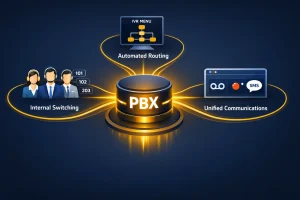
How a PBX Powers Your Business Communication
Why It Matters for Small Businesses
For an SME, the stakes are higher than for a large corporation. A small business doesn’t have the luxury of a 50-person customer service team to absorb the impact of a faulty phone line. Every call represents a potential lead or a critical support issue.
Traditional PBX systems were “On-Premise,” requiring significant capital expenditure (CapEx) and an in-house IT team to manage patches and hardware failures. Modern solutions, led by HAPBX, have moved this entire architecture to the cloud. This shift eliminates the “technical risk” of hardware failure.
The HAPBX Difference: Cloud-Native vs. Legacy
Most small businesses searching for the best small business pbx are looking to escape the “Maintenance Trap.” If you build your own PBX using open-source software like Asterisk or VitalPBX, you become your own telecom provider. This means you are responsible for security, updates, and—most dangerously—uptime.
HAPBX abstracts this complexity entirely. By operating as a fully managed “PBX-as-a-Service,” HAPBX provides SMEs with the power of an enterprise-grade switchboard without the operational overhead. Unlike legacy cloud systems that treat high availability as an optional add-on, HAPBX was engineered from the ground up for resilience.
By utilizing Dedicated Isolated Cloud Infrastructure, HAPBX ensures that your PBX operates in its own private virtual environment. This means your system performance is never impacted by another company’s traffic spikes, providing a level of stability that was previously only accessible to Fortune 500 companies.
For an SME, this translates to a professional image, predictable quality of service, and the peace of mind that your business is always “open for calls.”
Evaluating the Best Small Business PBX: Shared vs. Dedicated Infrastructure
When searching for the best small business pbx, most decision-makers focus on the user interface or the monthly price per user. However, the most critical factor—the one that determines whether your calls will drop during a busy Monday morning—is the underlying infrastructure model.
In the cloud telephony world, there are two primary architectures: Multi-Tenant (Shared) and Dedicated Instance (Isolated).
The “Noisy Neighbor” Problem in Shared Hosting
Most mainstream cloud PBX providers use a multi-tenant architecture. In this model, hundreds or even thousands of different companies share the same server resources, database, and software instance. While cost-effective for the provider, it creates a significant risk for the SME: the “Noisy Neighbor” effect.
If another company on your shared server experiences a massive spike in call volume or a security breach, your system’s performance can fluctuate. This results in “jitter,” high latency (lag), or even total service outages. For a business that relies on clear voice quality to close deals, these fluctuations are unacceptable.
The HAPBX Edge: Dedicated Isolated Instances
HAPBX was engineered to eliminate this risk entirely. Unlike standard providers, HAPBX operates on a Dedicated Isolated Cloud Infrastructure.
What does this mean for your business?
- Resource Isolation: Your PBX runs in its own private virtual environment. 100% of the allocated CPU, RAM, and bandwidth are reserved for your calls only.
- Enhanced Tenant Security: Because your data is physically or logically segregated from other users, the risk of cross-tenant data leaks or “collateral damage” from a cyberattack on another company is virtually zero.
- Customization Without Compromise: Shared systems often limit how much you can customize your settings because changes might affect other tenants. With HAPBX, you have full control over your private IP, domain, and system configurations.
By providing a dedicated instance to every client, HAPBX bridges the gap between the high-security requirements of a bank and the budget requirements of an SME. It ensures that your small business pbx telephone system remains stable, regardless of what is happening elsewhere in the cloud.
5 Critical Features of a High-Availability PBX System
A modern PBX must do more than route calls; it must act as a resilient backbone for your entire operational workflow. When evaluating the best small business pbx, look for these five “High-Availability” features that separate enterprise-grade solutions like HAPBX from entry-level VoIP apps.
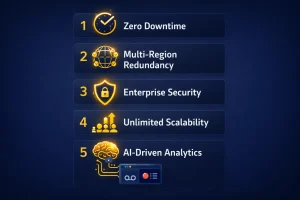
5 Must-Have Features of a High-Availability Small Business PBX
1. Zero-Downtime Maintenance
Traditional systems often require “maintenance windows”—periods late at night when the phones go offline for updates. In a global economy, there is no “off-peak” time. HAPBX utilizes a global cluster infrastructure that allows for “live patching” and background updates. This ensures that security enhancements and feature updates occur behind the scenes without ever disrupting a live call.
2. Multi-Region Redundancy & Global Clusters
A single server is a single point of failure. If a data center in one city loses power, your business shouldn’t go dark. HAPBX uses a Global Cluster Infrastructure (with major clusters in the US and expanding globally). If one node or region encounters an issue, the system instantly routes traffic through another region without human intervention. This “self-healing” capability is the hallmark of true High Availability (HA).
3. Enterprise-Grade Security (SIP Hardening)
Voice traffic is a prime target for hackers. A professional system must include:
- TLS/SRTP Encryption: To prevent eavesdropping on your conversations.
- SIP Hardening & IP Filtering: To block unauthorized access attempts.
- DDoS Mitigation: To protect your lines from being flooded by malicious traffic.
HAPBX includes these protections by default, ensuring your communication remains private and compliant with data protection standards.
4. Seamless, Unlimited Scalability
Most PBX providers penalize your growth by charging “per extension” or requiring expensive hardware upgrades as you add staff. HAPBX flips this model. Our architecture supports unlimited extensions, allowing your business to grow from 10 to 1,000+ users seamlessly. Whether you are adding a new remote team or opening a second location, your infrastructure scales instantly in the cloud.
5. Advanced Call Management & AI-Driven Analytics
Beyond basic routing, a top-tier PBX offers deep insights into your operations. Through tools like the Sonata Suite integrated within HAPBX, businesses gain access to:
- Real-time Switchboards: To monitor live call traffic.
- Detailed Stats: Tracking SLA, abandoned calls, and peak hours.
- AI Routing: Ensuring the most qualified agent receives the call based on data, not just “who is next in line.”
By integrating these features into a single, managed platform, HAPBX empowers small businesses to operate with the sophistication of a multi-national corporation, ensuring every customer interaction is handled with precision and reliability.
Solving the “Downtime” Pain Point: The Science Behind HAPBX Reliability
In the realm of small business pbx telephone systems, downtime is often discussed as a percentage—99.9%, for instance. To a casual observer, that sounds impressive. But to an IT manager, that 0.1% represents nearly nine hours of silence per year. As the HAPBX engineering team often states: “Downtime isn’t an inconvenience—it’s a critical failure.”
To solve this, HAPBX moved away from the “single-server” model that governs most VoIP providers and embraced a sophisticated Global Cluster Infrastructure.
The Anatomy of an Automatic Failover
Traditional cloud PBX systems often operate on a single Virtual Machine (VM). If that VM’s host hardware fails, or if the data center experiences a network spike, your phone lines go dead until the provider manually restarts the service.
HAPBX eliminates this single point of failure through a multi-node cluster architecture. In this setup, your PBX doesn’t live on one server; it is synchronized across multiple instances in real-time.
- Node Monitoring: The cluster constantly monitors the “health” of each node.
- Instant Routing: If a hardware or network issue is detected in one node, the system instantly routes your active calls and registrations to a healthy node in the cluster.
- Human-Free Intervention: This process happens in milliseconds without the need for an IT person to intervene, ensuring business continuity even during regional outages.
Latency Optimization and the 50ms Standard
Reliability isn’t just about the system being “up”; it’s about the quality of the voice. In the US market, high latency causes “echo” and “overlapping talk,” which makes a small business look unprofessional. HAPBX maintains a strict Global Low-Latency Cloud PBX Platform standard. By maintaining clusters in strategic regions (like the US), HAPBX keeps ping rates around 50ms, far surpassing the industry average of >150ms.
By offloading the “Infrastructure Worry” to a managed HA cluster, HAPBX allows SMEs to focus on their core operations, confident that their communication backbone is engineered for 100% resilience.
VI. Comparative Analysis: HAPBX vs. DIY PBX vs. Traditional Providers
When choosing the best small business pbx, most organizations find themselves caught between three distinct paths. Understanding the Total Cost of Ownership (TCO) and the operational burden of each is essential for a long-term investment.
1. The DIY / Self-Hosted Path (e.g., VitalPBX, Asterisk)
Many tech-savvy SMEs are tempted to build their own system using open-source platforms. While the software might be free, the “Hidden Costs” are staggering.
- The Risk: You are responsible for server maintenance, OS patching (like Debian updates), and firewall configuration. A single misconfiguration can lead to “Toll Fraud,” where hackers use your system to make thousands of dollars in international calls.
- The HAPBX Alternative: HAPBX is built on advanced platforms like VitalPBX but removes the technical burden. You get the same advanced features and control without the “technical debt” of managing the server yourself.
2. The Traditional “Big Box” Cloud Providers (e.g., RingCentral, 8×8)
These are the household names of UCaaS. While they offer a wide range of apps, they often come with a “Black Box” philosophy.
- The Limitations: These providers use massive, shared multi-tenant environments. If you need a specific, complex call flow or a dedicated IP for security compliance, you are often told “no” because their system is standardized for millions. Furthermore, their per-user pricing becomes a significant financial burden as your team grows.
- The HAPBX Advantage: HAPBX offers a Dedicated Instance. You get the control of an on-premise system with the flexibility of the cloud. Plus, with unlimited extensions, your monthly bill doesn’t skyrocket every time you hire a new employee.
3. The Legacy On-Premise PBX
Some businesses still cling to physical hardware in a closet.
- The Flaw: Hardware eventually fails. Power outages in your building kill your phone lines. Scaling requires buying more physical cards and hiring a technician to visit the site.
- The HAPBX Shift: HAPBX provides the same “Dedicated” feel of an on-premise box but hosts it in a secure, redundant cloud environment. It is “future-proof” hardware that never ages.
Summary Comparison Table
| Feature | DIY (Self-Hosted) | Big Box Cloud | HAPBX (Dedicated HA) |
| Infrastructure | Your Server / VPS | Shared Multi-tenant | Dedicated Isolated Instance |
| Management | 100% You | Provider (Limited) | Fully Managed by Experts |
| Downtime Risk | High (Single Point) | Moderate (Shared) | Near-Zero (Cluster HA) |
| Pricing Model | Variable / Unpredictable | Per User (Expensive) | Simple Subscription (Scalable) |
| Security | Manual / Vulnerable | Standardized | Enterprise-Level Hardening |
By positioning itself as the middle ground between “total DIY control” and “restrictive corporate cloud,” HAPBX offers a unique value proposition for the modern SME. It provides the best small business pbx experience by combining professional-grade power with “it just works” simplicity.
Security Standards: Protecting Your Business from VoIP Threats
In the digital era, your small business pbx telephone system is more than just a tool for voice; it is a gateway to your network. Unfortunately, hackers view VoIP systems as low-hanging fruit for “Toll Fraud”—a type of cyberattack where criminals hijack your system to make millions of unauthorized international calls, leaving your business with a five-figure bill.
For a business looking for the best small business pbx, security cannot be an afterthought. It must be baked into the architecture.
The Vulnerability of Shared Systems
In a standard multi-tenant cloud PBX, if one tenant’s security is compromised, there is a theoretical “blast radius” that could affect other tenants on the same server. Furthermore, because these providers must manage millions of users, their security settings are often standardized—meaning they might not be tight enough for businesses in high-compliance industries like healthcare, law, or finance.
How HAPBX Builds a Fortified Wall
HAPBX approaches security through the lens of Isolation. By utilizing a Dedicated Isolated Instance, your communication environment is not just a folder on a shared drive; it is a separate virtual fortress.
- Dedicated Private IP & Domain: Unlike shared providers where thousands of companies use the same IP address (which can be blacklisted or targeted), HAPBX provides you with a private IP and domain. This allows you to whitelist specific locations and lock down your system to only authorized users.
- SIP Hardening and DDoS Mitigation: HAPBX instances are pre-configured with advanced firewalls designed specifically to detect and block “SIP Vicious” attacks and brute-force attempts.
- Encryption by Default: Every HAPBX system supports TLS (Transport Layer Security) and SRTP (Secure Real-time Transport Protocol). This ensures that your voice data is encrypted from the moment it leaves your desk phone or mobile app until it reaches its destination, preventing eavesdropping and data interception.
By moving away from the “shared risk” model, HAPBX ensures that your business stays compliant with data privacy regulations while protecting your bottom line from the devastating costs of telecom fraud.
Scaling Without Friction: From Startup to Enterprise
The lifecycle of a successful SME is one of constant change. A company that starts with 5 employees today might have 50 by next year and 500 the year after. Most small business pbx telephone systems act as a “straitjacket” during this growth phase, requiring complex hardware upgrades or punishing you with exponential price hikes.
HAPBX was designed with a “Growth-First” philosophy, ensuring that your communication system is an accelerator, not a bottleneck.
Eliminating the “Per-User” Tax
The biggest hurdle to scaling with traditional cloud providers is their per-user pricing model. If you pay $30 per user, hiring 10 new people instantly adds $300 to your monthly overhead.
HAPBX disrupts this by offering unlimited extensions and unlimited concurrent calls (based on your instance capacity). Whether you have 10 employees or 1,000, your HAPBX instance grows with you. This allows SMEs to provision phones for remote teams, warehouse staff, and freelancers without worrying about a ballooning monthly invoice.
From Simple Business PBX to Advanced Call Center
Many businesses start with basic needs: an IVR and a few extensions. But as you grow, you may need “Call Center” capabilities.
- Modular Upgrades: With HAPBX, moving from the Enterprise Cloud package to the Call Center Add-on is a seamless software transition.
- Advanced Tools: You gain access to the Full Sonata Suite, including real-time switchboards for managers, automated dialers for sales teams, and deep-dive statistics to track agent performance (KPIs).
- CRM Integration: As your sales operations mature, HAPBX integrates with your CRM and Ticket systems, ensuring that when a customer calls, your agent instantly sees their history and needs.
Omnichannel and Remote Work Ready
Scaling also means geographic expansion. Because HAPBX is cloud-native and runs on a Global Cluster, adding a satellite office in a different city—or even a different country—is as simple as connecting an IP phone to the internet. Your team stays connected on the same private network, with the same security protocols, regardless of where they are working.
With HAPBX, scaling is no longer a “technical project” involving weeks of planning; it is a simple configuration change that happens in minutes.
Implementation Guide: Switching to HAPBX in 3 Simple Steps
Moving your company to a new small business pbx telephone system often feels like a daunting technical project. Many IT managers fear the “migration nightmare”—dropped calls during the transition, lost phone numbers, or complex configuration errors.
Because HAPBX is a fully managed service, we have refined the implementation process to eliminate these risks, allowing you to transition your entire communication backbone in three clear steps.
Step 1: Connectivity and Hardware Audit
Before going live, it is essential to ensure your local environment is ready for enterprise-grade VoIP.
- Bandwidth Assessment: While VoIP is efficient, a high-quality call requires stable, low-latency internet. Our team helps you calculate the necessary bandwidth based on your concurrent call volume.
- Hardware Choice: HAPBX is “hardware agnostic.” You can use existing IP phones (like Yealink, Poly, or Fanvil), or move entirely to a “soft-client” model using our VitXi WebRTC or mobile apps for iOS and Android.
Step 2: Custom Instance Configuration
This is where the power of a Dedicated Instance shines. Unlike shared providers where you are forced into a one-size-fits-all template, the HAPBX team works with you to build your “Dream Switchboard.”
- Call Flow Design: We help you map out your IVR (Auto-attendant), ring groups, and time-based routing (e.g., after-hours forwarding).
- Security Whitelisting: We configure your private IP and domain settings to ensure only authorized devices can connect to your HAPBX instance.
- Integration: If you are using the Call Center package, this is when we sync your PBX with your CRM or helpdesk software.
Step 3: Seamless Number Porting and Go-Live
The final step is moving your business identity.
- Number Porting: We coordinate the transfer of your existing local and toll-free numbers from your old provider.
- Zero-Downtime Transition: We set up your HAPBX instance before the numbers move. This “Parallel Running” ensures that when the switch happens, your team is already trained and logged in, meaning you don’t miss a single incoming customer call.
Conclusion: The Future of Your Business Voice
As we have explored throughout this guide, the search for the best small business pbx is ultimately a search for reliability. In an era where customers expect instant, high-quality interaction, your phone system is the primary ambassador for your brand.
Choosing a small business pbx telephone system that relies on shared infrastructure or requires you to manage your own server is a gamble that most SMEs cannot afford to take. The “Noisy Neighbor” effect, security vulnerabilities, and the high cost of maintenance can quickly turn a “cheap” VoIP solution into a major operational liability.
Why HAPBX is the Smarter Choice
HAPBX represents the pinnacle of modern business telephony. By combining the High Availability (HA) clusters typically reserved for large corporations with the flexibility and affordability required by SMEs, we have created a platform that grows with you.
- Peace of Mind: With our Global Cluster Infrastructure, downtime is virtually eliminated.
- Security: Your data lives in a Dedicated Isolated Instance, protected by enterprise-grade SIP hardening.
- Predictability: Our “Unlimited Extensions” model ensures your costs remain stable even as your team expands.
Whether you are seeking to escape the limitations of a legacy on-premise system or the instability of a shared cloud provider, HAPBX provides the “Safe, Sound, and Ready” infrastructure your business deserves.
Frequently Asked Questions (FAQ)
Q: Is HAPBX suitable for remote and hybrid teams?
A: Absolutely. Because HAPBX is cloud-native, employees can connect from anywhere using our VitXi mobile and web apps. The dedicated instance ensures that remote connections are just as secure as those in the office.
Q: How does HAPBX handle international latency?
A: We utilize a Global Low-Latency Cloud PBX Platform. By maintaining clusters in strategic hubs like the US, we keep ping rates stable (around 50ms), ensuring crystal-clear voice quality across borders.
Q: Do I need a full IT team to manage HAPBX?
A: No. While HAPBX is powerful enough for IT professionals, it is a fully managed service. We handle the patching, security updates, and server maintenance so you can focus on running your business.
Q: What makes HAPBX different from RingCentral or Nextiva?
A: The core difference is the infrastructure. Those providers use shared “multi-tenant” servers. HAPBX provides a Dedicated Instance, giving you more security, better performance, and significantly better value through our unlimited extension model.