

I didn’t start looking for 3CX alternatives because I love switching platforms.
I started because I was the one wearing the consequences.
I’m Daniel. I lead Customer Support Operations at a fintech company that serves clients across multiple regions. If you’ve ever worked in support, you know the uncomfortable truth: customers don’t care what PBX you use. They care whether they can reach you, whether you can hear them clearly, and whether their issue gets resolved without repeating themselves five times.
For a long time, we ran on 3CX. It wasn’t “bad.” In fact, on normal days, it was fine. Calls connected. Queues existed. Extensions worked. Our team was productive enough.
But as we grew, “fine” turned into a risk.
And I became the person who had to explain that risk—every time call quality dipped, every time routing acted weird, every time a peak-hour rush turned our support floor into a stress test.
This is the story of how I lived through that shift, how we moved from 3CX to HAPBX, and why the switch finally made voice operations boring again—in the best possible way.
The Day 3CX Didn’t Fail—But Support Did
It was a Monday. Peak time. The kind of morning where the queue doesn’t slowly build—it arrives.
Calls came in from customers trying to complete time-sensitive account actions. Others needed verification. Some were escalations from partners. And because we operate across regions, there wasn’t just one “peak”—there were overlapping peaks.
At first, everything looked normal. Agents were answering. The wallboard showed calls flowing.
Then the micro-frictions started.
A slight delay. A half-second audio cut. Customers saying, “Hello? Can you repeat that?” Agents leaning forward, asking questions twice, trying to confirm details that should have been crystal clear.
No outage. No dramatic red alert.
Just degradation.
And degradation is worse than downtime, because it doesn’t trigger clean decisions. People argue about it:
- “Maybe it’s the customer’s internet.”
- “Maybe it’s carrier routing.”
- “Maybe it’s just a bad day.”
But support doesn’t get to debate. Support absorbs.
When call quality becomes unpredictable, we don’t just lose time. We lose trust. We lose confidence. We lose momentum—because agents can’t move a conversation forward if they’re constantly reconstructing it.
That day, I stayed late to listen to call recordings. Not because I wanted to blame anyone, but because I needed to answer one question:
If voice is a trust channel for our business, why does it feel fragile when we need it most?
That was the moment I started pushing leadership to seriously evaluate 3CX alternatives.
Why I Started the Conversation About 3CX Alternatives
As Support Ops, my job isn’t to pick technology for the sake of it. My job is to protect the customer experience, keep the team sane, and make sure escalation paths work under pressure.
So I framed the problem in support language, not IT language:
- If customers can’t hear us clearly, they don’t feel safe.
- If queues behave unpredictably, we can’t manage staffing.
- If reporting is limited, we can’t coach effectively.
- If reliability depends on manual operational effort, we carry hidden risk.
When people search “3CX alternatives,” they often ask, “What’s better than 3CX?”
My question was different:
What PBX model reduces fragility and makes support performance predictable at scale?
That question naturally led to HAPBX vs 3CX as a real, practical evaluation—because the difference wasn’t just features. It was architecture, high availability, and the cost of operating voice.
The Reality of Growth: “Works for SMEs” Isn’t the Same as “Works for Enterprises”
I want to be fair to 3CX.
3CX can be a great fit for many teams—especially SMEs that want flexibility and can tolerate more hands-on ownership. It’s a traditional PBX approach, and depending on deployment style (on-prem, self-hosted, cloud), it can be cost-effective and capable.
But our reality changed.
We weren’t a small team with a single office peak hour anymore. We were multi-region, high-stakes, and our support workflows were becoming closer to call center operations than “office calling.”
That’s where our internal conversation shifted from “Does it have queues?” to:
- Is high availability native, or is it a DIY responsibility?
- Are we isolated from noisy-neighbor performance patterns?
- Can we scale predictably without licensing cliffs?
- Does the platform treat call center workflows as first-class, not bolted-on?
That’s what our cloud PBX comparison needed to answer.
The Checklist I Used to Evaluate 3CX Alternatives (Support Edition)
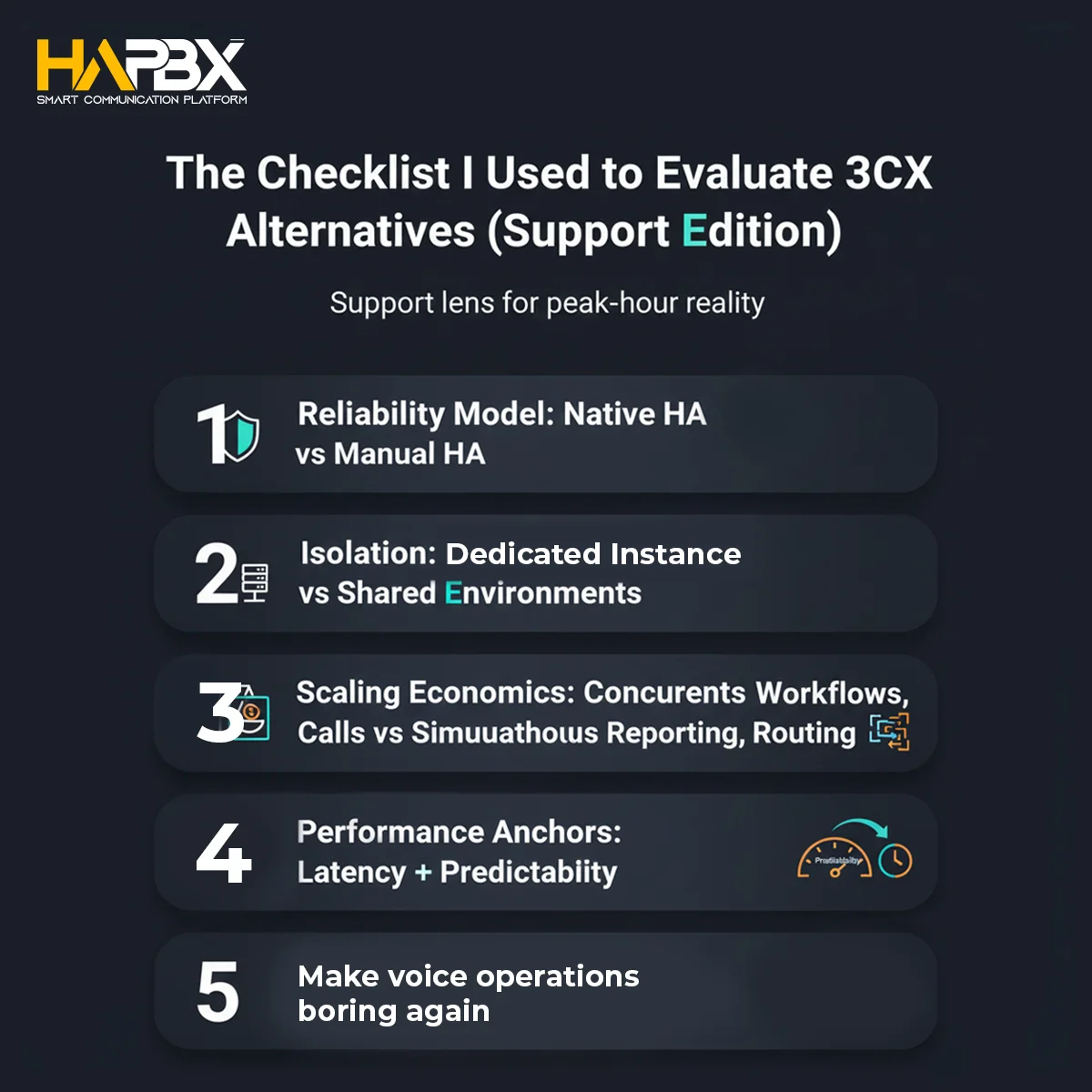
When IT evaluates PBX, they often focus on infrastructure. When I evaluate PBX, I focus on what happens on the support floor at peak hour.
Here’s the shortlist checklist that finally made our decision clear:
1) Reliability Model: Native HA vs Manual HA
Support doesn’t care how HA is built. Support cares whether it behaves reliably without heroics.
HAPBX is designed around native High Availability with cluster options such as Active/Active or Active/Passive, plus automated failover at a global cluster level. In plain language: less “manual stitching,” fewer fragile runbooks, fewer panic moments when something goes sideways.
That alone mattered. Because in support, the worst failures happen when the system is “half broken” and nobody knows whether to escalate, rollback, or wait.
2) Isolation: Dedicated Instance vs Shared Environments
This was a big one.
HAPBX emphasizes Dedicated Instance deployments. I’m not an infrastructure engineer, but I understand the impact: predictable performance, clearer planning, less risk that someone else’s load shapes our customer experience.
When you’re managing support SLAs, predictability isn’t a luxury. It’s the foundation of staffing.
3) Scaling Economics: Concurrent Calls vs Simultaneous Calls
This might sound like finance-only… until you run a queue.
Licensing models tied to Simultaneous Calls (SC) can create operational friction as volume grows. Even if you don’t hit hard limits, you start living with anxiety: “Are we about to cross a threshold that changes the cost structure or forces a redesign?”
HAPBX’s scaling model is framed around concurrent calls (plan-based). For Support Ops, that’s easier to reason about: concurrency is what we actually manage—peak demand patterns and staffing.
4) Call Center Depth: Workflows, Reporting, and Routing
Queues alone are not a call center.
Support needs routing logic, reporting, and operational tools that don’t require duct tape. HAPBX positions itself as a more call-center-oriented suite (routing, reporting, dialer, CRM/ticketing workflow alignment).
And that’s exactly what I wanted: fewer “workarounds,” more “built-in operational clarity.”
5) Performance Expectations That Are Easy to Communicate
I’m careful with performance claims. I don’t want marketing numbers; I want planning anchors.
HAPBX mentions latency optimization in a global cluster, with a ~50ms target framing, plus stable concurrent call ranges depending on tier. Again, I’m not chasing a vanity benchmark—what I needed was predictability I could explain to leadership and convert into staffing plans.
HAPBX vs 3CX: The Moment the Choice Became Obvious
When we laid out HAPBX vs 3CX, the choice wasn’t “which has more features.”
It was “which model matches who we are now.”
- 3CX felt like a PBX we could operate successfully if we invested enough effort and accepted certain operational realities.
- HAPBX felt like a platform designed to reduce those realities: Dedicated Instance, native HA, and a more enterprise-ready operating model.
As support lead, I didn’t care about winning an argument.
I cared about this: Can I promise our team that peak hour won’t turn into chaos because voice becomes unpredictable?
With HAPBX, that promise felt more realistic.
Our Cloud PBX Comparison Snapshot (The Version I Presented to Leadership)
When leadership asked for a clear summary, I didn’t give them a 40-page technical deck. I gave them this:
- If we stay on a traditional PBX operating model, we continue paying with operational attention.
- If we move to an enterprise cloud-native model with isolation + native HA, voice becomes less fragile.
Then we aligned on a simple cloud PBX comparison view:
- Who is it built for (SME vs enterprise)?
- How does HA work (native vs manual)?
- How does scaling work (concurrent call planning vs SC licensing mechanics)?
- How operationally heavy is it?
- Does it support call center workflows as first-class?
Once everyone agreed those were the right questions, the debate got quieter.
And that’s usually a sign you’re making the right decision.
Migration: What It Felt Like from the Support Floor
Support teams fear migrations for one reason:
We’re the ones who get yelled at if it goes wrong.
So our migration approach was designed around “no drama.” We didn’t do a single risky cutover. We moved in phases.
Phase 1: Pilot Where Pain Was Highest
We started with our highest-volume queues and the teams most impacted by call friction. Not because it was easy—but because it proved value quickly.
Phase 2: Parallel Run Until We Trusted It
We ran old and new in parallel, validating:
- routing behavior
- queue performance under load
- reporting that managers actually need
- escalation flows that must remain stable
Support doesn’t need perfect. Support needs consistent.
Phase 3: Phased Cutover, Not a Cliff Jump
We migrated team by team and flow by flow, so we always had control. That reduced stress and made training manageable.
From my perspective, the migration wasn’t about “switching systems.”
It was about restoring confidence: agents shouldn’t wonder whether the phone system will behave today.
What Changed After We Switched to HAPBX (Support Outcomes, Not Marketing)
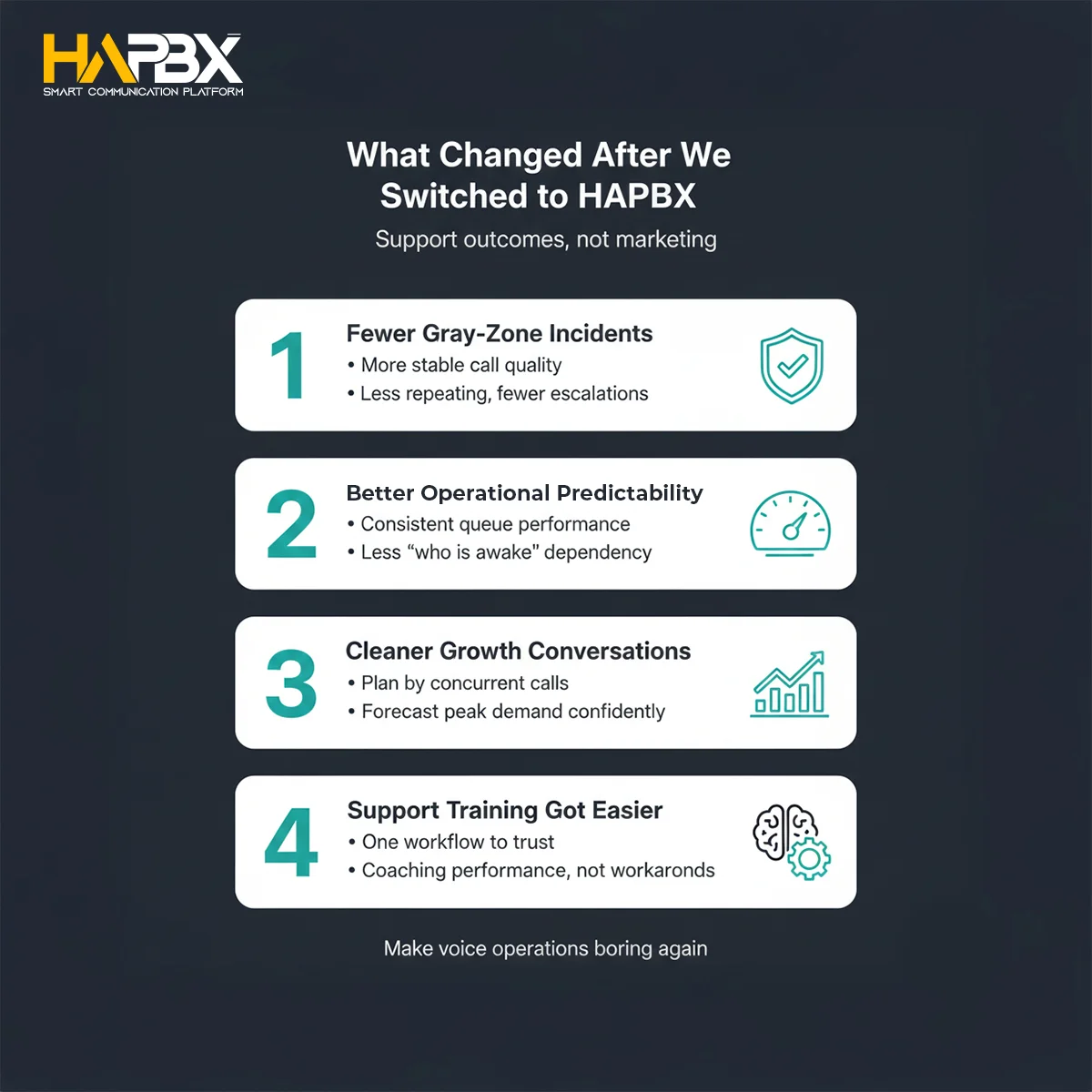
After we stabilized on HAPBX, the first thing I noticed wasn’t a fancy feature.
It was the absence of noise.
1) Fewer Gray-Zone Incidents
The “almost broken” moments became rarer. That matters because those moments destroy efficiency quietly.
When call quality is stable, conversations move forward faster. Agents don’t have to repeat. Customers don’t feel uncertain. Escalations don’t pile up.
2) Better Operational Predictability
Dedicated Instance architecture and native HA aren’t just technical buzzwords. For support, they translate into planning stability:
- staffing plans don’t get derailed by unpredictable voice behavior
- queue performance becomes more consistent under traffic
- incidents become less dependent on “who is awake and available”
3) Cleaner Growth Conversations
Because scaling is framed around concurrent calls (plan-based), capacity planning became easier to explain.
Instead of asking, “Are we about to hit a licensing threshold?” we asked, “What concurrency do we need for next quarter’s peaks?”
That’s how businesses should plan: around demand, not surprises.
4) Support Training Got Easier
When systems are stable, training becomes simpler. New agents learn one workflow and trust it. Team leads coach performance instead of coaching “how to survive system weirdness.”
This was a quiet win, but it was real.
Who I’d Recommend Each Platform For (Honest Support Perspective)
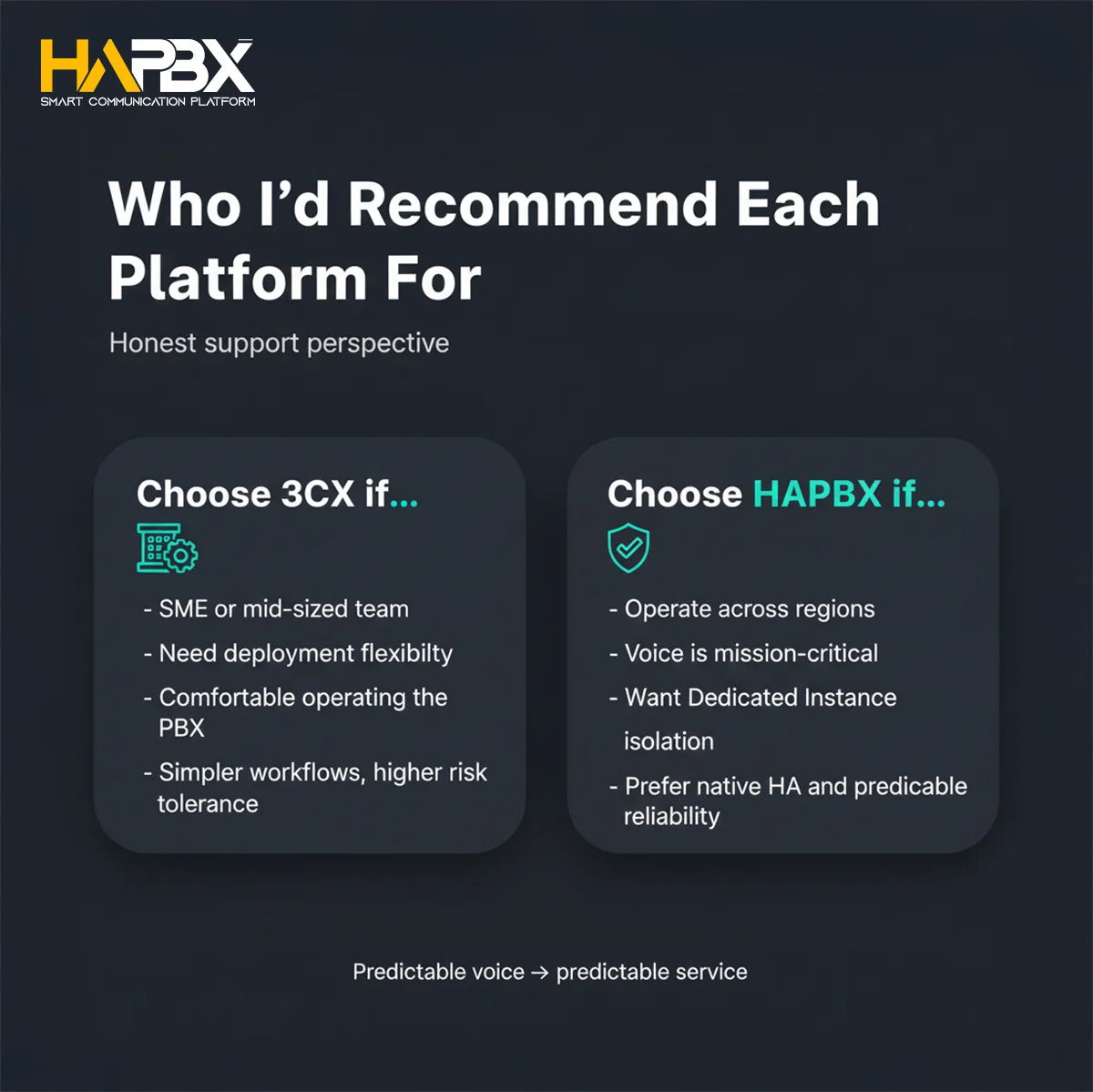
I don’t believe in “one platform is best for everyone.”
If you’re reading this because you’re searching for 3CX alternatives, here’s my honest take:
Choose 3CX if…
- you’re an SME or mid-sized team
- you value deployment flexibility
- you’re comfortable operating the PBX (or have a strong partner)
- your support workflows are simpler and risk tolerance is higher
3CX can be a practical, effective choice in those scenarios.
Choose HAPBX if…
- you operate across regions
- voice is mission-critical (support, compliance, escalations, call center)
- you want Dedicated Instance isolation and native HA options
- you want a model that reduces fragile manual operations and makes reliability predictable
From the support floor, that’s the difference: predictable voice gives you predictable service.
Conclusion: The Best 3CX Alternative Makes Voice Boring Again
I didn’t advocate for a switch because I wanted “new technology.”
I advocated because I wanted our support team to stop paying for voice fragility with their stress.
When we moved from 3CX to HAPBX, we weren’t just switching PBX platforms. We were upgrading our expectations of reliability—moving toward a model built around:
- Dedicated Instance isolation (no shared-resource surprises).
- Native HA (Active/Active or Active/Passive) with automated failover.
- Operational predictability that matches enterprise and call-center realities.
- Scaling based on real concurrent-call demand, not licensing thresholds.
And what made HAPBX feel “enterprise-ready” wasn’t a single feature—it was the fundamentals:
- Rapid deployment: go live in minutes, without complex infrastructure setup.
- Stable operation: GEO-distributed, clustered, failover-ready design for always-on availability.
- Cost optimization: a dedicated cloud model built for long-term efficiency at scale.
If you’re evaluating 3CX alternatives, here’s my simple advice:
Choose the platform that makes voice boring again.
Because when voice is boring, support can focus on what actually matters: customers.