
Exploring RingCentral alternatives? See HAPBX vs RingCentral in a clear cloud PBX comparison—dedicated infrastructure, stable performance, and secure scaling.
The day our calls started dropping during peak hours, it wasn’t “a tech issue” anymore—it was a revenue issue. And once customers begin hearing delays or repeats, trust erodes faster than any SLA can repair.
As a CTO managing teams across London, San Francisco, and Singapore, I’ve always believed that communication tools should be invisible—always on, always clear, always reliable.
For a long time, RingCentral felt like the safe choice. But as our operations scaled, subtle issues started appearing: a bit of delay, a few dropped calls during busy hours, and a growing sense that our call quality wasn’t as predictable as it needed to be. Then the bigger concern emerged: once you’re at enterprise scale, reliability isn’t “nice to have”—it becomes part of your business risk profile.
That’s when I started actively researching RingCentral alternatives—or more broadly, alternatives to RingCentral that weren’t just feature-similar, but architecturally stronger. Not because I wanted to “switch vendors,” but because I needed to switch architecture—toward a platform designed for performance consistency, security, and scalability without penalties.
1) The Financial Impact: Calculating the True Cost of Downtime
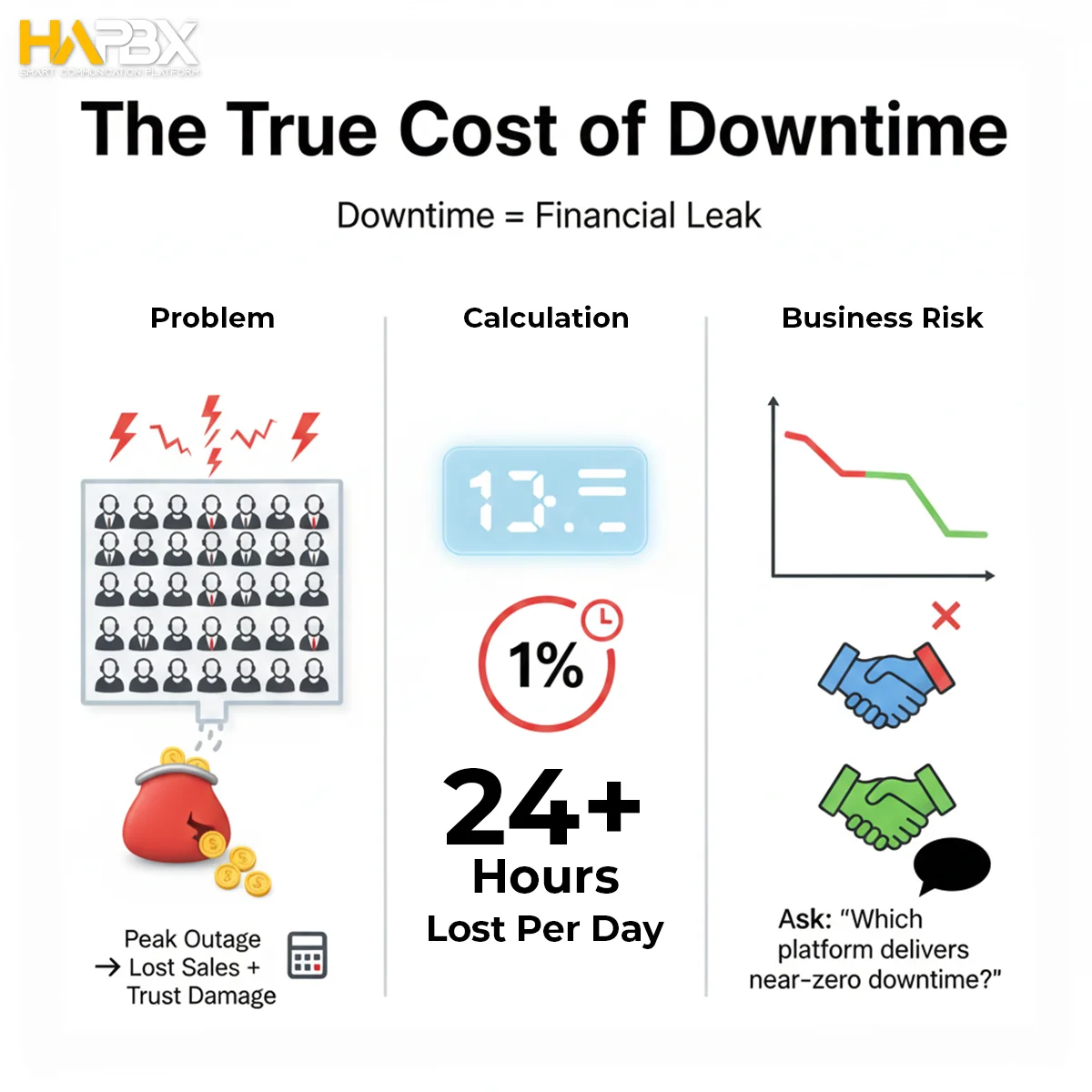
In the enterprise world, downtime isn’t a technical glitch—it’s a financial leak. When evaluating RingCentral alternatives, businesses must look beyond subscription fees and assess the cost of failure.
For an enterprise with 100 agents, even 1% downtime translates to over 24 hours of lost collective productivity every single day. In industries like Fintech or Logistics, a brief outage at peak time doesn’t just slow work—it can trigger lost sales and damaged customer trust.
At that point, I stopped asking “What’s the monthly cost?” and started asking:
“Which platform is built to deliver virtually no downtime?”
2) Why Businesses Seek RingCentral Alternatives (What We Actually Felt)
This is the part many buyers don’t see until they scale: performance isn’t only about features—it’s about infrastructure behavior under load. As we expanded, the problems weren’t dramatic every day, but they were consistent enough to create friction across teams.
Here’s how it looked in reality:
| Pain Point (Observed) | What It Causes | What the Business Really Loses |
| Downtime / instability | Missed calls, dropped conversations | Revenue opportunities + customer trust |
| Latency / audio delay | Talk-over, longer calls | Productivity + customer experience |
| Shared infrastructure variability | Inconsistent performance at peak | SLA risk + operational stress |
| Tier/feature gating | Must upgrade plans for essentials | Cost creep as team scales |
| Scaling penalties | New teams = new bill lines | Growth becomes “more expensive than it should be” |
That table is the real reason enterprises search for RingCentral alternatives and RingCentral competitors: not because the product lacks features, but because unpredictability scales faster than teams can tolerate.
3) Cloud PBX Comparison: Shared vs Dedicated (The “Noisy Neighbor” Moment)
In a typical cloud PBX model, businesses share resources with other tenants. You might never notice—until peak hours, when everyone uses the system heavily. That’s when “cloud convenience” can become “cloud variability.”
So I shifted our cloud PBX comparison to focus on the core structural question:
Is it shared multi-tenant… or is it Dedicated Instance?
| Feature | Shared Cloud PBX (Multi-tenant) | Dedicated Instance Cloud PBX |
| Resource allocation | Shared CPU/RAM/network across tenants | Resources reserved for one business |
| “Noisy neighbor” risk | Present (other tenants can affect performance) | Eliminated (isolated environment) |
| Call quality under load | Potential jitter/latency spikes | More consistent under peak traffic |
| Security isolation | Shared platform increases blast radius | Better segregation; smaller shared attack surface |
| Configuration control | Limited to provider’s common setup | More flexible per-business configuration |
| Scalability | Scales, but can be bounded by shared capacity | Scales predictably due to reserved resources |
This was the turning point. Because if your infrastructure is shared, your performance can never be fully predictable—no matter how polished the front-end is.
CTA (Mid-Article)
If you’re shortlisting RingCentral alternatives right now, start with architecture.
→ Want the exact evaluation checklist we used for our cloud PBX comparison? Get it here: [link]
4) Why HAPBX: Global Cluster Infrastructure and the 50ms Standard
HAPBX stood out because it wasn’t positioned as “another app.” It was positioned as infrastructure.
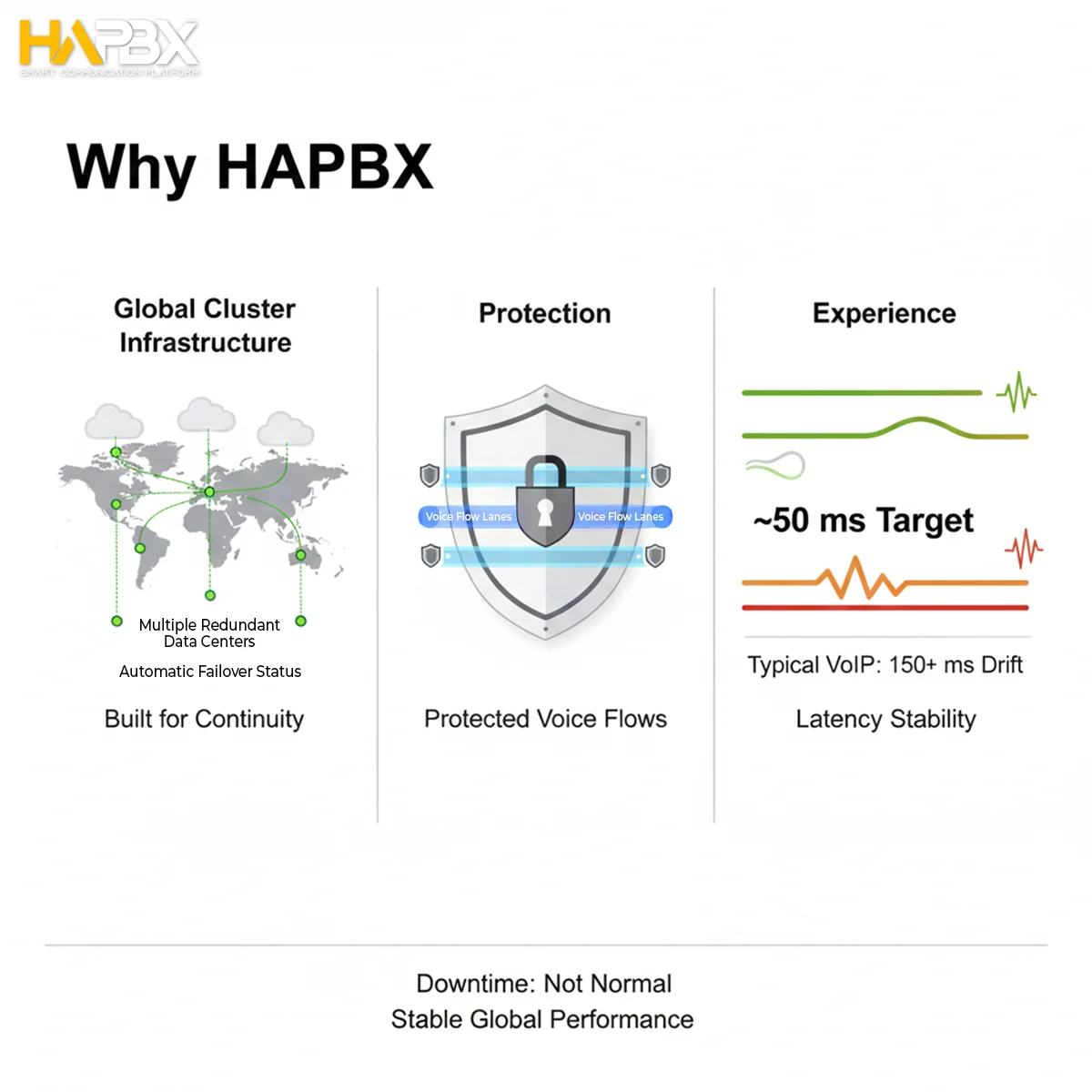
Instead of relying on a risky single-VM approach, HAPBX runs on a Global Cluster Infrastructure, designed for continuity. In our evaluation, what mattered wasn’t just a claim—it was what the architecture was built to protect:
- Eliminating downtime as a normal condition (aiming for minimal disruption)
- Maintaining stable performance globally
- Reducing risk by separating and protecting critical voice flows
In terms of call experience, the story point that stuck with me was latency stability: while typical VoIP setups can drift above 150ms, HAPBX emphasized stability around ~50ms. At enterprise scale, that difference is not technical trivia—it’s the difference between calls that feel effortless and calls that feel “slightly broken.”
5) HAPBX vs RingCentral: The Comparison That Matters
A realistic HAPBX vs Ringcentral conversation should avoid surface-level feature lists. Most platforms have IVR, routing, and dashboards. The differentiator is what happens when your system is under stress.
Here’s the executive comparison we used internally:
| Criteria | RingCentral (Typical Shared/Standard Model) | HAPBX (Dedicated / Global-Cluster Approach) |
| Infrastructure | Shared / multi-tenant (resources shared) | Dedicated Instance + Global Cluster design |
| Availability | Good, but can be impacted by shared load | High Availability focus; built for minimal disruption |
| Performance predictability | Can fluctuate under peak loads | Stable, predictable performance (enterprise-grade) |
| Latency (story claim) | Can exceed 150ms in some scenarios | ~50ms stability target |
| Scaling | Often scales with plan/tier and resource availability | Designed to scale without “noisy neighbor” constraints |
| Security posture | Shared environment → broader shared risk surface | Isolation + private IP/domain options reduce shared risk |
| Cost model (scaling) | Feature gates / tier upgrades may increase cost | Unlimited extensions (no extra cost) emphasized |
| Best fit | Convenience-first UCaaS adoption | Business-continuity-first operations |
That chart made our decision easier. When you’re running a global enterprise, you don’t buy “calls.” You buy continuity.
6) Scaling Without Penalties: Unlimited Extensions + High Concurrency
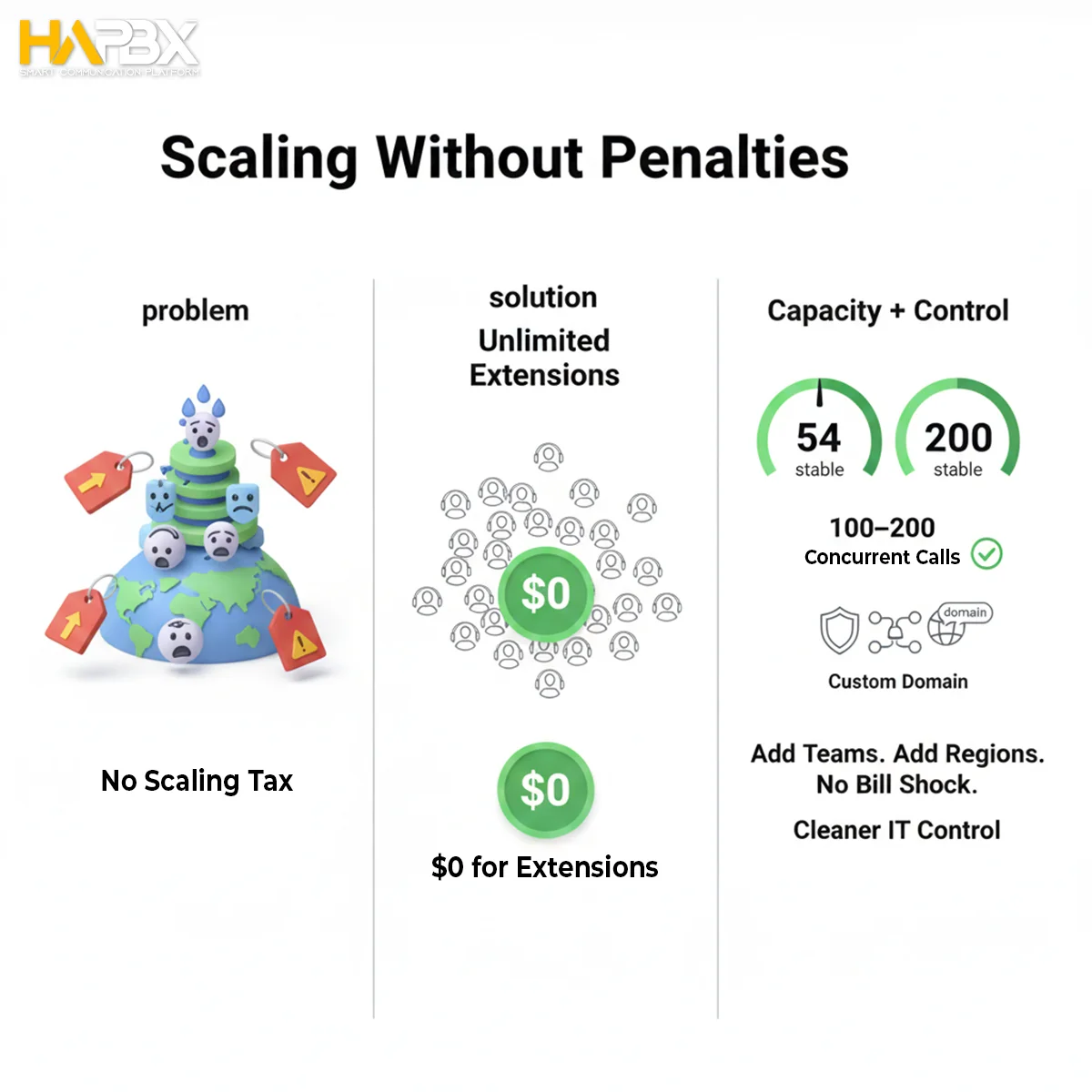
One of the most frustrating patterns in the UCaaS market is how growth becomes expensive in hidden ways. New teams, new regions, new extensions—suddenly you’re paying “scaling tax.”
HAPBX flips that model with a clear promise: unlimited extensions at no extra cost, and support for 100–200 concurrent calls. That matters because it removes the psychological friction of growth. Teams shouldn’t hesitate to add departments or build new support lines because “the PBX bill will jump again.”
It also supports modern expansion needs like private IP and domain, making growth cleaner and more controllable from an IT perspective—one of the key reasons people search for a RingCentral replacement.
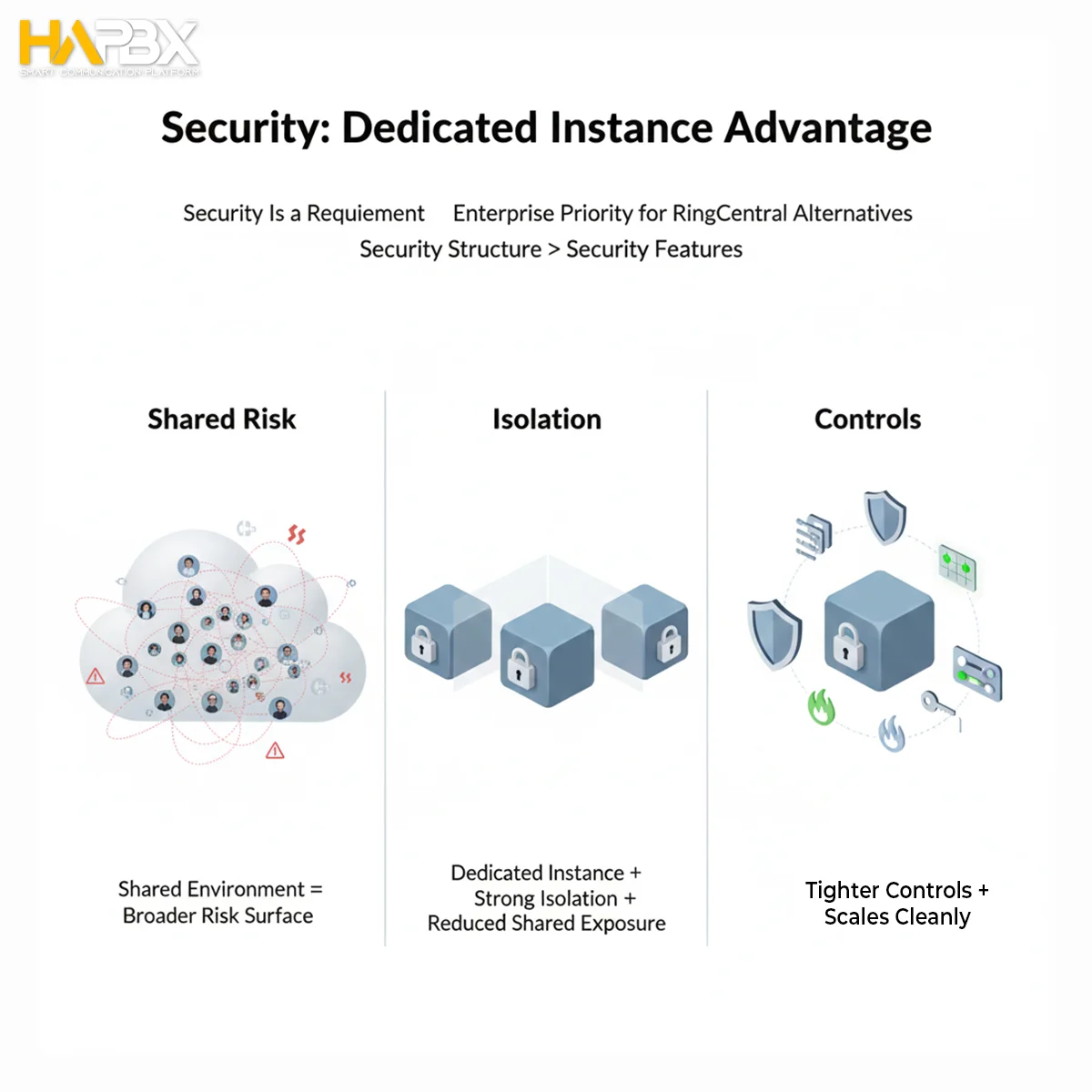
7) Security: The Dedicated Instance Advantage
In fintech, security isn’t a checklist—it’s a requirement. In shared environments, the risk surface is naturally broader. HAPBX’s Dedicated Instance approach reduces shared exposure, strengthens isolation, and supports tighter controls as you scale.
That’s exactly what enterprise buyers should prioritize when searching for RingCentral alternatives: not only “security features,” but security structure.
Conclusion: The Right RingCentral Alternative Is the One Built for Continuity
Switching to HAPBX wasn’t about chasing novelty. It was about building a communication layer that didn’t create risk.
If you’re evaluating RingCentral alternatives, don’t stop at pricing and UI demos. Build your decision around architecture: multi-tenant vs Dedicated Instance, stability under load, security isolation, and scalability without penalties.