

Legacy phone infrastructure is becoming a liability. For decades, organizations relied on physical ISDN or PRI lines to stay connected. These systems were stable, but they were also rigid. You paid for fixed capacity you often didn’t use, and scaling up required expensive hardware upgrades.
Today, agility is the priority.
This is where SIP trunking takes over. It replaces those obsolete copper wires and legacy circuits with modern voip trunk lines, linking your business phone system directly to the global network via the internet. It is efficient, scalable. Most importantly, it cuts operational costs significantly.
In this guide, we will break down exactly how this technology works and why it is the standard for modern enterprise communications, and how advanced platforms like HAPBX are taking it a step further with dedicated infrastructure.
What is SIP Trunking?
SIP Trunking is the digital method used to connect a business’s phone system to the internet, replacing traditional telephone lines. However, to truly leverage its power, we must look deeper than just “making calls over the internet.”
Beyond Traditional Phone Lines: A New Era of Communication
Historically, businesses relied on the Public Switched Telephone Network (PSTN) via physical ISDN or PRI (Primary Rate Interface) lines. These were physical copper wires physically drilled into your office building. They were expensive, difficult to scale (requiring you to buy channels in blocks of 23), and tied to a single geographic location.
As global telecom giants continue the “PSTN Switch Off” and phase out copper networks, Voice over Internet Protocol (VoIP) has taken the throne. SIP Trunking is the enterprise-grade technology that enables this shift. It acts as the bridge between your private business phone system and the outside world, utilizing your existing internet connection to carry voice, video, and data instantly.
The Core Definition: SIP and Trunking
To understand the technology, we must break down the acronym:
- SIP (Session Initiation Protocol): This is the signaling protocol used to set up, maintain, and terminate real-time sessions. While we often associate it with voice calls, SIP is capable of controlling multimedia communication sessions, including video conferencing, instant messaging, and presence information.
- Trunking: In the analog days, a “trunk” was a bundle of physical wires. In the digital context, a SIP trunk is a virtual link installed over your internet connection. It can theoretically support an unlimited number of concurrent calls, practically constrained by bandwidth, codec selection, and infrastructure capacity.
Think of SIP trunking as the “virtual phone line” that allows your On-Premise PBX or Cloud PBX to talk to the rest of the world without needing a physical connection to a telephone company.
How Does SIP Trunking Work?
Understanding the underlying sip trunking architecture is essential for IT teams evaluating infrastructure. Unlike circuit-switched networks of the past that required a dedicated physical path for every conversation, SIP trunking utilizes packet switching. This process breaks voice signals into digital packets, transmits them over a network, and reassembles them at the destination.
Key Components of a SIP Trunking Ecosystem
For a SIP trunk to function, three core elements must operate in harmony:
1. Your IP PBX (Private Branch Exchange)
The PBX is the “brain” of your sip trunk phone system. It handles call routing, voicemail, extensions, and hold music.
- Legacy/On-Premise IP PBX: A physical server located in your server room. To use SIP trunks, this hardware must be SIP-enabled.
- Cloud PBX (The Modern Standard): Increasingly, businesses are bypassing physical hardware entirely for solutions like HAPBX (High Available Private Branch Exchange). In this scenario, the PBX lives in the cloud on a Dedicated Instance. HAPBX natively handles SIP connectivity, meaning you often don’t need to configure a separate “trunk” yourself—it is a managed part of the infrastructure.
2. The Internet Service Provider (ISP)
Because SIP trunks operate virtually, your internet connection acts as the digital highway. For enterprise deployments, fiber-optic connections are recommended to ensure low latency and minimal jitter, guaranteeing high-definition voice quality.
3. The SIP Trunk Provider (ITSP)
The Internet Telephony Service Provider (ITSP) replaces the traditional phone company. They connect your IP PBX to the PSTN, handling call routing to mobile/landlines worldwide, number management (DIDs), and emergency services (E911).
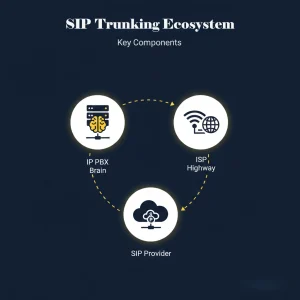
Key Components of a SIP Trunking Ecosystem
The Call Flow: Digital Voice Transmission
How does a call actually travel from your office to a client’s mobile phone?
- Initiation: A user picks up a VoIP phone or opens a softphone app and dials a number. The IP PBX recognizes the request.
- Encapsulation: The PBX converts the voice audio into data packets using specific codecs (like G.711 or G.729).
- Transmission (The SIP Trunk): These packets are sent from the PBX, through the business’s firewall and router, and onto the SIP trunk.
- Routing: The SIP provider (ITSP) receives these packets via the internet. They instantly look up the destination number and route the call to the appropriate carrier or local network.
- Termination: The call reaches the destination network (the client’s mobile carrier), is converted back into audio, and the client’s phone rings.
This entire process occurs in milliseconds, removing geographic barriers and allowing businesses to establish local presence anywhere in the world.
Benefits of SIP Trunking
The shift to SIP trunking is a strategic financial and operational move. By decoupling your telephony from physical infrastructure, SIP trunking offers immediate improvements in Total Cost of Ownership (TCO) and operational agility.
Cost Savings
The most immediate driver for SIP adoption is the bottom line. Traditional telephony is notoriously expensive, riddled with maintenance fees, hardware costs, and rigid contracts. SIP trunking changes the financial model from Capital Expenditure (CapEx) to Operational Expenditure (OpEx).
- Elimination of PRI Lines: Primary Rate Interface (PRI) lines require you to pay for channels in blocks (typically 23 at a time). If you need 24 channels, you are forced to pay for 46. SIP trunking allows for precise capacity planning, letting you pay only for the concurrent call paths you actually need.
- Lower Call Rates: Routing calls over the internet significantly reduces long-distance and international charges. Many providers offer “unlimited” bundles that bypass traditional carrier tolls.
- Infrastructure Consolidation: By converging voice and data onto a single broadband connection, you eliminate the need to maintain separate physical networks, reducing hardware maintenance costs.
Scalability and Flexibility
In the legacy world, adding phone lines meant weeks of waiting for technicians. With SIP, scalability is instantaneous. This “elasticity” allows businesses to handle seasonal spikes or expand to new locations on-demand.
- Remote Work Readiness: Because the “phone line” is virtual, employees can access their business line from office phones, laptops, or mobile apps anywhere.
- Unlimited Expansion: Platforms built on modern SIP architecture—specifically Cloud PBX solutions like HAPBX—take this a step further by offering unlimited extensions. This ensures that technical limitations never bottle-neck your hiring or expansion plans.
Reliability and Business Continuity
Contrary to myths about VoIP stability, a properly architected SIP environment offers superior redundancy to copper wires. Physical lines are vulnerable to local disasters; SIP is location-agnostic.
- Automatic Failover: Advanced SIP providers allow for pre-configured failover rules. If your office internet goes down, calls can automatically reroute to mobile devices, a secondary office, or a voicemail-to-email system.
- High Availability (HA): For enterprises where downtime is not an option, High Availability is the gold standard. High Availability is the gold standard—and HAPBX was architected specifically around this principle, utilizing a Global Cluster Infrastructure rather than retrofitting HA onto a shared system. If one node encounters an issue, traffic instantly syncs to another, guaranteeing near-zero downtime..
Unified Communications Integration
SIP trunking is the gateway to Unified Communications as a Service (UCaaS). It allows phone systems to integrate seamlessly with CRMs (Salesforce, HubSpot) for screen pops and supports rich media sessions like video conferencing and screen sharing over the same protocol.
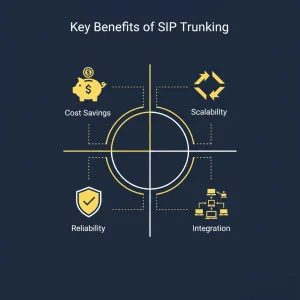
key benefits of SIP trunking
SIP Trunking vs. Traditional Phone Systems
To fully appreciate the value of SIP, it is helpful to contrast it directly with the technologies it is replacing. Many businesses are still holding onto legacy systems due to inertia, not realizing the operational drag it creates.
SIP Trunking vs. PRI (Primary Rate Interface)
For decades, the ISDN PRI was the standard for enterprise voice. It delivered digital voice over physical T1/E1 lines.
| Feature | PRI (Legacy) | SIP Trunking (Modern) |
| Connection | Physical copper wires (T1/E1) | Virtual connection via Internet |
| Scalability | Rigid (Blocks of 23 channels) | Flexible (1 channel at a time) |
| Setup Time | Weeks (requires physical install) | Hours or Minutes |
| Reliability | Susceptible to physical line damage | Redundant, cloud-based failover |
| Cost | High monthly fees + maintenance | Lower monthly fees, minimal hardware |
PRI is rapidly becoming obsolete. Telecom carriers in many countries (including the UK, Australia, and parts of the EU) are actively decommissioning ISDN networks, forcing a migration to SIP.
The End of Analog Lines (POTS)
Plain Old Telephone Service (POTS) lines are functionally limited (no HD voice or video) and expensive to maintain. Continuing to rely on them puts businesses at risk of sudden obsolescence. Migrating to SIP upgrades the entire infrastructure to be software-defined and data-rich.
Implementing and Setting Up SIP Trunking
Transitioning to SIP trunking is a significant upgrade, but with preparation, it can be seamless. Unlike plugging in an analog phone, setting up a SIP trunk involves configuring your network ecosystem to prioritize voice.
Essential Requirements for SIP Trunking Deployment
Before you purchase a SIP channel, you must ensure your infrastructure is “voice-ready.”
1. Robust Internet Connection
Your internet connection is now your phone line.
- Bandwidth: Voice traffic consumes bandwidth (typically 85-100 kbps per concurrent call using high-quality codecs). Ensure you have sufficient upload and download speeds to handle your peak call volume alongside regular office data usage.
- Stability: Bandwidth is important, but latency (delay) and jitter (variance in delay) are the real killers of voice quality.
For enterprise setups, a Dedicated Internet Access (DIA) fiber line is highly recommended over shared broadband to guarantee consistent performance.
2. Compatible IP PBX System or Cloud PBX Solution
You need a system capable of “speaking” SIP.
- Legacy Systems: If you have an older on-premise PBX, you may need a VoIP Gateway (specifically an ATA or Analog Telephone Adapter) to convert the SIP signal for your analog hardware.
- Modern IP PBX: Most modern on-premise systems (like Asterisk or 3CX) support SIP natively.
- The “Zero-Hardware” Route: Alternatively, you can bypass this requirement entirely by choosing a Cloud PBX provider like HAPBX. In this model, HAPBX hosts the PBX for you, eliminating the need for local hardware configuration or gateways.
3. Network Configuration
This is the most common stumbling block. Your router needs to know how to handle voice packets.
- NAT Traversal: Network Address Translation (NAT) can sometimes confuse VoIP signals, leading to issues like one-way audio. Your firewall must be configured to allow SIP traffic (usually on UDP port 5060) and RTP traffic (media ports).
- SIP ALG (Application Layer Gateway): Many consumer-grade routers have “SIP ALG” enabled by default. While intended to help, it often corrupts SIP packets. It is standard industry practice to disable SIP ALG on your router for a stable connection.
SIP Trunking Setup Process
- Audit Your Needs: Determine how many concurrent calls you make at peak times. A rule of thumb is a ratio of 1 SIP channel for every 3-4 employees, though this varies by industry (e.g., call centers need a 1:1 ratio).
- Choose Your Provider: Select a carrier based on coverage, support, and security (more on this in the next section).
- Configuration: Enter the SIP credentials (username, password, and domain/IP provided by your carrier) into your PBX interface.
- Number Porting (LNP): If you are keeping your existing business numbers, initiate a Local Number Portability request. This process moves your numbers from the old carrier to the new SIP provider.
- Testing: Before going live, test inbound and outbound calls, emergency routing (E911), and failover capabilities.
Common Challenges and Proactive Troubleshooting Tips
Even with the best planning, hiccups can occur.
- One-way Audio: Usually a firewall or NAT issue blocking the inbound or outbound media stream. Check your port forwarding rules.
- Choppy Voice: Often caused by network congestion. Implement Quality of Service (QoS) to prioritize voice packets over large downloads or video streaming.
- Registration Failures: Double-check your SIP credentials and ensure your ISP is not blocking VoIP ports.
Security and Reliability Considerations
As we navigate, security is paramount. SIP trunking utilizes the public internet, introducing new attack vectors, but with the right architecture, it is more secure than legacy lines.
Addressing SIP Trunking Security Risks
VoIP security is about protecting two things: your wallet and your conversations.
- Toll Fraud: This is the most common threat where hackers gain access to your PBX to route expensive international calls through your account.
- Mitigation: Use strong, complex passwords for SIP credentials and implement IP whitelisting, ensuring your PBX only accepts traffic from your provider’s known IP addresses.
- Eavesdropping & Interception: Since voice data travels as packets, it can theoretically be intercepted.
- Mitigation: Implement TLS (Transport Layer Security) to encrypt the signaling (who is calling whom) and SRTP (Secure Real-Time Transport Protocol) to encrypt the actual audio media. This makes the conversation unreadable to anyone “listening” on the wire.
- HAPBX Security Advantage: While standard SIP trunks rely on shared public cloud environments, HAPBX mitigates risk through Dedicated Instance Infrastructure. By isolating resources per tenant and utilizing private IPs/Domains, the surface area for attacks (like “noisy neighbor” exploits) is drastically reduced compared to generic shared hosting.
High Availability and Disaster Recovery
In the digital age, silence is expensive. Your system needs a 24/7 pulse.
- Provider Redundancy: Premium providers operate geographically dispersed data centers with automatic failover.
- Disaster Recovery: If your office is offline (e.g., power outage), calls should instantly divert to mobile numbers or secondary sites. This resilience is the core promise of HAPBX’s global cluster architecture.
Choosing the Right SIP Trunking Provider
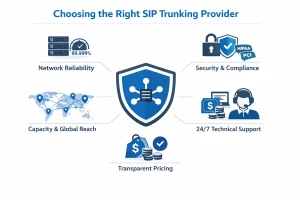
Choosing the Right SIP Trunking Provider
In a flooded market, selecting the right partner is critical. Use this framework to evaluate potential providers.
Network Reliability
Look for “Tier-1” providers who own their infrastructure rather than reselling connections. Demand a Service Level Agreement (SLA) with a 99.999% uptime guarantee.
Security & Compliance
Ensure TLS/SRTP encryption is standard. Beyond privacy, ask about active toll fraud mitigation. Can their system automatically detect and block suspicious spikes in international calling (e.g., a sudden flood of calls to a high-cost region at 3 AM)?
If you are in regulated industries (Healthcare, Finance), verify compliance (HIPAA, PCI-DSS).
Capacity & Reach
Can they scale instantly? Do they offer International DIDs with local termination for high audio quality?
Transparent Pricing
Be wary of “unlimited” plans that hide restrictive “fair usage policies” or caps. Look for transparent billing models—whether metered (pay-per-minute) or flat-rate (pay-per-channel)—that clearly list all taxes, E911 fees, and setup costs upfront.
Technical Support
Prioritize providers offering 24/7 dedicated technical support staffed by engineers who understand SIP packet analysis and network configurations, not just Tier-1 agents reading from a script.
Comparison: Standard SIP Trunking vs. HAPBX Managed SIP
While standard SIP trunking provides the connection, HAPBX provides the entire ecosystem. Here is how a typical DIY SIP setup compares to the HAPBX Dedicated model.
| Feature | Standard SIP Trunking (Generic Providers) | HAPBX (Managed Cloud PBX) |
| Infrastructure Model | Shared (Multi-Tenant)
Your traffic competes with others on the same server. |
Dedicated Instance
Isolated resources reserved exclusively for your business. |
| Performance Stability | Variable
Susceptible to “noisy neighbor” effects (latency spikes). |
Guaranteed
Latency maintained ~50ms; unaffected by other clients. |
| Setup Complexity | High (DIY)
You configure firewalls, NAT, and PBX hardware. |
Zero (Fully Managed)
Plug-and-play; infrastructure is managed by HAPBX. |
| Reliability (Uptime) | Basic Failover
Reroutes calls if a server fails (often with delay). |
Global Cluster (HA)
Instant synchronization across nodes for near-zero downtime. |
| Security | Standard Encryption
Often an extra paid add-on. |
Enterprise-Grade
TLS/SRTP, DDoS mitigation, and Private IP included. |
| Scalability | Limited by Hardware
Your on-premise PBX dictates the limit. |
Unlimited
Scale users and channels instantly without hardware constraints. |
HAPBX: A Cloud PBX Beyond Standard SIP Trunking
While understanding SIP trunking is essential, many businesses discover that managing raw SIP trunks and on-premise PBX hardware is a burden they no longer want to carry.
Enter HAPBX (High Available Private Branch Exchange).
HAPBX is not just a pipe for connecting calls; it is a fully managed, enterprise-grade Cloud PBX platform. We take the raw power of SIP trunking and wrap it in a managed infrastructure that guarantees uptime, security, and ease of use.
Why HAPBX Redefines Business Communication
Standard SIP trunking requires you to be the expert. You manage the firewall, you configure the PBX, and you troubleshoot the jitter.
HAPBX flips the script. We believe that internal communication and customer care should not be limited by technical risks. HAPBX operates as a “Total Internal Switchboard System” that is always safe, sound, and ready for any scale.
Dedicated Instance Infrastructure
This is the single biggest differentiator in the market today. Most Cloud PBX and SIP providers operate on Multi-Tenant (Shared) Environments. This is like living in an apartment building: if your neighbor throws a loud party (a massive spike in traffic or a DDoS attack), you can’t sleep.
HAPBX operates on a Dedicated Instance Infrastructure.
- Zero “Noisy Neighbors”: Your resources are physically and logically isolated. Another client’s traffic spike will never degrade your call quality.
- Enhanced Security: Isolation reduces the surface area for threats. Your data lives in its own private virtual environment, not a shared database.
- Custom Control: Because the instance is yours, we can offer flexible configurations, private IP ranges, and specific domain setups that shared platforms simply cannot support.
Uninterrupted Communication & Scalability
The “HA” in HAPBX stands for High Availability.
- Global Cluster Infrastructure: Unlike a single server setup, HAPBX runs on a global cluster. If a node in the US encounters an issue, your system instantly syncs with a node in another region. This architecture delivers on the promise of near-zero downtime.
- Scalability Without Hardware: Whether you have 10 users or 1,000+, HAPBX grows with you. There are no expensive line cards to buy or servers to upgrade. You can add extensions instantly, supporting infinite growth without service interruption.
Modern, Flexible, and Secure: The Future-Proof Promise
HAPBX is designed for the modern workforce. It supports secure hybrid and remote work models natively.
- Secure Remote Access: Using private IPs and domains, your remote team connects securely to the corporate network from anywhere in the world—Sydney, London, or New York—without complex VPNs or security trade-offs.
- Enterprise-Grade Defense: The platform includes built-in DDoS mitigation, IP reputation filtering, and SIP hardening.
If you are looking for raw connectivity, SIP trunking is the technology. But if you are looking for a solution that guarantees reliability, eliminates hardware headaches, and provides a dedicated environment for your business, HAPBX is the upgrade your enterprise needs.
The Evolution of SIP Trunking: What’s Next for Business Telephony
As we look toward 2026 and beyond, SIP trunking is no longer just about “cheap calls.” It is transforming into the intelligent nervous system of enterprise communication. The convergence of high-speed 5G networks and Artificial Intelligence is reshaping what is possible over a voice connection.
Modern SIP platforms now layer Artificial Intelligence to offer real-time sentiment analysis of customer calls and live voice-to-text translation, breaking down global language barriers.
The standalone phone system is fading. SIP is becoming the engine behind platforms like Microsoft Teams (via Direct Routing), allowing businesses to “Bring Your Own Carrier” (like HAPBX) for better reliability and lower costs than default plans.
With 5G, mobile devices are becoming primary SIP endpoints, delivering HD voice quality that rivals wired desk phones without being tethered to a physical office.
Conclusion
As we have explored, transitioning to SIP Trunking is no longer a question of “if,” but “when.” It is the foundational shift required to modernize your business infrastructure. However, simply plugging a standard SIP trunk into a shared cloud server is only solving half the problem. In a hyper-connected 2025 market, uptime is your reputation.
Why risk your critical business conversations in a shared environment or a DIY setup that drains your IT resources?
HAPBX offers you a different path. We provide the raw power and cost-efficiency of SIP technology, but we encase it in a Dedicated Instance Infrastructure that guarantees security, eliminates “noisy neighbor” interference, and ensures High Availability. We turn a complex technical requirement into a seamless, managed asset.
Ready to elevate your communication standard?
Stop managing infrastructure and start focusing on growth. Contact HAPBX today to discuss how our High-Availability Cloud PBX can provide the dedicated, secure foundation your enterprise deserves. Let’s build a system that is always safe, sound, and ready for any scale.