
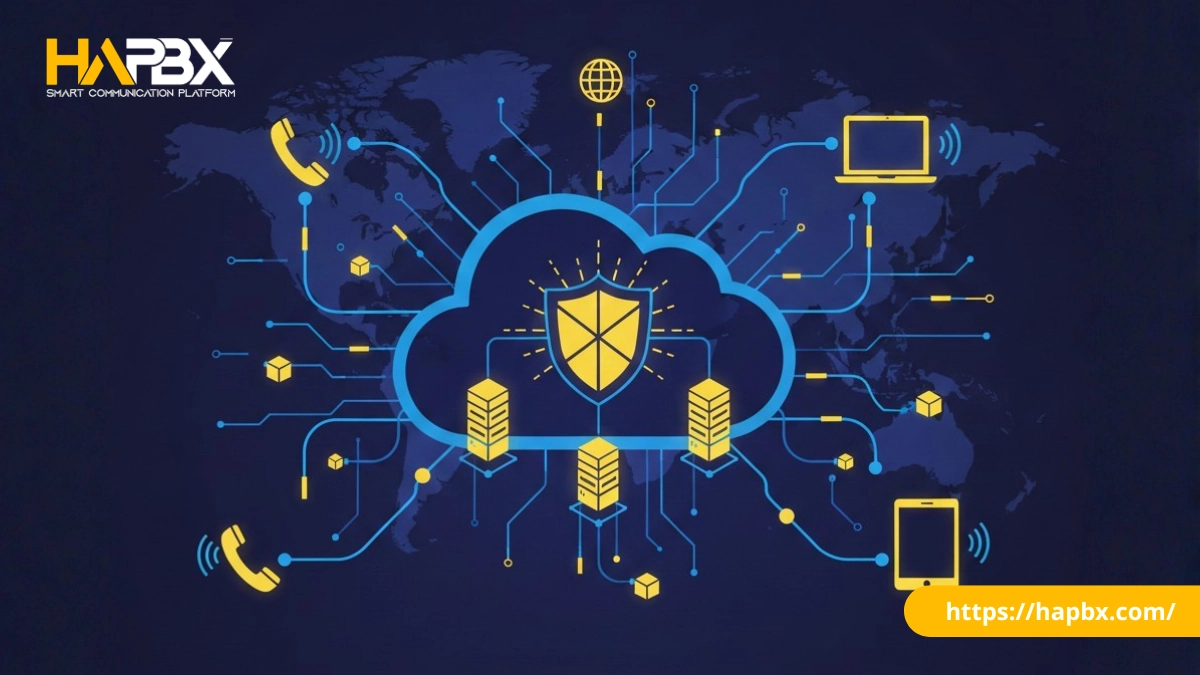
Voice over Internet Protocol (VoIP) has fundamentally shifted how the world communicates, transforming rigid landlines into dynamic, internet-based conversations. By converting analog voice signals into digital data packets, VoIP allows businesses to bypass expensive copper wiring and make calls from anywhere—whether on a desk phone, laptop, or mobile app.
However, simply “moving to the cloud” is no longer enough to guarantee a competitive advantage. As IP telephony becomes the global standard, many organizations are discovering that generic, shared-hosting VoIP solutions often struggle with stability, suffering from jitter, latency, and the infamous “noisy neighbor” effect.
This guide goes beyond the basic definition of internet calling. We will explore the mechanics of high-performance VoIP, exposing the hidden risks of standard cloud PBX and explaining why High Availability (HA) infrastructure is now the essential requirement for mission-critical enterprise voice.
This guide is written for businesses evaluating enterprise-grade VoIP platforms like HAPBX, where uptime, security, and performance are non-negotiable requirements—not optional features.
1. What is VoIP?
VoIP (Voice over Internet Protocol) is a technology that allows you to make voice calls using a broadband internet connection instead of a regular (or analog) phone line.
VoIP converts your voice vibrations into compressed digital signals that travel over the internet. These signals are then converted back into audio at the receiving end, allowing for real-time conversation.
Also referred to as IP Telephony, Internet Calling, or Cloud PBX, VoIP services function by breaking down audio into data packets and transmitting them over local area networks (LANs) or the wide area network (WAN/Internet). This technology transforms voice from a standalone, physical service into a dynamic application that runs alongside your email, web traffic, and cloud databases.
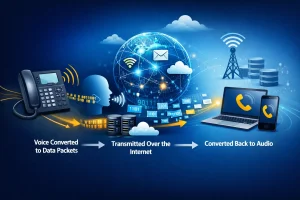
VoIP converts your voice vibrations into compressed digital signals that travel over the internet
2. How VoIP Works?
To understand why some VoIP systems deliver crystal-clear audio while others suffer from “robot voice” or dropped calls, we must look under the hood. At its core, VoIP is a method of taking analog audio signals (your voice) and turning them into digital data that can be transmitted over the internet.
But how does this process actually happen in real-time? It involves a complex orchestration of protocols, codecs, and switching methods that happen in milliseconds.
Packet Switching vs. Circuit Switching: The Fundamental Shift
The traditional landline system (PSTN) relied on circuit switching. When you made a call, a physical path (circuit) was dedicated exclusively to that conversation between two points. It was reliable, but incredibly inefficient and expensive; if the line was physically damaged or the circuit was busy, communication stopped.
VoIP utilizes packet switching, the same technology that powers the internet.
- Digitization: When you speak into a VoIP phone, the device captures the analog sound waves.
- Encapsulation: These sound waves are compressed and broken down into small units called data packets. Each packet is labeled with a destination IP address and a sequence number.
- Transmission: These packets are sent over the internet via the most efficient path available at that exact moment. They don’t need a dedicated line; they travel alongside your emails and browser traffic.
- Reassembly: When they reach the destination (the person you are calling), the receiving device reassembles the packets in the correct order and converts them back into sound.
Why this matters for business: Packet switching is what makes VoIP so scalable. You don’t need to install new wires to add a new employee; you simply add a new logical connection to the network.
However, because packets travel over the public internet, they are susceptible to latency if the infrastructure isn’t optimized—a key reason why dedicated instances are becoming preferred over shared hosting environments.
The Technical Backbone: SIP and Codecs
There are two critical technical components that dictate the success of a VoIP call:
- SIP (Session Initiation Protocol)
Think of SIP as the traffic cop of VoIP. It is a signaling protocol used to initiate, maintain, modify, and terminate real-time sessions. SIP doesn’t carry the voice audio itself; rather, it sets up the “handshake” between two devices. It handles the ringing, the connection, and the teardown of the call.
- Security Note: Because SIP is an open standard, it is a common target for hackers. Modern enterprise VoIP solutions, like HAPBX, employ SIP Hardening and TLS encryption to protect these signaling messages from being intercepted or spoofed.
- Codecs
Codecs are the algorithms responsible for compressing your voice data to make it travel faster, and then decompressing it on the other end.
- G.711: Provides uncompressed, high-quality audio (HD Voice) but consumes more bandwidth.
- G.729: Compresses audio significantly to save bandwidth, which is useful for remote workers with unstable internet, though audio quality may dip slightly.
Advanced VoIP platforms now use dynamic codec negotiation, automatically switching between high fidelity and high compression based on current network health to prevent dropped calls.
Hardware vs. Softphones: The Device Ecosystem
One of the defining characteristics of modern VoIP is device agnosticism. Your business phone number is no longer tied to a specific desk or wall jack; it is tied to a user account that can live on multiple devices simultaneously.
IP Phones (Hardphones):
These look like traditional desk phones but connect via an Ethernet cable or Wi-Fi. They have specialized hardware to process audio packets (DSP – Digital Signal Processors) to ensure high sound quality and echo cancellation. They are still the standard for executives and receptionists who handle high call volumes.
Softphones (Software Telephones):
A softphone is an application installed on a desktop, laptop, or smartphone that mimics a physical phone. It turns a general-purpose computer into a fully functioning VoIP endpoint.
- For the Hybrid Workforce: Softphones allow employees to take their office extension home. When a client calls the office number, the app on the employee’s mobile rings.
- The HAPBX Advantage: High-end systems utilize Private Domains and Private IPs for these softphone connections. Unlike consumer apps (like WhatsApp) or standard softphones that fight for public bandwidth, enterprise softphones connected to a dedicated cloud cluster ensure that remote connections remain secure and distinct from general web traffic, maintaining the professional integrity of the call.
By decoupling the phone number from the physical location, VoIP has enabled the “Work from Anywhere” era. However, this flexibility places a massive burden on the underlying cloud infrastructure.
As we will explore in the next sections, the difference between a frustrating VoIP experience and a flawless one usually comes down to whether that infrastructure is Shared or Dedicated.
3. Top Benefits of Switching to VoIP (IP Telephony)
For decades, the business case for telephone systems was purely functional: you needed a dial tone to conduct business. Today, the adoption of VoIP (IP Telephony) is driven by strategic necessity. According to recent industry data, businesses that switch to VoIP can reduce their communication costs by up to 50% while increasing productivity by nearly 20% through unified features.
However, the benefits extend far beyond the balance sheet. Switching to an IP-based system fundamentally changes how an organization operates, turning communication from a static utility into a flexible, scalable software asset.
Here are the primary benefits driving modern enterprises toward VoIP.
3. 1. Significant Cost Reduction and Predictable TCO
The most immediate driver for VoIP adoption is the dramatic reduction in Total Cost of Ownership (TCO). Traditional Public Switched Telephone Network (PSTN) lines are expensive to install, maintain, and scale.
- Lower Operational Expenses (OpEx): Traditional systems often require complex maintenance contracts and expensive visits from technicians just to move a phone line from one office to another. VoIP eliminates these physical maintenance costs. Since the “phone switch” is software-based (often hosted in the cloud), maintenance, patches, and updates are handled remotely—often automatically.
- Eliminating CapEx Spikes: Legacy PBX systems required massive upfront Capital Expenditure (CapEx) for proprietary hardware—heavy server cabinets and specialized wiring. VoIP shifts this to a predictable monthly subscription model.
- Reduced Call Costs: Because voice data travels over the internet, long-distance and international calls are significantly cheaper—often free between branch offices—bypassing the heavy tolls charged by traditional telecom carriers.
Pro Insight: Advanced VoIP models (specifically those built on Dedicated Instances) are now moving away from the “per-user” pricing trap. Instead of paying for every single extension, modern high-availability solutions often charge based on the infrastructure capability (e.g., concurrent call paths). This allows businesses to create unlimited extensions without seeing their monthly bill skyrocket.
3.2. Unlimited Scalability and Agility
In the old world of telephony, growth was a logistical headache. If you hired 10 new sales representatives but your physical PBX board only had 5 spare ports, you had to buy expensive hardware expansion cards or an entirely new system.
VoIP offers unlimited expandability. Because the system is virtual, adding a new line is as simple as clicking a button in a web portal.
- Instant Provisioning: You can deploy a new phone number or extension in minutes, not weeks. This is vital for businesses that experience seasonal spikes or are opening new branch offices.
- Elastic Growth: Whether you are a startup with 10 users or an enterprise scaling to 1,000+, the system grows with you without requiring a “rip and replace” of your hardware.
- Concurrent Call Handling: Enterprise-grade VoIP platforms are designed to handle high-volume traffic. Modern infrastructure can process 100+ concurrent calls by default, ensuring that customers never hear a busy signal during peak hours.
3.3. Enabling the Hybrid and Remote Workforce
The concept of the “office” has evolved, and VoIP is the technology that makes hybrid work possible. A traditional landline tethers an employee to a specific desk. If they aren’t in the chair, they miss the call.
VoIP decouples the phone number from the physical location.
- The Softphone Revolution: Employees can install a “Softphone” app on their laptops or smartphones. This app functions exactly like their office desk phone. When a client calls their office extension, it rings on their mobile device, regardless of whether they are in Sydney, London, or working from home.
- Unified Presence: Managers can see who is “online” or “on a call” regardless of physical location, maintaining team cohesion.
- Professional Image: Remote workers can make outbound calls from their personal mobile devices while displaying the company’s business ID, protecting their privacy and maintaining professional branding.
Security Note: While flexibility is key, enterprise VoIP adds a layer of security that consumer apps (like WhatsApp or Skype) lack. By using private domains and secure IP tunneling, corporate VoIP ensures that remote traffic is encrypted and monitored, preventing data leakage.
3.4. Advanced Enterprise Features and AI Integration
Because VoIP treats voice as digital data, it allows for seamless integration with other business software—something a copper wire could never do. This transforms the phone system into a productivity hub.
- CRM Integration: VoIP platforms can sync with tools like Salesforce, HubSpot, or Zoho. When a customer calls, a “Screen Pop” instantly appears on the agent’s computer, displaying the caller’s name, history, and recent support tickets before the agent even answers.
- AI-Powered Efficiency: Modern VoIP is the gateway to Artificial Intelligence in communication. Features like AI Routing (intelligently sending calls to the best-skilled agent), real-time sentiment analysis, and automated voicemail-to-text transcription are becoming standard.
- Sophisticated Call Flow (IVR): Even small businesses can appear like large corporations using Multi-Level Interactive Voice Response (IVR) menus (e.g., “Press 1 for Sales, Press 2 for Support”), which can be configured and changed instantly via a web browser.
3.5. High Definition (HD) Voice Quality
Historically, early VoIP services suffered from poor quality. However, with the advent of high-speed broadband and advanced codecs (like G.722), VoIP now offers HD Voice—audio quality that actually surpasses traditional landlines.
HD Voice captures twice the acoustic frequency range of a standard phone call, making conversations sound clearer and more natural. This reduces fatigue on long conference calls and minimizes misunderstandings.
While the potential for HD quality is inherent in VoIP, realizing it depends entirely on the underlying infrastructure.
As we will explore in the next section, operational stability is the dividing line between a frustrating, jittery experience and a crystal-clear, professional connection. True HD quality is only guaranteed when the system runs on Dedicated Infrastructure that eliminates the “noise” of shared public servers.
4. VoIP vs. Landline: The Comparison Chart
When evaluating communication infrastructure, the choice isn’t just between “Old” (Landline) and “New” (VoIP). The real decision lies in choosing the right architecture for your VoIP implementation.
Most businesses are unaware that “Cloud PBX” comes in two forms: Standard Shared Cloud (cheap but inconsistent) and High Availability Enterprise Cloud (dedicated and robust).
The following chart compares Traditional Landlines, Standard VoIP providers, and HAPBX—the High-Availability solution built on Dedicated Instances.
| Feature | Traditional Landline (PSTN) | Standard Cloud VoIP (Shared) | HAPBX (Enterprise HA Cloud) |
| Infrastructure Model | Analog copper wires (Physical Circuit). | Multi-Tenant Cloud. Resources are shared among thousands of users. | Dedicated Instance. Isolated infrastructure on a Global Cluster. Resources are yours alone. |
| Reliability (Uptime) | High. Works independently of the internet. | Variable. Prone to the “Noisy Neighbor” effect and single-server failures. | High Availability (HA). Near-zero downtime via automatic failover and multi-region clustering. |
| Performance (Latency) | Stable. | Unpredictable. Latency can spike >150ms during peak hours. | Guaranteed. Latency maintained ~50ms for crystal-clear HD audio. |
| Security | Secure (hard to tap physically). | Moderate. Uses Public IPs, vulnerable to mass DDoS and scanning. | Enterprise-Grade. Uses Private IP & Private Domain. Isolated environment eliminates cross-tenant risks. |
| Scalability | Difficult. Requires physical wiring and hardware upgrades. | Flexible. Easy to add users, but performance may degrade at scale. | Unlimited. Instantly scale extensions. Supports 100–200+ concurrent calls by default without hardware upgrades. |
| Management | Managed by Telco (slow support). | Self-service or Ticket-based. | Fully Managed Service. HAPBX handles patching, security, and infrastructure health 24/7. |
| Cost Model | Expensive CapEx & call tolls. | Low CapEx, but unpredictable quality costs. | Predictable OpEx. High value for dedicated resources and peace of mind. |
The Verdict: Why Infrastructure Matters?
- Traditional landlines are obsolete for agility and cost.
- Standard VoIP is suitable for small, non-critical setups but introduces risks like “jitter” and security vulnerabilities due to its shared nature.
- HAPBX offers the “Best of Both Worlds”: It combines the flexibility of the cloud with the bulletproof reliability of a dedicated system. By operating on a Global Cluster Infrastructure, HAPBX eliminates the single points of failure that plague standard VoIP, ensuring your business communication is always safe, sound, and ready for any scale.
For 99% of businesses, the landline is obsolete. The cost savings and flexibility of VoIP are simply too great to ignore. However, the chart above reveals one critical weakness of VoIP: Reliability is “Variable”
While landlines offer 99.999% uptime because they use dedicated physical circuits, standard VoIP solutions rely on shared public internet paths. This leads us to the most critical realization for IT decision-makers: The problem isn’t VoIP technology itself; the problem is the infrastructure your provider uses.
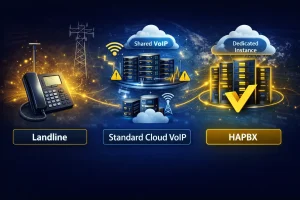
Voip vs landline vs hapbx high availability
5. The Hidden Risks of Standard Cloud VoIP
As organizations rush to decommission their copper lines and embrace the cloud, many fall into a common trap. They assume that all “Cloud PBX” providers are the same. They migrate to a popular, low-cost VoIP service, only to discover that their call quality is inconsistent, audio drops during peak hours, and their data is more vulnerable than before.
This is the “gap” in the market. Between the rigid stability of old landlines and the flexibility of modern cloud calling, there is a dangerous middle ground: Standard Shared Cloud VoIP.
To understand why mission-critical businesses need High Availability (HA) solutions, we must first dissect the hidden technical risks inherent in standard, multi-tenant VoIP platforms.
5.1. The “Noisy Neighbor” Problem in Shared Hosting
The vast majority of commercial VoIP providers operate on a multi-tenant model. Imagine a high-rise apartment building where all residents share a single water pipe. If one resident on the top floor decides to fill a massive swimming pool, the water pressure drops for everyone else in the building.
In the world of Cloud PBX, this is known as the “Noisy Neighbor” effect.
- Resource Contention: In a standard environment, your business shares server resources (CPU, RAM, and Bandwidth) with hundreds or thousands of other companies on the same server instance.
- The Impact: If another client on your shared server experiences a sudden spike in call volume—or worse, gets hit by a cyberattack—the server’s processing power is drained.
- The Result: Your calls begin to suffer. You experience “robotic” voice audio, delayed inputs, or dropped calls, even though your own internet connection is perfect. You are effectively at the mercy of strangers’ usage patterns.
5.2. Security Vulnerabilities in Public Cloud PBX
Security is often the overlooked casualty of cheap VoIP. Standard providers typically host their services on public cloud instances with generic security configurations designed to fit “everyone.”
- Shared IP Risks: In many shared hosting environments, multiple tenants may operate under the same public IP address ranges. If a “neighbor” on your server engages in spam calling or suspicious activity, that IP address could get blacklisted by carriers. Suddenly, your legitimate sales calls are being flagged as “Spam Risk” on your customers’ phones, damaging your brand reputation.
- Increased Attack Surface: Public, multi-tenant environments are attractive targets for hackers. A Denial-of-Service (DoS) attack aimed at the platform affects every single tenant on that cluster.
- Data Leakage: Without strict logical isolation, there is a theoretical (and sometimes practical) risk of cross-tenant data leakage. For enterprises in finance, healthcare, or legal sectors, relying on a shared “black box” infrastructure is often a compliance violation waiting to happen.
5.3. The Cost of Latency and Jitter
In email or web browsing, a 2-second delay is annoying but acceptable. In voice communication, a delay of 150 milliseconds is catastrophic.
VoIP quality is measured by three metrics: Latency (delay), Jitter (variation in delay), and Packet Loss.
- The Threshold: To maintain a conversation that feels “natural,” latency must be kept stable, ideally around 50ms. Once it exceeds 150ms, users start talking over each other, creating frustration and miscommunication.
- The Shared Cloud Failure: Standard cloud providers often route traffic through congested public internet nodes or distant data centers to save costs. During peak usage hours, jitter spikes. You might hear every second word, or the call might disconnect entirely.
Standard Cloud VoIP solves the cost problem of landlines but often fails the quality test of enterprise operations. For a small coffee shop, a dropped call is a minor inconvenience. For a sales team, a customer support center, or a hospital, downtime and poor audio are not just annoyances—they are direct revenue leaks.
This reality has forced a technological evolution. Leading enterprises are now moving away from “Shared Cloud” and adopting High Availability (HA) VoIP on Dedicated Instances—a solution engineered to eliminate the noisy neighbor, guarantee latency under 50ms, and provide the isolated security that standard providers cannot offer.
6. The New Standard: High Availability (HA) VoIP
In the early days of cloud computing, businesses were willing to tolerate occasional glitches in exchange for cost savings. A dropped call or a 5-minute outage was seen as the “price of innovation.”
Today, that tolerance is gone.
For modern enterprises—especially those in healthcare, finance, logistics, and high-velocity sales—voice is a mission-critical utility. If your email server goes down for 10 minutes, you can catch up later. If your phone system goes down for 10 minutes, you lose immediate revenue, miss emergency alerts, and damage customer trust permanently.
This necessity has given rise to the new gold standard in IP Telephony: High Availability (HA) VoIP.
What is High Availability (HA)?
High availability is not just a marketing buzzword; it is a system design approach. While standard “Reliability” implies that a system should work without error, “Availability” assumes that failures will happen (hardware breaks, power fails, internet lines get cut) and designs the system to continue operating despite them.
A true High availability VoIP system aims for “Five Nines” (99.999%) uptime. This translates to less than 5.26 minutes of downtime per year. To achieve this, HA systems eliminate Single Points of Failure (SPOF). Unlike a standard server where a blown power supply kills the whole system, HA architecture relies on redundancy, failover protocols, and synchronized clusters.
Dedicated Instance vs. Shared Cloud: The Core Architecture
The most significant difference between a standard VoIP provider and a High Availability solution like HAPBX lies in the infrastructure model: Shared vs. Dedicated.
The Standard Model (Shared Multi-Tenant)
As discussed in the previous section, most providers squeeze thousands of customers onto a single server cluster. This is cost-effective for the provider but dangerous for the user. Your data streams, security protocols, and processing power are mixed with everyone else’s.
The HA Model (Dedicated Isolated Instance)
High Availability solutions—such as HAPBX’s Dedicated Instance architecture—operate on fully isolated infrastructure designed to eliminate shared-resource risks
- Resource Isolation: Your business is assigned its own isolated cloud environment. Your CPU, RAM, and bandwidth are reserved exclusively for your calls. Even if the rest of the cloud is experiencing a massive traffic spike, your slice of the infrastructure remains unaffected.
- Guaranteed Performance: Because there is no “noisy neighbor” to steal resources, performance metrics become predictable. HAPBX, for example, guarantees high performance and stability at the enterprise level, maintaining latency (ping) strictly around 50ms. This prevents the “robotic” voice quality that occurs when latency creeps above the 150ms threshold common in shared environments.
- Compliance & Control: For industries with strict data sovereignty laws (like GDPR or HIPAA), a dedicated instance offers a clear audit trail. You know exactly where your data lives and who has access to it, unlike the “black box” of shared hosting.
Global Cluster Infrastructure and Automatic Failover
How does a High Availability system survive a catastrophic failure, such as a data center fire or a regional internet outage? The secret lies in Clustering.
Leading solutions like HAPBX utilize a Global cluster infrastructure. Instead of relying on one server, the system runs on a synchronized network of nodes (servers) distributed across different geographic regions (e.g., US, Asia, EU).
- Real-Time Synchronization: These nodes constantly “talk” to each other, replicating data and call states in real-time.
- Automatic Failover: If the primary node hosting your calls encounters an issue (a hardware failure or network drop), the system detects the heartbeat loss instantly. Traffic is automatically rerouted to a healthy secondary node.
- The User Experience: This failover happens so fast that the end-user often doesn’t realize a failure occurred. A call might experience a millisecond of silence before continuing, rather than disconnecting entirely. This architectural resilience ensures that your business never goes offline, regardless of physical infrastructure failures.
Enterprise Security: Private IPs and SIP Hardening
Security is the other side of the Availability coin. A system under a DDoS (Distributed Denial of Service) attack is effectively “down” even if the hardware is working fine.
Standard VoIP systems often use Public IPs that are scanned millions of times a day by bots looking for open ports to exploit. High Availability platforms take a proactive, fortress-like approach to security:
- Private IP & Private Domain:
By assigning a Private IP and domain to your dedicated instance, HA solutions like HAPBX effectively remove your phone system from the “public” visibility of the internet. This significantly reduces the attack surface. Your employees can connect securely from anywhere, but random internet traffic cannot “ping” your PBX. - SIP Hardening & Geo-Fencing:
HA systems employ advanced SIP Hardening. This includes strict firewall rules that only accept voice traffic from authorized locations (Geo-Fencing). If your business operates only in Australia and the US, the system will automatically block any connection attempt originating from high-risk regions, neutralizing toll fraud attempts before they even reach your dialer. - Encrypted Streams (TLS/SRTP):
While standard VoIP might send voice data in plain text, HA systems encrypt the signaling (TLS) and the media stream (SRTP). This ensures that even if a malicious actor intercepts the data packets, they cannot listen to the conversation.
Zero Downtime Maintenance
One of the biggest headaches for IT managers is “Maintenance Windows.” In traditional or shared systems, applying security patches or upgrading software often requires scheduling downtime—usually at 2:00 AM on a Sunday—or risking a service interruption during business hours.
High Availability eliminates maintenance downtime.
Because the system runs on a cluster, updates are applied using a “Rolling Update” strategy.
- The provider updates Node A while Node B handles the traffic.
- Once Node A is updated and verified healthy, traffic is moved back.
- Node B is then updated.
This capability—highlighted as a key benefit of HAPBX—means your system is always running the latest security patches and features without you ever having to hang up the phone. It transforms maintenance from a disruptive event into a background process that is invisible to the user.
Why HAPBX is the Exemplar of HA VoIP
While many providers claim to be “reliable,” true High Availability requires a fundamental commitment to infrastructure that few are willing to make.
HAPBX (High Available Private Branch Exchange) was engineered specifically to fill this gap in the market. It was not built as a cheap, mass-market shared VoIP solution. Instead, it was designed from the ground up on Dedicated Isolated Cloud Infrastructure to serve businesses that cannot afford failure.
- Built for Scale: HAPBX supports 100+ concurrent calls by default, with unlimited expandability.
- Managed Responsibility: Unlike self-hosted solutions (like managing your own Asterisk server) where you are responsible for fixing the server when it breaks, HAPBX operates as a fully managed service. The provider takes on the technical risk, ensuring the “engines” are running 24/7 so you can focus on driving the business.
In the final analysis, High Availability is not an optional add-on; it is the necessary insurance policy for your digital communication. By choosing a Dedicated Instance model, you are securing your business’s voice against the unpredictability of the internet.
7. How to Choose the Right VoIP Provider
Selecting a VoIP provider is no longer just about comparing price per user. It is about choosing a technology partner that will safeguard your business communications for the next decade. With hundreds of providers flooding the market—from massive telecom giants to small resellers—finding the right fit can be overwhelming.
To cut through the marketing noise, IT managers and business owners need to ask the right technical questions. Use this Enterprise VoIP Litmus Test to evaluate potential providers.
1. The Infrastructure Question: “Is it Shared or Dedicated?”
This is the single most important question. Most providers will say “Cloud,” but you need to know what kind of cloud.
- Red Flag: If they describe their service as “Multi-Tenant” or cannot guarantee isolated resources, you are signing up for a Shared Environment. You risk the “noisy neighbor” effect and unpredictable latency.
- The Gold Standard: Look for providers like HAPBX that explicitly offer Dedicated Instances. This ensures your CPU, RAM, and bandwidth are reserved solely for your company, guaranteeing the consistency required for mission-critical operations.
2. The Scalability Model: “Per User” vs. “Concurrent Calls”
Examine the pricing and growth model carefully.
- The Trap: Many providers charge a high license fee per user. If you have 100 employees, you pay for 100 licenses, even if only 10 people are on the phone at once. This gets incredibly expensive as you scale.
- The Better Choice: Look for a model that focuses on Concurrent Calls or infrastructure capacity. HAPBX, for instance, supports unlimited extensions and focuses on the capacity of the trunk (e.g., 100–200 simultaneous calls). This allows you to give a phone extension to every employee (even the intern) without inflating your monthly bill.
3. Service Level Agreement (SLA): “What is your uptime guarantee?”
Don’t just take their word for it; look at the contract.
- Standard: 99.9% uptime (allows for ~9 hours of downtime per year).
- High Availability: Look for providers committed to “Near-Zero Downtime” or 99.999% availability. Ask specifically about their Failover Strategy. Do they use a Global Cluster? If their US node fails, does traffic automatically route to an EU or Asian node? If the answer is “we will fix it within 4 hours,” that is too slow for modern business.
4. Security and Compliance
If you are in finance, healthcare, or legal, security is non-negotiable.
- Ask: “Do you support Private IPs and Private Domains?”
- Ask: “Is your signaling encrypted with TLS and audio with SRTP?”
- Ask: “Can you Geofence my traffic to block connection attempts from high-risk countries?”
A provider that operates on a dedicated private environment will say “Yes” to all three.
5. Management Level: “Do I have to fix it?”
Finally, distinguish between “Self-Hosted” and “Managed Service.”
- Self-Hosted (DIY): You rent a server (VPS) and install software like Asterisk or VitalPBX. You are responsible for updates, security patches, and fixing it when it breaks. This is risky and resource-intensive.
- Fully Managed (HAPBX Model): The provider handles the infrastructure, security patches, and failover configurations. You simply use the service. This “Managed Cloud” approach eliminates technical risk and frees your IT team to focus on core business growth.
8. Frequently Asked Questions about VoIP
Here are the answers to the most common questions businesses ask when considering a switch to High Availability VoIP.
Q1: Does VoIP work when the internet goes down?
Answer: At the office, no—but business continues. High Availability systems instantly route calls to employee mobile apps (using 4G/5G) or forward them to voicemail, ensuring you remain accessible during local outages.
Q2: Is VoIP secure enough for sensitive business data?
Answer: Yes, often more than landlines if configured correctly. Enterprise solutions like HAPBX use Private IPs and full encryption (TLS/SRTP) to prevent eavesdropping and block unauthorized access.
Q3: What is the difference between “Cloud PBX” and “VoIP”?
Answer: VoIP is the technology that transmits voice over the internet. Cloud PBX is the full-featured business phone system (with menus, voicemail, and routing) that runs on top of that technology in the cloud.
Q4: Will I lose my current business phone numbers if I switch?
Answer: No. You can keep your existing numbers through a process called Number Porting. Your provider transfers them from your old carrier seamlessly so customers never notice a change.
Q5: Why is my current VoIP call quality poor?
Answer: This is usually due to “Jitter” or congestion on a shared server.Switching to a Dedicated Instance on a provider like HAPBX solves this by reserving bandwidth exclusively for your calls and optimizing the routing path to keep latency under 50ms.
Conclusion
The migration from copper wires to Voice over IP is the defining communication shift of our generation. It has democratized access to enterprise features, lowered costs, and broken the chains tying employees to their desks.
However, as we look toward the future of work, the “Standard Cloud” model is showing its cracks. In a world where business never sleeps and remote work is the norm, reliability is the new currency. Businesses can no longer afford the risks of shared infrastructure, noisy neighbors, and unpredicted downtime.
High Availability (HA) VoIP represents the maturity of this technology. By choosing a solution built on Dedicated Isolated Infrastructure—like HAPBX—you are not just buying a phone system; you are investing in business continuity. You are ensuring that every sales call connects instantly, every support query is heard clearly, and your organization remains safe, sound, and ready for any scale.
Ready to elevate your communication?
Stop managing infrastructure and start focusing on growth. Contact HAPBX and explore how our platform can provide your business with the guaranteed performance, security, and almost zero downtime that modern enterprises demand.