

A PBX switchboard remains a core component of business communication, even as phone systems shift from traditional hardware to cloud-based platforms. Acting as the central point for call handling and routing, modern PBX switchboards help businesses manage incoming calls efficiently, reduce missed connections, and improve customer experience.
In this guide, we explain how PBX switchboards work, compare traditional and cloud-based models, and explore real-world business use cases. You’ll also see how modern Cloud PBX platforms – such as HaPBX – are redefining the role of the PBX switchboard with higher availability, clearer call quality, and simpler management.
What Is a PBX Switchboard and Why It Still Matters
A PBX switchboard is the call-handling and call-routing center within a PBX (Private Branch Exchange) system. In simple terms, a PBX is a company’s internal phone network that manages incoming and outgoing calls while allowing employees to communicate internally – often at a lower cost than traditional landline setups.
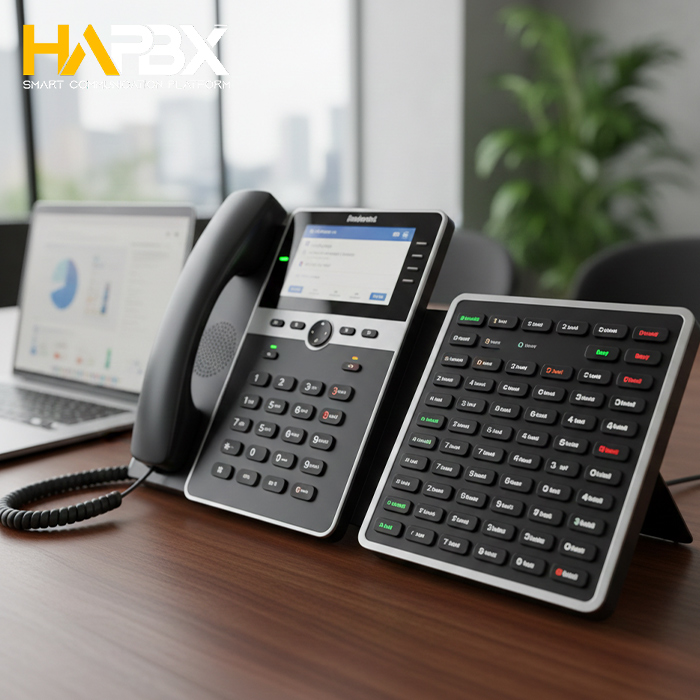
Within this system, the switchboard acts as a central control point. All external and internal calls pass through it before being directed to the correct extension, department, or operator. While the concept dates back to early telephone networks, modern PBX switchboards no longer resemble the large, panel-filled boards of the 20th century. Today, they typically take the form of a desk phone or a software-based operator console that is easy to use and space-efficient.
PBX switchboards remain relevant because they have evolved alongside Cloud PBX platforms, supporting digital call routing, remote operation, and modern business workflows without losing their core role in organized call management.
PBX Phone System: Complete Guide for Business Communication (2026)
How a PBX Switchboard Works: Core Functions Explained
Handling Incoming Calls
When an external call reaches a business, it first enters the PBX system through the public telephone network (PSTN) or a VoIP connection. The PBX switchboard acts as the first control point, receiving the call and determining where it should go next. Using a desk phone or an operator console, the switchboard answers the call and routes it to the appropriate department, extension, or queue.
Call Transfer and Internal Call Management
One of the core roles of a PBX switchboard is managing how calls move inside the organization. Operators can transfer calls to specific extensions or departments, place callers on hold, resume conversations, or announce a call before completing the transfer.
Modern switchboards also support handling multiple calls at once, evenly distributing calls among available staff and preventing bottlenecks. This ensures customers are not passed around unnecessarily and internal teams can connect with the right colleagues quickly.
Operator Console and Call Visibility
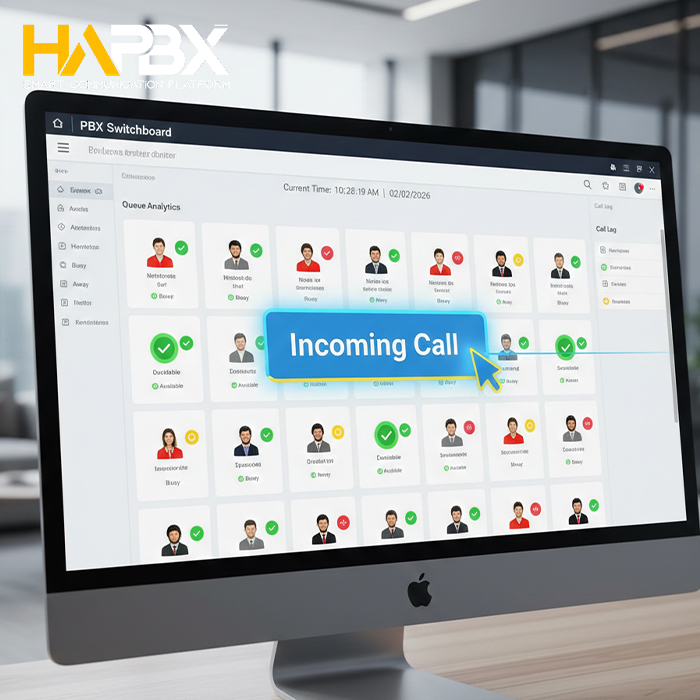
A modern PBX switchboard provides operators with real-time visibility into the system. The operator console shows extension status – such as busy, idle, or offline – and highlights active call queues.
This visibility is especially important in high-call-volume environments, where operators need to make quick routing decisions. By seeing who is available and how many calls are waiting, the switchboard helps maintain smooth call flow, reduce wait times, and prevent missed or dropped calls.
Types of PBX Switchboards: Traditional vs Cloud-Based
Over time, telephone switchboards have evolved significantly from their early mechanical forms into sophisticated digital systems. Today, most businesses choose from three primary PBX switchboard models: traditional (on-premises) PBX, IP-PBX, and cloud-based PBX. Each type serves the same core purpose – managing and routing calls – but differs in deployment, cost structure, and operational responsibility.
Understanding these differences helps businesses select a switchboard model that aligns with their technical resources, budget, and communication needs.
Traditional (Hardware-Based) PBX Switchboards
Traditional PBX switchboards, also known as on-premises PBX systems, are physically installed at a company’s location. A dedicated hardware unit acts as the central hub, routing both incoming and internal calls to the appropriate extensions. Because the system is owned outright, businesses maintain full control over configuration, features, and call handling rules.
This model is often valued for its independence from third-party providers and relatively low ongoing operating costs once installed. However, it comes with notable trade-offs. Initial setup can be expensive, and maintenance typically requires trained IT staff or external technicians. As hardware ages, repairs and upgrades can add long-term cost and complexity.
IP-Base Switchboards
An IP-PBX switchboard uses internet protocol (IP) technology to manage calls but is commonly hosted or maintained by a service provider. Instead of owning and maintaining the PBX hardware, businesses subscribe to the service, shifting responsibilities such as system updates, troubleshooting, and technical support to the provider.
This approach reduces upfront investment and eliminates the need for in-house PBX expertise. IP-PBX systems are often well suited to smaller organizations that want advanced PBX features without managing physical infrastructure. However, service limitations and per-user pricing mean larger teams may face higher recurring costs and less direct control over system changes.
Cloud-Based PBX Switchboards
Cloud-based, or virtual PBX switchboards, represent the most modern deployment model. In this setup, the entire PBX system operates in the cloud, with call routing and switchboard functions accessed through web-based interfaces or applications. Physical equipment is limited to desk phones or softphones, significantly reducing on-site infrastructure.
This model appeals to businesses seeking fast deployment, centralized management, and easy access across locations. Maintenance, updates, and system reliability are handled by the provider, allowing companies to focus on operations rather than infrastructure. The primary requirement is a stable, high-quality internet connection, as call performance depends directly on network reliability.
Benefits and Use Cases of a PBX Switchboard for Businesses
Key Business Benefits
A PBX switchboard enables businesses to handle calls in a more structured and professional manner. All incoming calls are routed through a central point, ensuring customers reach the correct department or employee without unnecessary transfers. This reduces missed calls, shortens response times, and creates a smoother experience for callers.
Internally, PBX switchboards help employees connect with one another more efficiently, minimizing delays caused by misdirected calls or unavailable contacts. Compared to traditional landline systems, PBX switchboards are also more cost-efficient, as multiple users can share external lines and call management becomes easier to scale without major infrastructure changes.
Who Operates a PBX Switchboard?
In many organizations, the PBX switchboard is primarily managed by receptionists or front-desk staff, commonly referred to as PBX operators. Their responsibility is to answer incoming calls, identify the caller’s needs, and route calls to the appropriate department – such as sales, customer service, or technical support.
In larger environments, call center agents and supervisors may operate switchboard functions to control call queues and workload distribution. With Cloud PBX systems, office administrators or IT teams can also configure and oversee switchboards remotely through web-based operator consoles, allowing operations to continue smoothly even in remote or hybrid work settings.
Industries and Business Use Cases That Benefit Most
While nearly any organization can benefit from a PBX switchboard, some industries rely heavily on structured call handling and gain particular value from it. These include:
- Healthcare and medical practices, where calls must be directed quickly to the correct department or specialist.
- Legal firms, which depend on timely client communication and efficient call routing.
- Construction and engineering companies, where teams are often distributed across sites and offices.
- Retail and e-commerce businesses, handling customer inquiries, orders, and support requests.
- Education institutions, managing calls from students, parents, and administrative departments.
- Customer support centers and service providers, where high call volumes require clear routing and queue management.
Across these use cases, PBX switchboards help businesses maintain reliable communication, improve responsiveness, and support daily operations without unnecessary complexity.
PBX Switchboard vs IVR vs Auto Attendant
While PBX switchboards, IVR systems, and auto attendants all serve the purpose of managing incoming calls, they differ significantly in how calls are handled and when human involvement is required. Understanding these differences helps businesses design call flows that balance efficiency with a positive caller experience.
| Feature | PBX Switchboard | IVR | Auto Attendant |
| Call handling approach | Human-operated | Fully automated | Hybrid (automation + human support) |
| Caller interaction | Speaks directly with an operator | Uses keypad or voice menu | Starts automated, escalates if needed |
| Best suited for | Complex or sensitive inquiries | High-volume, repetitive requests | Balanced, mixed call types |
| Ability to handle exceptions | High | Limited | Moderate to high |
| Typical use cases | Reception desks, VIP support, executive offices | Department routing, basic information | Frontline call handling for most businesses |
When to Use Each Approach
A PBX switchboard is most effective when calls require judgment, context, or personal interaction – such as handling VIP customers, urgent issues, or requests that do not fit predefined categories.
An IVR system works best for routine, high-volume scenarios where callers can easily self-select options, such as choosing a department or accessing basic information.
An auto attendant sits between the two, using automation to manage initial call routing while allowing calls to reach a live operator when necessary.
Why Many Businesses Combine Them
In practice, many organizations use a combination of these tools rather than relying on a single solution. IVR or auto attendants handle routine calls efficiently, while PBX switchboards remain essential for situations that require human judgment and personalized assistance.
This blended approach helps businesses reduce wait times, improve call flow, and maintain a professional, responsive communication experience.
PBX Switchboard in a Cloud PBX Environment
In a Cloud PBX environment, the PBX switchboard no longer relies on on-site hardware to manage and route calls. Instead, switchboard functions are delivered through a cloud-based platform, where call handling, routing rules, and operator tools are hosted in secure data centers. Operators access the switchboard via a web-based console or application, allowing them to manage calls from virtually any location with an internet connection.
One of the key advantages of this model is high availability. Cloud PBX platforms are typically built on redundant infrastructure, ensuring call services remain active even if part of the system experiences an outage. Low latency and optimized call routing help maintain clear call quality, while centralized management allows administrators to configure switchboards, update call flows, and monitor performance from a single interface. As businesses grow, Cloud PBX systems can also scale to handle higher call volumes and additional users without major system changes.
These benefits explain why Cloud PBX is increasingly becoming the standard for PBX switchboards. By removing the limitations of physical infrastructure and simplifying system management, Cloud PBX enables businesses to maintain reliable, modern call handling while adapting more easily to changing communication needs.
Why Choose HaPBX for a Modern PBX Switchboard Solution
HaPBX Sonata Switchboard is designed to empower modern enterprises with a centralized, intelligent, and highly reliable call management environment. Built on HaPBX’s cloud-native infrastructure and global cluster architecture, Sonata Switchboard delivers operational transparency, real-time control, and enterprise-grade stability for call-driven organizations.
Developed and operated by HPA Direct’s engineering ecosystem, HaPBX is not just a PBX system – it is a scalable communication backbone for business growth.
Unified Operator Interface for Real-Time Control
Sonata Switchboard provides a centralized visual dashboard that allows operators and supervisors to monitor and manage call activity in real time.
Key interface components include: User & Extension Monitoring
Operators can instantly track the status of all extensions with intuitive color indicators:
- Green – Online: Extension is connected and available
- Gray – Offline: Extension is disconnected
- Red – In Call: Extension is actively handling a call with caller ID displayed
- Yellow – Ringing: Incoming call not yet answered
This visual clarity enables faster decision-making, better call routing, and reduced response time across teams.
Intelligent Queue Management for High-Volume Environments
Sonata Switchboard supports dynamic queue monitoring, allowing supervisors to track which agents are logged in and ready to receive calls.
- Users can remain logged into queues even when temporarily unavailable on the main system
- Queue visibility enables real-time workforce balancing
- Supervisors gain instant insight into call distribution performance
This structure is especially valuable for customer support centers, sales teams, and multi-department organizations managing fluctuating call volumes.
Advanced Call Parking for Supervisor-Level Call Control
One of Sonata Switchboard’s most powerful operational features is Call Parking.
How It Works
When an agent needs management assistance, the call can be parked using a simple command (70+ Extension). The caller remains on hold with music playback, while supervisors can instantly view parked calls inside the switchboard interface.
Business Benefits
- Faster escalation handling
- Better internal coordination
- Reduced dropped calls
- Improved customer experience
This feature ensures that no important customer request is lost or delayed.
Smart Status Synchronization & Do Not Disturb (DND) Logic
Sonata Switchboard automatically synchronizes agent status across softphones and system interfaces.
When DND mode is activated:
- The agent is excluded from receiving queue calls
- The system visually updates the agent status
- Call distribution logic automatically adjusts
- This protects agent workload balance and prevents unnecessary interruptions during meetings or focused tasks.
Enterprise-Grade Security with Dedicated Instance Architecture
Unlike shared multi-tenant PBX systems, HaPBX operates on a Dedicated Instance Model. Each business receives:
- Isolated infrastructure environment
- Independent cluster resources
- Strong separation of voice and data traffic
- Reduced security exposure
This architecture aligns with enterprise compliance requirements and ensures consistent performance without “noisy neighbor” risks.
High Availability Powered by Global Cluster Infrastructure
HaPBX Sonata Switchboard runs on a geo-distributed cluster system with no single point of failure.
Key advantages:
- Near-zero downtime
- Automatic failover protection
- Stable call continuity during infrastructure disruptions
This reliability level makes HaPBX ideal for mission-critical communication environments such as call centers, customer service operations, and multi-branch enterprises.

Optimized Performance with Low Latency Routing
HaPBX delivers average call latency around 50ms, ensuring:
- Clear audio quality
- Reduced call delay
- Stable international routing
- High-volume traffic stability
This performance foundation allows businesses to scale call operations without sacrificing quality.
Built for Scalability Without Artificial Limits
HaPBX removes traditional PBX restrictions:
- No per-user limitations
- No extension caps
- Flexible concurrent call expansion
Organizations can scale teams, departments, and call traffic instantly without costly infrastructure upgrades or system redesigns.
Strategic Growth Direction: Beyond Traditional PBX
HaPBX is positioned not only as a communication platform, but as a future-ready enterprise integration layer.
The roadmap focuses on:
- Deep ERP integration
- Business management system connectivity
- Centralized operational dashboards
- Cross-department communication automation
Even with core features such as call routing, call parking, internal transfers, and department-level call distribution, HaPBX already delivers measurable operational value by ensuring that every customer request is tracked, routed, and handled by the right team.
Frequently Asked Questions About PBX Switchboards
Is a PBX switchboard still relevant today?
Yes. While communication technology has evolved, PBX switchboards remain relevant because they provide structured call handling and human oversight where needed. Modern switchboards have moved beyond physical panels and now operate through digital or cloud-based platforms, making them well suited to today’s business communication needs.
Can a PBX switchboard be operated remotely?
Yes. With Cloud PBX systems, switchboards can be accessed through web-based operator consoles. This allows receptionists and operators to manage calls from different offices or remote locations, as long as they have a stable internet connection.
Does Cloud PBX eliminate the need for switchboards?
No. Cloud PBX changes how switchboards are deployed, but it does not remove their role. Instead of relying on on-site hardware, Cloud PBX integrates switchboard functions into a centralized platform, allowing businesses to combine automation with human call handling more efficiently.
What is the difference between a switchboard and a receptionist phone system?
A switchboard focuses on managing and routing calls across an organization, often with visibility into call status and queues. A receptionist phone system is typically limited to basic call answering and transferring. Modern PBX switchboards provide broader control, analytics, and integration options that go beyond a standard receptionist setup.
Conclusion: PBX Switchboards Are Evolving – Not Disappearing
PBX switchboards continue to play a vital role in modern business communications. While the technology behind them has changed significantly, their core purpose – ensuring calls are handled efficiently and reaching the right people – remains just as important as ever. Businesses still rely on switchboards to maintain clear call flows, support customers effectively, and enable smooth internal communication.
What has evolved is the way switchboards are deployed and managed. The shift from hardware-based systems to cloud-based PBX platforms has removed many traditional limitations, making switchboards easier to operate, more reliable, and better suited to today’s distributed work environments. Instead of physical infrastructure, businesses now benefit from centralized management, high availability, and improved call quality.
As a future-ready platform, HaPBX brings these modern capabilities together in a practical PBX switchboard solution designed for real-world business use. For organizations looking to modernize their call handling without unnecessary complexity, exploring HaPBX – or requesting a free demo – is a logical next step toward a more reliable and adaptable communication setup.