

In the high-stakes world of customer service, the call center pbx (Private Branch Exchange) is the heart of your operation. It’s the central nervous system that routes every incoming query, every support request, and every outbound sale. But when this heart skips a beat—through downtime, poor call quality, or dropped connections—the entire business suffers. How do you ensure your system is not just functional, but a fortress of reliability?
This article dives deep into the world of call center pbx systems. We’ll explore the critical differences between legacy hardware and modern cloud solutions. More importantly, we’ll introduce HAPBX (High Available Private Branch Exchange), an enterprise-grade cloud platform engineered to deliver near-perfect uptime. If you’re tired of battling infrastructure and want a system that simply works, this guide is for you.

Is your Call Center PBX a liability? Downtime means lost revenue and damaged trust. Upgrade to HAPBX: engineered for near-perfect uptime.
What Exactly Is a Call Center PBX?
At its core, a PBX is a private telephone network used within an organization. Employees can communicate internally (with each other) and externally (with the outside world) using a shared set of phone lines.
However, a call center pbx is a PBX on steroids. It’s specifically designed to handle the high-volume, high-complexity demands of a dedicated call center environment. A standard office PBX might route a call to a receptionist or an employee’s extension. A call center PBX is built for intelligent, automated, and large-scale call management.
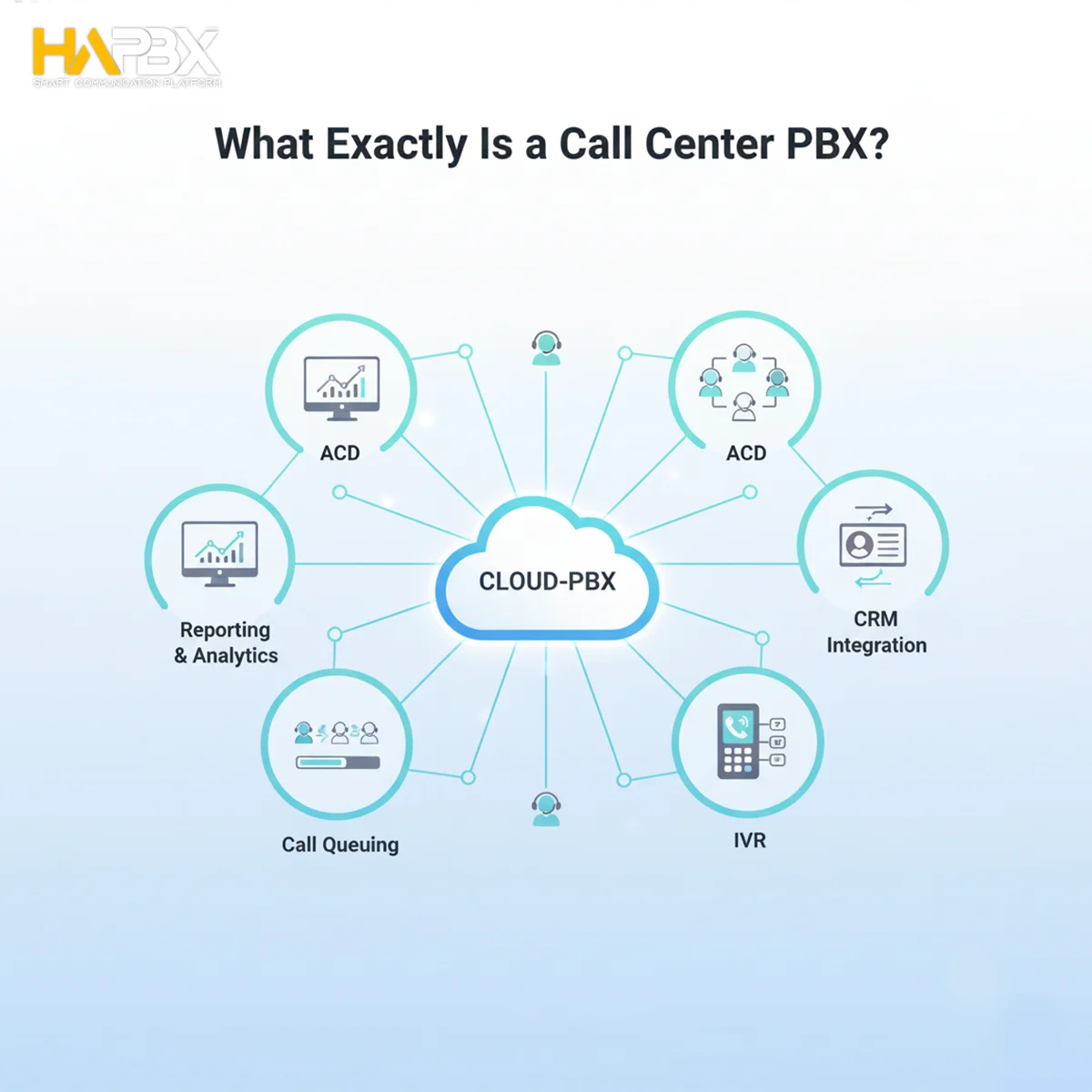
A true Call Center PBX needs more than basic routing. Demand ACD, IVR, and CRM integration to turn every call into a personalized experience.
The core functions that separate a true call center pbx from a standard office system include:
- Automatic Call Distribution (ACD): This is the most critical feature. ACD intelligently routes incoming calls to the most appropriate agent or department based on pre-set rules. This can include skills-based routing (e.g., “send Spanish-language calls to Spanish-speaking agents”), round-robin, or “least-occupied” agent.
- Interactive Voice Response (IVR): The familiar “Press 1 for Sales, Press 2 for Support” menu. IVR allows for customer self-service, freeing up agents from repetitive queries and ensuring callers are pre-sorted before they ever speak to a human.
- Call Queuing: When all agents are busy, you can’t just let the phone ring or go to voicemail. A call center PBX places callers in a virtual queue, often playing music or providing an estimated wait time, until an agent is free.
- Advanced Reporting & Analytics: Call center managers live and die by data. These systems provide real-time dashboards and historical reports on metrics like call volume, average wait time, first-call resolution, agent productivity, and call abandonment rates.
- CRM Integration: The system must “talk” to your Customer Relationship Management (CRM) software. When a call comes in, the agent’s screen should automatically pop up with the customer’s complete history, turning a cold transfer into a personalized, efficient interaction.
The Evolution of Call Center PBX Systems
Not all call center pbx systems are created equal. They have evolved significantly, and the platform you choose will directly impact your costs, flexibility, and reliability.
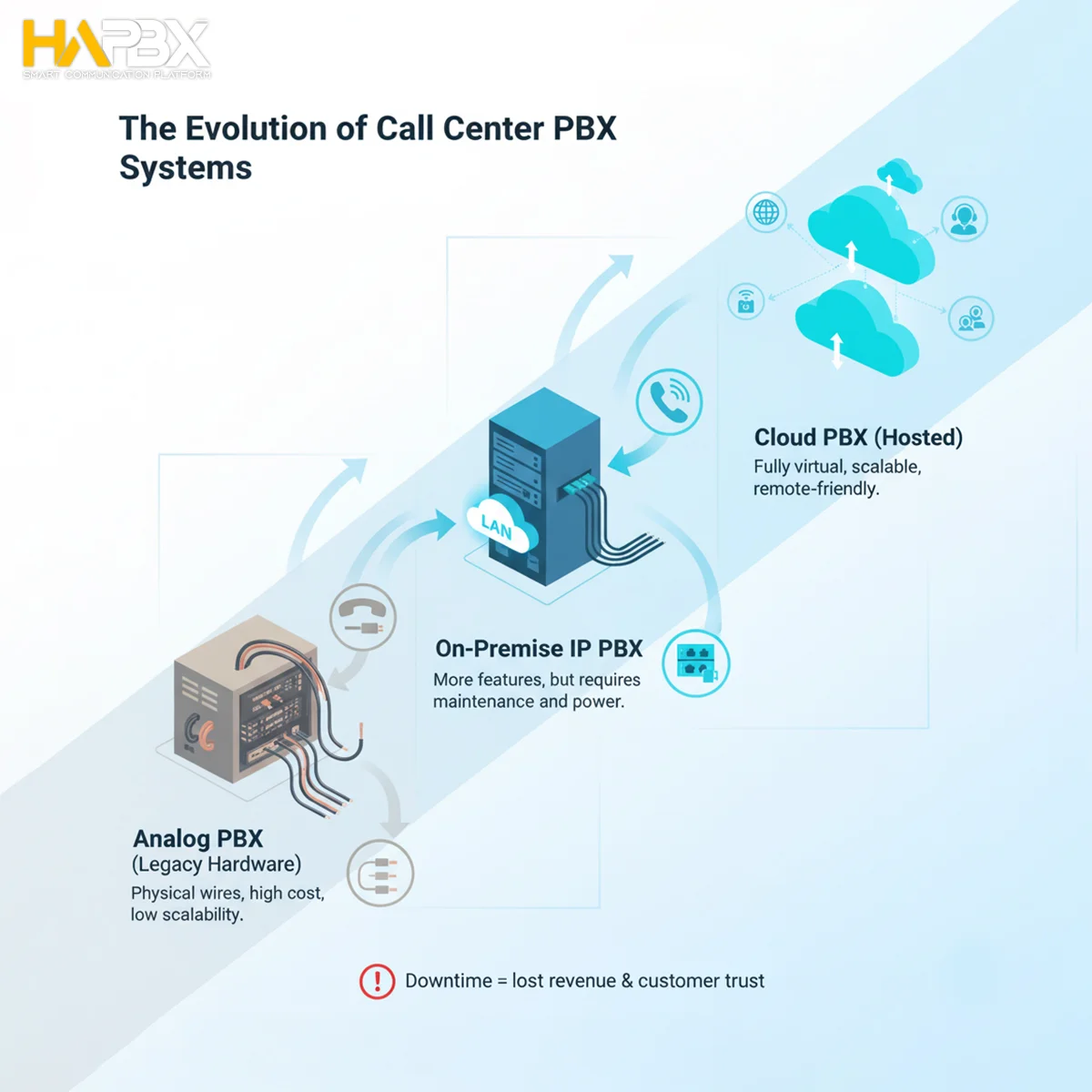
Ditch the hardware headaches! The future of the Call Center PBX is Cloud-Hosted. Say goodbye to CAPEX, hello to flexible OPEX and infinite scalability.
Traditional Analog PBX: This is the legacy hardware. Think of a massive, physical box of wires and circuit boards locked in a server room. It runs on old-fashioned copper phone lines (POTS). While durable, these systems are incredibly expensive to maintain, difficult to scale (requiring new physical hardware), and offer very few, if any, of the modern features listed above.
On-Premise IP PBX: This was the first step into the modern era. An IP PBX still lives on a server in your office, but it uses your company’s Local Area Network (LAN) and the internet (VoIP) to make and receive calls. It offers more features, but it’s still a significant capital expense (CAPEX). You are responsible for all maintenance, security, and upgrades. If the server fails or your office loses power, your call center goes dark.
Cloud PBX (Hosted Call Center PBX): This is the modern standard and the future of the industry. With a hosted call center pbx, there is no box. The entire PBX system is “hosted” in the cloud by a specialized provider. You simply pay a predictable monthly fee (OPEX) per user. This model eliminates all infrastructure worries, provides endless scalability, and allows for perfect integration with remote work—agents can log in from anywhere in the world.
“For a call center, downtime isn’t just an inconvenience; it’s a direct line to lost revenue and damaged customer trust.”
HAPBX: The High-Reliability Call Center PBX Solution
While most cloud PBX solutions offer benefits over on-premise hardware, not all cloud environments are the same. For a high-volume call center, the provider’s architecture is paramount. This is where HAPBX introduces a critical differentiator.
What is HAPBX?
HAPBX stands for High Available Private Branch Exchange. As its name suggests, it is a cloud PBX platform architected from the ground up for one primary goal: maximum reliability. It is defined as an always-available and secure enterprise Cloud PBX platform.
The Core Differentiator: Dedicated Instance Infrastructure
The magic of HAPBX lies in its infrastructure. Many hosted PBX providers use a “multi-tenant” environment, where your business shares the same server resources as hundreds of other companies. If another customer on your shared server has a massive, unexpected spike in call volume, it can slow down your performance.
HAPBX avoids this “noisy neighbor” problem by operating on a Dedicated Instance infrastructure.
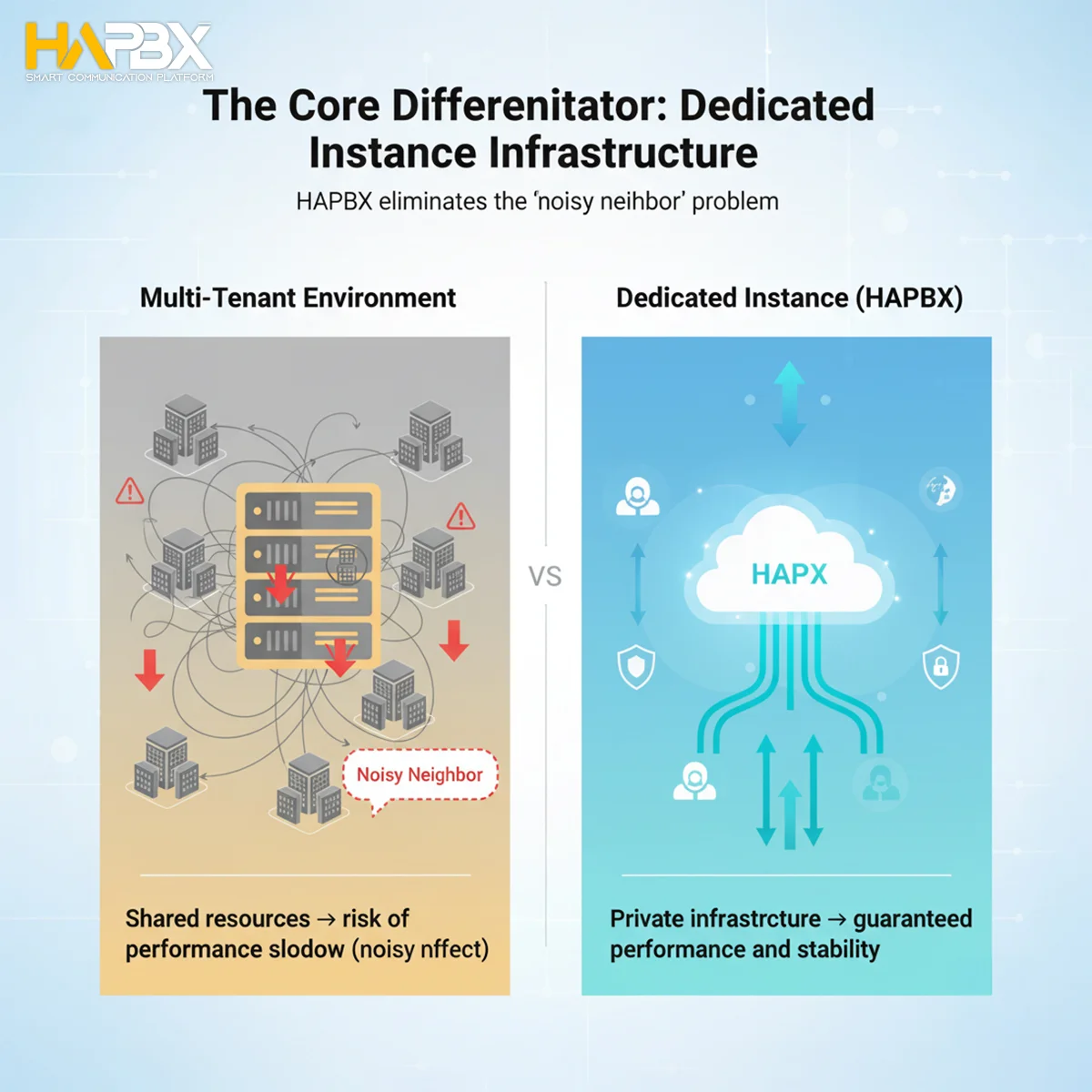
Don’t let the “noisy neighbor” slow you down. HAPBX uses a Dedicated Instance for your Call Center PBX—guaranteeing performance and crystal-clear call quality, always.
Call Center managers live by data. Does your Call Center PBX deliver real-time reports on agent productivity and abandonment rates? It should.
What does this mean for your call center?
Guaranteed Performance: Your PBX runs in its own private, isolated environment. Your call quality and system responsiveness are never affected by other customers.
Unmatched Stability: This architecture provides the high performance and stability required at an enterprise level.
Flexible Scalability: Because the instance is dedicated to you, it can be scaled up or down with precision to meet your specific needs.
This model is the gold standard for call center pbx solutions that cannot compromise on quality.
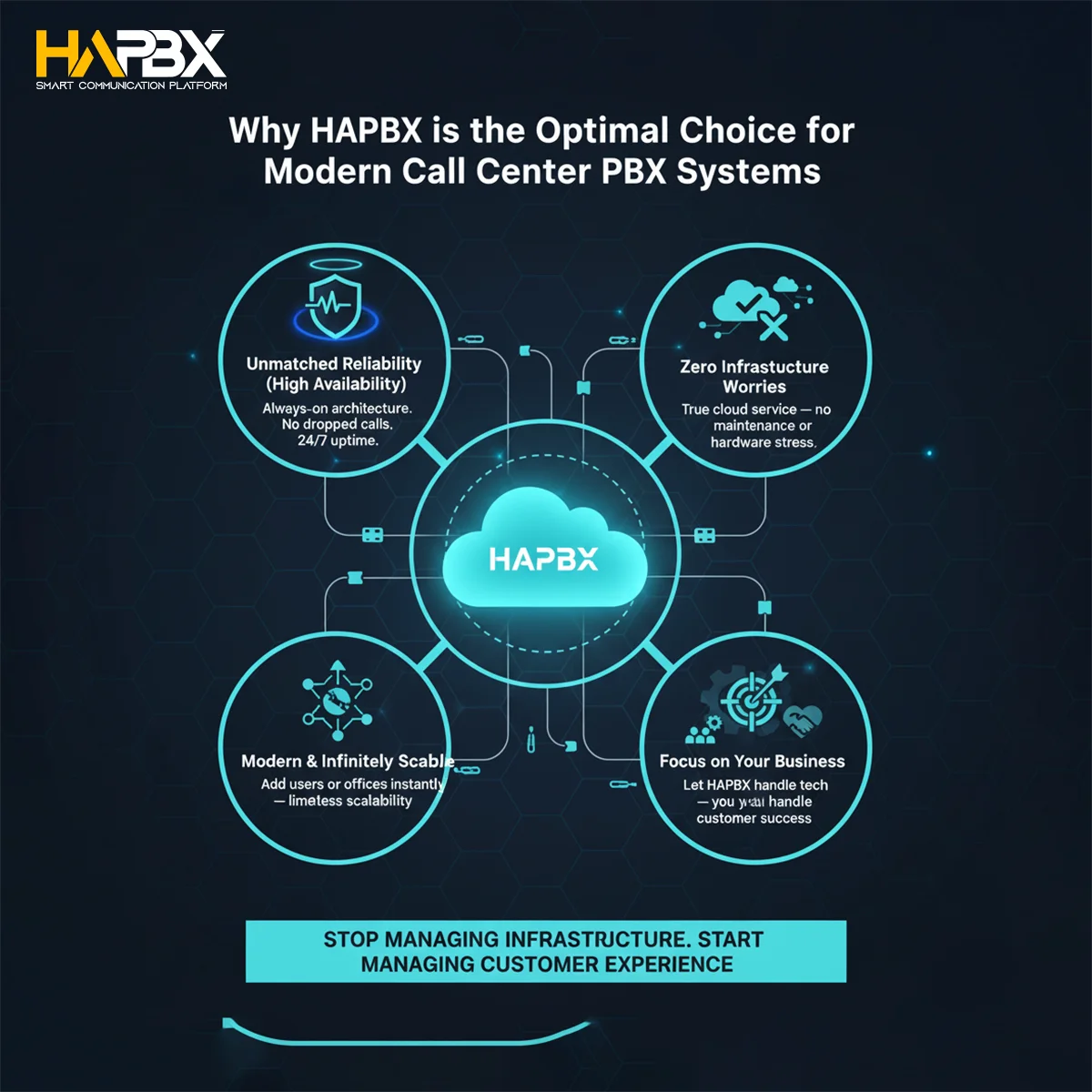
Why HAPBX is the Optimal Choice for Modern Call Center PBX Systems
When your entire business model relies on seamless communication, “good enough” isn’t good enough. HAPBX is engineered to solve the specific pain points that plague call center managers.
Why HAPBX is the Optimal Choice.png
1. Unmatched Reliability (High Available)
The “HA” in HAPBX is its core promise. The entire system is designed to be always available, uninterrupted, helping businesses communicate internally and in/out continuously.
This is achieved through a technical architecture that emphasizes high reliability; almost no downtime. For a call center, this translates to:
- No more dropped calls during peak hours.
- No more apologies to customers who “couldn’t get through.”
- Peace of mind that your revenue stream is protected 24/7/365.
2. A True Cloud Service – Zero Infrastructure Worries
Migrating to HAPBX means you are not just buying software; you are outsourcing your infrastructure headaches. As a true cloud service, customers do not have to worry about infrastructure.
This frees your IT team from the endless cycle of managing, patching, and upgrading physical servers. Instead of reacting to hardware failures, your technical staff can focus on high-value projects that drive the business forward.
3. Modern, Flexible, and Infinitely Scalable
Legacy call center pbx systems are rigid. Adding 20 new agents for the holiday rush could mean weeks of complex, expensive hardware provisioning.
HAPBX is built to be modern & flexible. Because it uses a private IP and domain structure, it is incredibly easy to expand. Need to double your agent count overnight? It’s a simple software configuration.
Need to open a new office on another continent? They can be integrated into the same PBX in minutes. This agility is impossible to achieve with on-premise solutions.
4. The HAPBX Value Proposition: Focus on Your Business
Ultimately, HAPBX operates on a simple, powerful philosophy: internal communication and customer care should not be limited by infrastructure or technical risks.
The value proposition is clear: businesses can focus on development, while the switchboard system is always safe, smooth and ready for any scale. This shift allows you to move your focus from managing your technology to managing your customer experience.
“HAPBX’s value proposition is simple: Stop managing your infrastructure and start managing your customer experience.”
Comparison: HAPBX (Dedicated Cloud) vs. Traditional PBX
The choice becomes clear when you see the solutions side-by-side.
| Feature | HAPBX (Dedicated Cloud PBX) | Traditional On-Premise PBX |
| Reliability | High Available; architected for almost no downtime. | Dependent on physical hardware; vulnerable to power loss, server failure, and maintenance. |
| Infrastructure | Cloud service; provider manages all hardware. No infrastructure worries. | Requires significant investment, maintenance, and physical space for servers. |
| Cost Model | Predictable OPEX (monthly subscription). No large upfront investment. | High CAPEX (upfront purchase). Ongoing, unpredictable maintenance costs. |
| Scalability | Flexible and easy to expand. Add users, lines, or locations in minutes. | Rigid and expensive. Scaling often requires purchasing new, costly hardware. |
| Security | Managed by provider with enterprise-grade security on a secure platform. | The business is 100% responsible for managing security, firewalls, and updates. |
| Remote Work | Natively supported. Agents can log in from any device, anywhere. | Extremely difficult to configure. Often requires complex, insecure VPNs. |
Frequently Asked Questions (Q&A)
Before we conclude, let’s answer some common questions about call center pbx solutions.
Q1: What is the main difference between a standard PBX and a call center PBX?
The main difference is intelligence and volume. A standard PBX is designed for basic call routing (e.g., call extension 101). A call center pbx is designed for high-volume, intelligent routing using features like ACD (Automatic Call Distribution) to send calls to the right agent based on skills, IVR (Interactive Voice Response) for self-service, and advanced call queuing to manage high demand.
Q2: Why is a “hosted call center pbx” better than an on-premise one?
A hosted call center pbx offers three primary advantages:
Lower Total Cost of Ownership (TCO): You eliminate all hardware, maintenance, and upgrade costs, moving from a large capital expense (CAPEX) to a predictable operating expense (OPEX).
Scalability & Flexibility: You can add or remove agents in minutes, not weeks, and your team can work from anywhere.
Reliability: Providers like HAPBX build in geographic redundancy and high-availability measures that are financially and logistically impossible for a single business to replicate on-premise.
Q3: What is “Dedicated Instance” and why does it matter for my call center?
A Dedicated Instance means your cloud PBX service runs in its own private, isolated virtual environment. The alternative, “shared tenancy,” puts your service on the same server as many other companies.
For a call center, a Dedicated Instance is critical because it guarantees performance. Your call quality and system speed will never be degraded just because another company on the platform is having a busy day.
Conclusion: Stop Risking Your Revenue on Outdated Technology

Enable your remote agents instantly. A modern hosted Call Center PBX like HAPBX natively supports remote work from any device, anywhere in the world.
The call center pbx is more than just a phone system; it’s the primary engine of your customer relationships and revenue generation. Running it on outdated, unreliable hardware, or even a low-grade shared cloud service, is a daily gamble. Every dropped call is a lost customer. Every minute of downtime is a direct hit to your bottom line.
A modern call center pbx solution like HAPBX changes the game. By moving to a hosted call center pbx built on a High Available, Dedicated Instance infrastructure, you are not just upgrading your technology—you are adopting a new business philosophy. You are choosing to let your team focus on development and customer care, confident that your communication system is always safe, smooth and ready for any scale.