

For decades, analog PBX systems were the standard for business communication. They relied on physical hardware, copper phone lines, and on-site maintenance. At the time, this approach was sufficient because businesses were centralized, employees worked in offices, and communication needs were relatively stable.\Today, business communication has changed dramatically.
- Over 70% of companies now support remote or hybrid work
- Customers expect instant response and 24/7 availability
- Even 30 minutes of downtime can lead to lost sales, missed support calls, and damaged brand trust
These changes have driven businesses to move from legacy systems to cloud-based PBX platforms. Among them, HAPBX (High Available Private Branch Exchange) stands out as a next-generation cloud PBX built for high availability, scalability, and enterprise-grade reliability.
What Is an Analog PBX Phone System?
An analog PBX phone system is a traditional private branch exchange installed on company premises. It connects internal extensions and external calls through PSTN copper lines and physical switching hardware.
Key Characteristics
| Aspect | Analog PBX |
| Deployment | On-premise hardware |
| Network | PSTN / copper lines |
| Capacity | Fixed by hardware |
| Maintenance | On-site IT required |
| Flexibility | Low |
Analog PBX systems were designed for static, office-based environments—conditions that no longer reflect modern business operations.
Typical Challenges of Analog PBX Systems
| Challenge | Business Impact |
| High upfront hardware cost | $3,000–$10,000+ initial investment |
| Difficult expansion | New hardware, downtime, extra cost |
| Single point of failure | Entire system down if PBX fails |
| Limited integrations | No CRM, analytics, or modern tools |
| Downtime risk | Lost calls = lost revenue |
Analog PBX increasingly becomes a business liability rather than an asset.
What Is a Cloud PBX System?
A cloud PBX system hosts all call control and routing in the cloud instead of on local hardware. Calls are delivered over the internet using VoIP technology.

What Makes HAPBX Different?
HAPBX is designed as a true High Availability Cloud PBX, not a basic hosted PBX or self-hosted virtual machine.
Infrastructure Comparison: Analog PBX vs HAPBX
| Infrastructure Area | Analog PBX | HAPBX Cloud PBX |
| Hosting | On-site hardware | Cloud-based |
| Architecture | Single server | GEO-distributed clusters |
| Failover | Manual or none | Automatic |
| Power dependency | Local office only | Independent of office |
| Single point of failure | Yes | No |
Business Benefit:
HAPBX ensures continuous communication even during outages, protecting sales and customer support operations.
Reliability & High Availability
| Factor | Analog PBX | HAPBX |
| Uptime | ~99.0–99.5% | 99.99%+ |
| Failure recovery | Manual | Automatic |
| Downtime per year | Up to 44 hours | Near zero |
| Impact on business | Missed calls, lost trust | Continuous availability |
Business Benefit:
Higher uptime directly translates to higher revenue protection and customer satisfaction.
Scalability: Fixed vs Elastic
| Scalability Aspect | Analog PBX | HAPBX |
| Extensions | Limited by hardware | Unlimited |
| Concurrent calls | Hardware-bound | Unlimited |
| Expansion time | Days or weeks | Instant |
| Expansion cost | High | Minimal |
Business Benefit:
Businesses scale teams instantly without infrastructure investment.
Deployment Speed
| Deployment Stage | Analog PBX | HAPBX |
| Hardware procurement | Required | Not required |
| Installation | On-site | None |
| Configuration time | Weeks | Minutes |
| Go-live speed | Slow | Immediate |
Business Benefit:
Faster deployment = faster time-to-revenue.
Cost Model: CAPEX vs OPEX
| Cost Category | Analog PBX | HAPBX |
| Initial cost | High CAPEX | Low entry cost |
| Maintenance | Ongoing hardware cost | Included |
| Upgrade cost | Expensive | Included |
| Budget predictability | Low | High |
Business Benefit:
HAPBX improves cash flow and financial predictability.
Feature Comparison
| Feature | Analog PBX | HAPBX |
| Voice calling | ✔ | ✔ |
| Call recording | Add-on | Included |
| Switchboard | Limited | Advanced |
| IVR | Basic | Advanced |
| Analytics & billing | No | Yes |
| Call center features | No | Yes (plans) |
Business Benefit:
HAPBX turns communication into a data-driven business tool, not just a phone system.
Remote Work & Mobility
| Aspect | Analog PBX | HAPBX |
| Remote access | Difficult | Native |
| Softphones | Limited | Full support |
| Browser calling | No | WebRTC |
| Global access | No | Yes |
Business Benefit:
Supports remote teams without complexity or quality loss.
Call Quality & Latency
| Metric | Analog PBX | HAPBX |
| Latency | Distance-dependent | ~50ms average |
| Voice quality | Variable | HD quality |
| Routing | Static | Optimized global routing |
Business Benefit:
Clearer calls lead to better sales conversations and customer experience.
Security and Compliance
| Security Area | Analog PBX Risks | HAPBX Security Model |
| Physical access | Hardware can be accessed or damaged | No on-site hardware |
| Software updates | Outdated firmware | Automatic updates |
| Data protection | No encryption | Encrypted signaling |
| Monitoring | Limited or none | Continuous monitoring |
| Isolation | Shared physical environment | Dedicated cloud instance |
Business Benefit:
Lower risk of security breaches and compliance violations.
Maintenance & Management
| Maintenance Aspect | Analog PBX | HAPBX |
| Updates | Manual | Automatic |
| IT workload | High | Minimal |
| Downtime during upgrades | Yes | No |
| Support requirement | On-site IT | Provider-managed |
Business Benefit:
IT teams focus on growth instead of infrastructure maintenance.
Why HAPBX Is the Best PBX for Small Business
| Business Need | How HAPBX Delivers |
| Reliability | High Availability architecture |
| Cost efficiency | No hardware, low entry cost |
| Fast growth | Unlimited scalability |
| Professional image | Enterprise-grade features |
| Future readiness | Cloud-native & API-ready |
HAPBX allows small and medium businesses to operate like large enterprises—without enterprise complexity or cost.
Future-Proofing Business Communication
| Future Factor | Analog PBX | HAPBX |
| PSTN phase-out | At risk | Not affected |
| Software evolution | Limited | Continuous |
| Integration readiness | Poor | Strong |
Final Verdict: Cloud PBX vs Analog PBX
| Area | Analog PBX | HAPBX Cloud PBX |
| Availability | Low | High Availability (HA) |
| Scalability | Limited | Unlimited |
| Deployment | Slow | Minutes |
| Cost Model | CAPEX-heavy | Flexible OPEX |
| Features | Basic | Enterprise-grade |
| Remote Work | Weak | Native |
| Future-proof | No | Yes |
HAPBX: A Cloud PBX Platform Built for Real Business Needs
In today’s business environment, communication downtime is no longer tolerated. Missed calls mean missed revenue, lost customers, and damaged credibility. Legacy systems struggle to keep up with this reality, while many “cloud PBX” solutions on the market still rely on self-hosted or single-instance architectures that fail under real operational pressure.
HAPBX represents the future of business communication—a truly enterprise-ready, cloud-native PBX platform designed from the ground up to meet modern business demands.
Unlike traditional analog PBX systems or lightweight hosted PBX solutions, HAPBX is built to solve three core operational requirements that every modern business depends on:
- Rapid deployment
- High availability and operational stability
- Long-term cost optimization
These three pillars define why HAPBX is not just another PBX product, but a strategic communication platform for growing businesses.
1. Rapid Deployment: From Signup to Live System in Minutes
Traditional PBX deployment is slow and complex. Businesses must purchase hardware, install equipment, configure phone lines, and often rely on external technicians. This process can take weeks and delay business operations, branch openings, or customer service launches.
HAPBX eliminates this friction entirely.
How HAPBX Enables Rapid Deployment
- No on-premise hardware required
- No PBX server installation or cabling
- Cloud-based provisioning and centralized management
- Pre-configured enterprise features ready out of the box
With HAPBX, a business can have a fully operational PBX system within minutes, not days or weeks.

Direct Business Benefits
- Faster time-to-market for new offices or teams
- Immediate readiness for sales and support operations
- No dependency on local IT infrastructure
- Ideal for startups, remote teams, and fast-scaling companies
Result: Communication is no longer a bottleneck—it becomes an enabler of growth.
2. Stable Operation: High Availability by Design, Not by Add-On
Most communication failures are not caused by human error, but by infrastructure limitations—single servers, local power outages, or network failures. Traditional analog PBX systems and many common PBX platforms operate with a single point of failure, making downtime unavoidable.
HAPBX is fundamentally different.
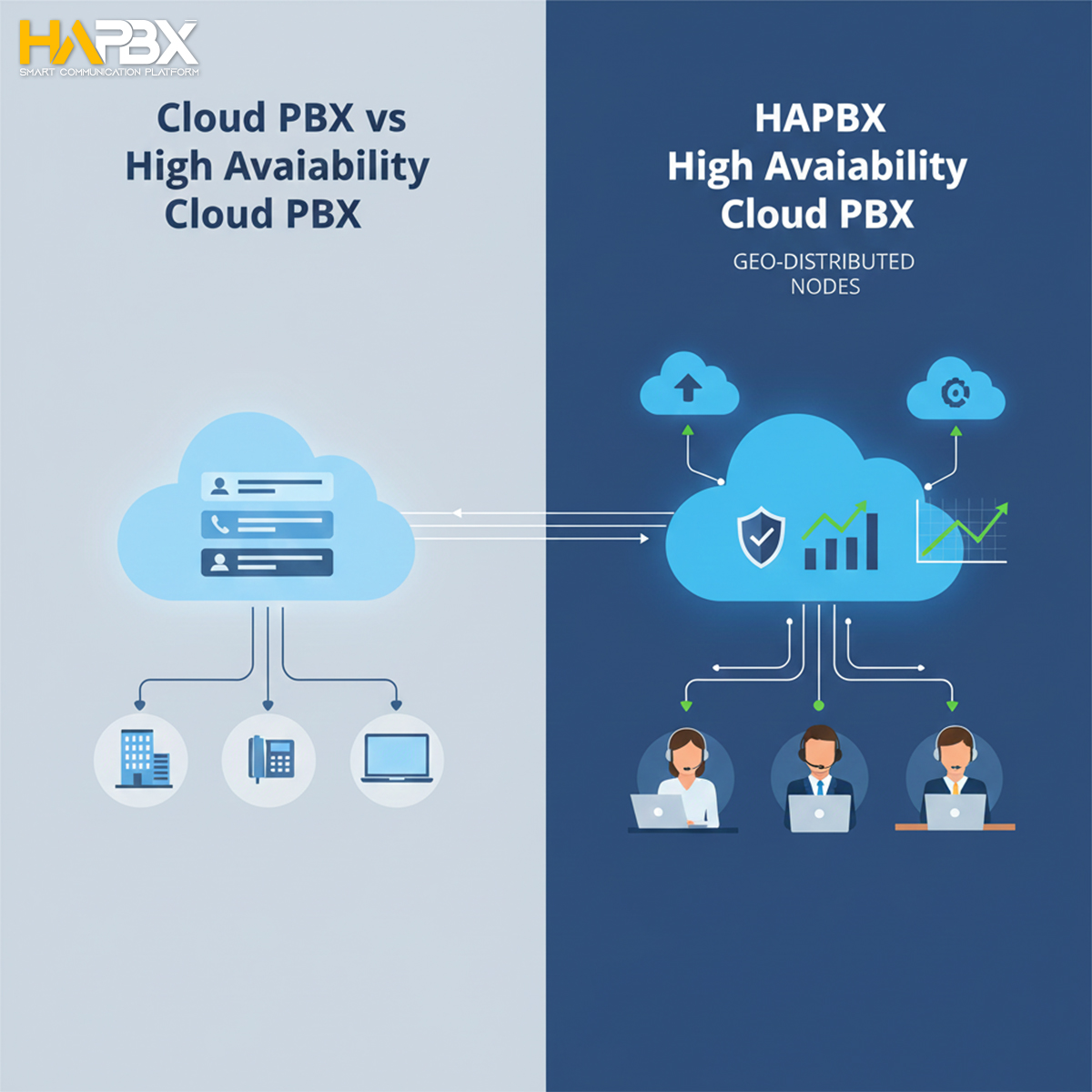
High Availability Architecture of HAPBX
- GEO-distributed global cluster infrastructure
- Dedicated cloud instances per tenant (not shared self-hosted VMs)
- Automatic failover between nodes
- No service interruption when a node fails
This architecture ensures that calls continue to flow even when part of the system is unavailable.
Why This Matters to Businesses
- Near-zero downtime (99.99%+ availability)
- No lost sales calls or support tickets
- Consistent customer experience, even during incidents
- Reduced operational risk and reputational damage
Result: Communication becomes a reliable foundation for business operations, not a risk factor.
3. Long-Term Cost Optimization: Smarter Spending, Higher ROI
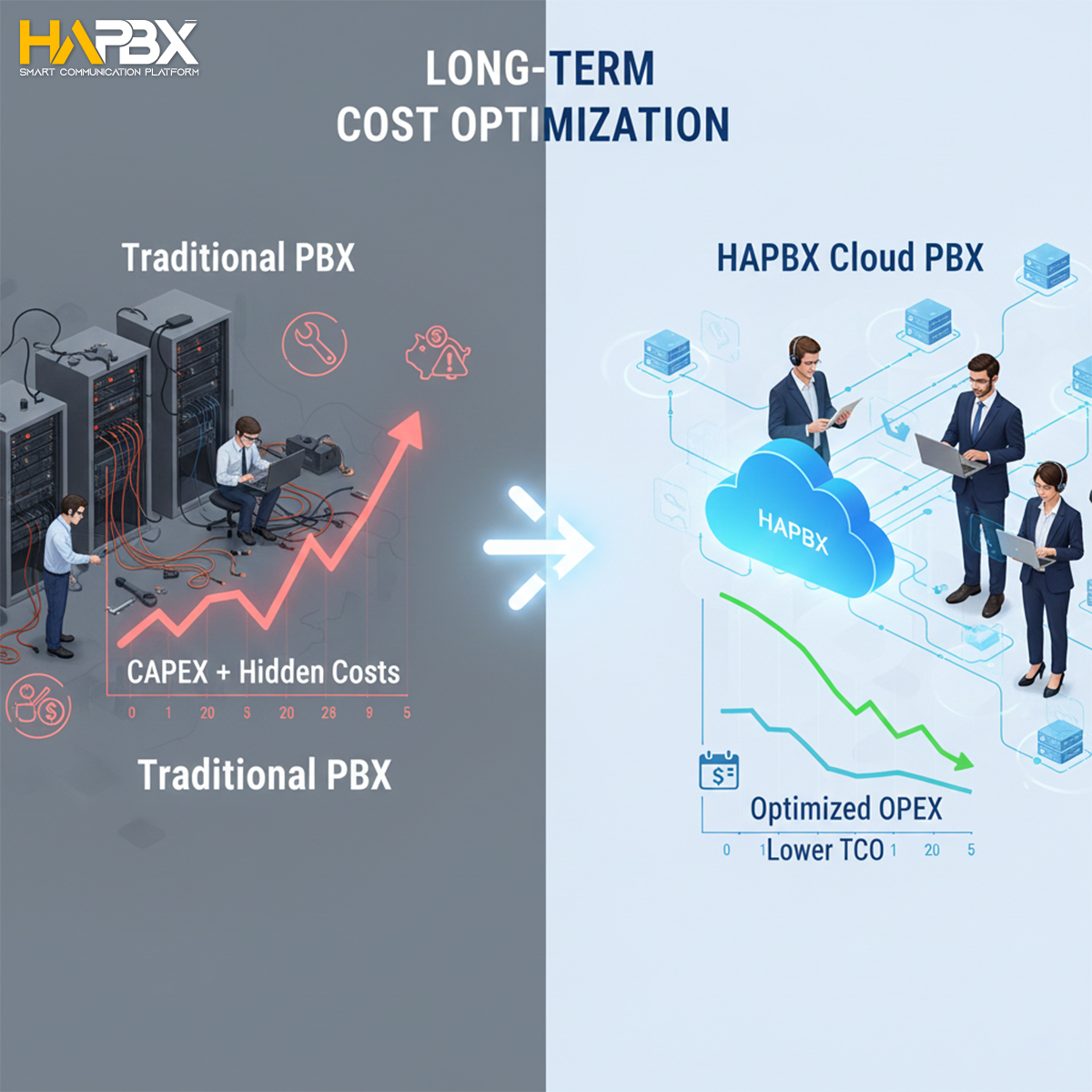
Traditional PBX systems are CAPEX-heavy. Businesses invest heavily upfront in hardware, then continue paying for maintenance, upgrades, and replacements. Even many popular PBX solutions require hidden costs for scaling, redundancy, or advanced features.
HAPBX is built around a dedicated cloud model that optimizes total cost of ownership (TCO).

How HAPBX Reduces Long-Term Costs
- No hardware purchase or replacement costs
- Subscription-based OPEX model
- Built-in scalability without extra infrastructure
- Enterprise features included, not charged as add-ons
- Reduced IT workload and maintenance overhead
Compared to traditional PBX systems and common PBX platforms, businesses can reduce communication-related costs by 30–60% over a 3–5 year period.
Direct Financial Benefits
- Lower upfront investment
- Predictable monthly expenses
- Easier budgeting and financial planning
- Higher ROI as the business scales
Result: Communication costs decrease over time, even as the business grows.
More Than an Upgrade: A Strategic Advantage
For companies looking for the best PBX for small business, or any organization ready to move beyond legacy limitations, HAPBX offers more than improved technology.
It delivers:
- Speed – Deploy in minutes, not months
- Stability – High availability designed into the platform
- Efficiency – Lower total cost without sacrificing quality
HAPBX transforms business communication from a technical necessity into a competitive advantage.
It is not just an upgrade—it is a strategic foundation for modern business growth.