

“Technology is best when it brings people together.” – Matt Mullenweg, Founder of WordPress.
When I first started my company, communication was chaos.We had a tangle of desk phones, cables, and endless dialing patterns. Back then, our analog PBX phone system was the heart of our office — simple, reliable, and entirely offline.
It worked — until it didn’t.
Scaling became painful, remote work was impossible, and maintenance felt like a full-time job. That’s when I discovered HaPBX, a platform that reimagines everything I once loved about analog systems — but rebuilt for the cloud era.
Let me share what I’ve learned from that journey.
What Is An Analog PBX Phone System?
An analog PBX (Private Branch Exchange) is a local phone network that connects internal extensions to outside lines through analog circuits.
It’s like your office’s own mini telephone exchange — perfect for handling internal calls, routing, and voicemail without relying on the internet.
In its time, it was revolutionary. But as businesses evolve, so must the systems that power them.
That’s where HaPBX enters — offering everything analog PBX systems provided, but with unlimited scalability, cloud flexibility, and no hardware headaches.
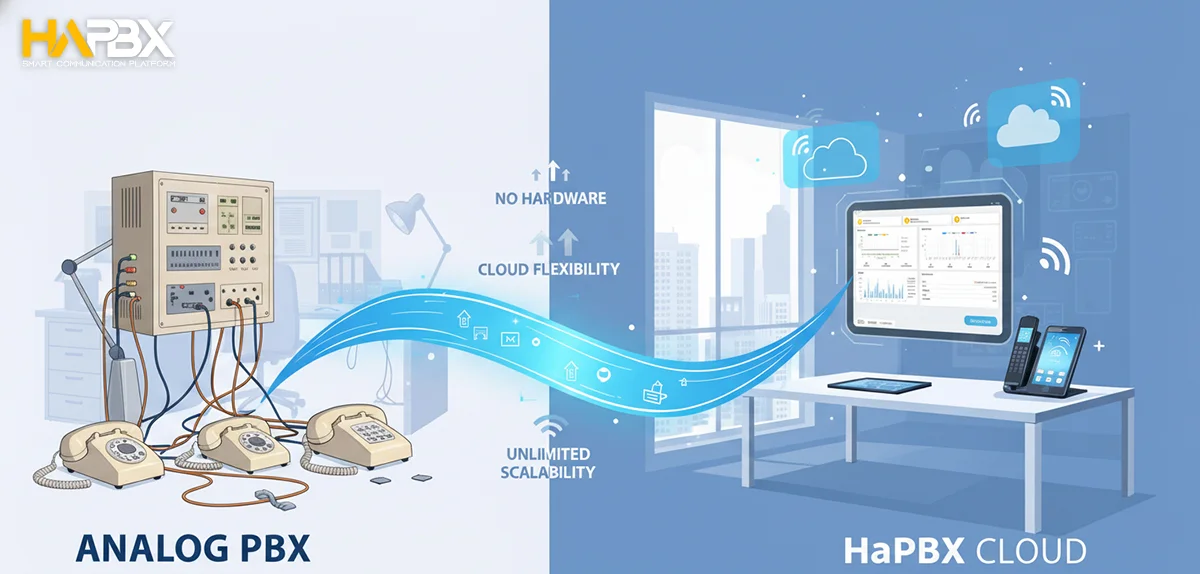
How Do Analog PBX Phone Systems Work?
An analog PBX system is essentially a network of telephones connected through a central control unit. Every phone in your office is wired — quite literally — into this system using copper lines.
When someone picks up a handset and dials an extension, that signal travels through a maze of analog circuits inside the PBX unit. The system recognizes which internal or external number is being dialed, and then it routes the call manually through electrical signals.
It’s an elegant piece of engineering — and for decades, it was the standard for corporate communication. The voice quality is crisp and consistent, unaffected by bandwidth fluctuations or internet outages.
However, there’s a hidden cost behind that reliability:
🔌 Every new employee means new wiring, new ports, and more hardware configuration.
🧰 Troubleshooting isn’t a quick software fix — it often requires a technician to visit the site, trace cables, and physically test each line.
🏢 Remote or hybrid work becomes nearly impossible unless you install complex call forwarding setups or expensive SIP gateways.
That’s why many companies today are moving away from physical PBX systems toward smarter, cloud-based alternatives.
💡 HaPBX keeps the same familiar PBX logic — call routing, extensions, and internal transfers — but reimagines it entirely in the cloud.
No copper lines, no hardware limitations. Just open a laptop or smartphone, log into your HaPBX dashboard, and your entire phone network comes with you — whether you’re in the office, working remotely, or managing teams across continents.
On-Premise PBX
An on-premise PBX means all your telephony hardware — the PBX server, switches, cabling, and phone endpoints — live physically within your office.
For traditional businesses, this setup offers a sense of control and security. You manage your own phone infrastructure, route calls locally, and operate completely offline. For industries with strict data compliance needs, this can be reassuring.
Advantages include:
🛠️ Full internal control: You decide how the PBX operates, who has access, and when changes are made.
📞 Local call routing: Calls between internal extensions never leave your building, ensuring stable and private communication.
🔒 Internet independence: Even if your internet goes down, local phones continue to function.
But these strengths come with steep trade-offs:
💸 High setup and maintenance costs: You must invest in physical servers, cabling, UPS systems, and periodic upgrades.
🧑🔧 IT dependency: Every adjustment — from adding an extension to fixing a voicemail issue — requires technical staff or outside vendors.
🔄 No flexibility: As soon as your team starts working remotely or from multiple branches, the on-premise PBX becomes a bottleneck.
📉 Limited integration: Traditional PBX cannot connect with modern tools like CRM, helpdesk, or AI analytics without expensive middleware.
That’s where HaPBX offers a better way forward.
Built on a cloud-native architecture, HaPBX removes all the physical barriers of on-premise systems. Your data, call routing, and configurations live securely in the cloud — backed by 99.99% uptime, automated nightly backups, and real-time monitoring.
No racks, no reboots, no technician visits — yet the performance is as solid as your old hardware PBX, and the flexibility is infinitely greater.

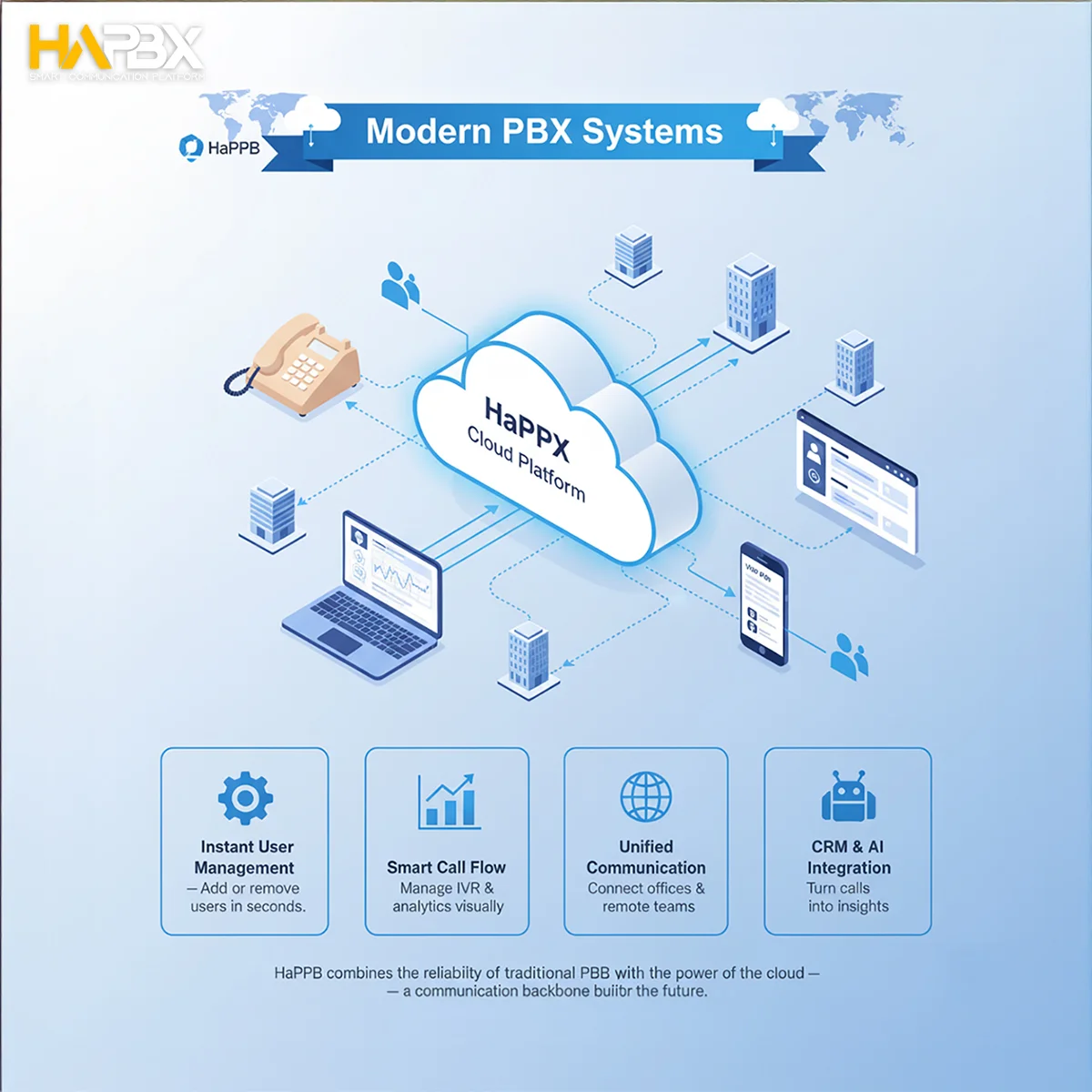
Modern PBX Systems
Today’s business environment demands more than just “making calls.”
Teams work from multiple locations, customer interactions span continents, and communication tools need to integrate seamlessly with CRM, chat, and video platforms.
That’s why modern PBX systems — like HaPBX — are redefining what business telephony means.
A modern PBX combines the reliability of analog systems with the scalability of the cloud. It supports analog, SIP, and VoIP connections in a single platform, so you can reuse your existing desk phones while upgrading your system’s intelligence and flexibility.
With HaPBX, you can:
⚙️ Add or remove users instantly through a web-based dashboard — no technician, no downtime.
📊 Manage call flows, IVRs, and ring groups in minutes, with an intuitive drag-and-drop interface.
🔍 Access real-time analytics on call volume, missed calls, or agent performance, helping you optimize customer experience.
🌐 Connect multiple offices or remote teams under one unified system, all managed centrally in the cloud.
HaPBX also integrates directly with CRM platforms, AI transcription tools, and ticketing systems, so every call turns into actionable business insight.
In other words, you keep everything that made PBX systems great — the structure, the internal logic, the professionalism — but shed all the old burdens of hardware, cost, and maintenance.
HaPBX gives your business a future-proof communication backbone: as easy to manage as an app, as reliable as the PBX box that started it all.
Main Purpose of a PBX System
The goal of any PBX, analog or digital, is simple:
- Route internal and external calls efficiently.
- Reduce telecommunication costs.
- Improve response time and call management.
What makes HaPBX stand out is how it expands this core purpose with intelligent routing, CRM integration, and unified communication tools — turning your PBX from a phone system into a business growth platform.
Types of PBX Phone Systems
| Type | Technology | Connectivity | Ideal For |
| Analog PBX | Copper-based, analog signaling | PSTN lines only | Small offices with local operations |
| Digital PBX | Digital circuit switching (TDM) | PRI/T1 lines | Mid-sized businesses |
| IP PBX | Internet Protocol (VoIP) based | SIP trunk, VoIP gateway | Hybrid or tech-enabled teams |
| Cloud PBX (HaPBX) | Cloud-hosted, fully virtualized | Internet / SIP-based | Remote, scalable, and modern teams |
HaPBX brings the best of all worlds — the stability of analog, the clarity of digital, and the flexibility of the cloud.
Identifying and Bypassing Your PBX
If you’re not sure whether you’re using a PBX system or just analog lines, here’s how to tell:
- You have your own extension numbers.
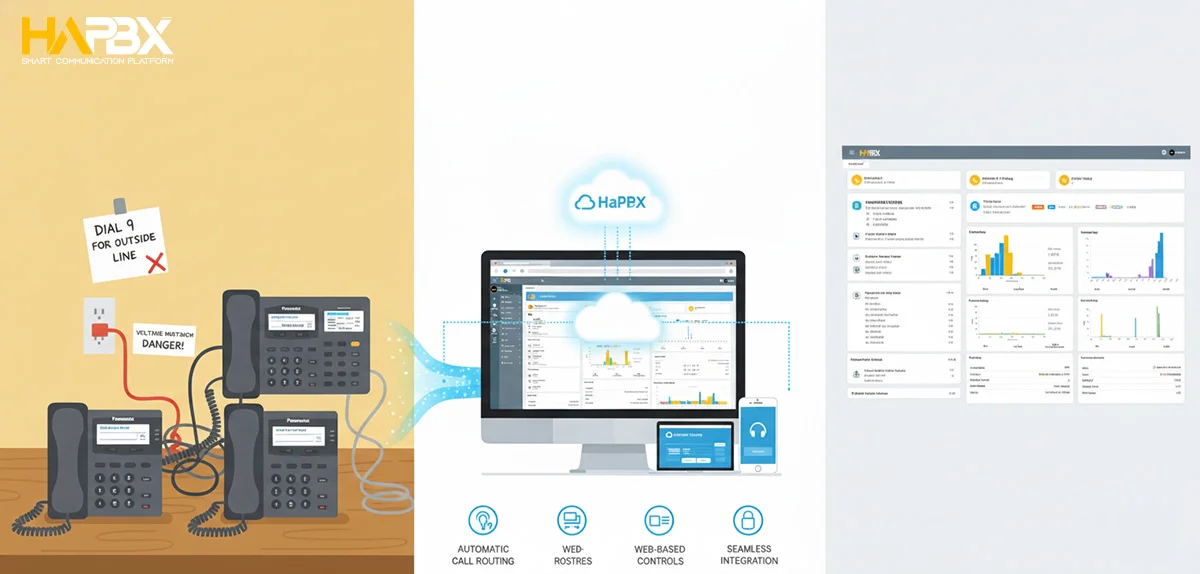
- You dial 9 to reach an outside line.
- There’s an Auto Attendant on your main line.
- Your phones show PBX-specific features like “Transfer” or “Do Not Disturb.”
- Your devices are brands like Avaya, Nortel, or Panasonic.
⚠️ Caution: PBX phones should never be plugged directly into an analog phone terminal — the voltage difference can damage both.
HaPBX simplifies this by handling all routing and hardware integration in the cloud — no physical wiring, no voltage mismatches, no guesswork.
Common Scenarios with PBX Systems
Even the most reliable analog PBX systems face challenges:
- No dial tone: Often wiring or power-related.
- Internal calls only: Trunk configuration issue.
- Static or poor sound: Old cables or grounding faults.
- Dropped transfers: Outdated PBX firmware.
HaPBX resolves these problems by replacing physical constraints with cloud-based routing and monitoring. You can troubleshoot in seconds — not hours — with our intuitive admin dashboard and 24/7 technical support.
Functions of PBX Systems
- Core PBX functions include:
- Auto Attendant and IVR menus.
- Call Forwarding, Transfer, and Parking.
- Ring Groups and Call Queues.
- Call Recording and Monitoring.
HaPBX enhances these with AI call analytics, CRM syncing, and multi-location integration, helping teams deliver professional-grade communication experiences without enterprise-level complexity.
Q&A: Frequently Asked Questions About PBX and HaPBX
1. What’s the main difference between an analog PBX and HaPBX?
An analog PBX relies on physical copper wiring and local hardware to manage calls, while HaPBX operates entirely in the cloud. With HaPBX, there’s no need for physical servers or maintenance — everything from call routing to user management happens online.
2. Can I keep my existing desk phones when switching to HaPBX?
Yes. HaPBX supports hybrid connectivity — including analog, SIP, and VoIP — so you can reuse your current desk phones while adding modern cloud functionality like analytics, IVR, and CRM integration.
3. How secure is a cloud PBX system like HaPBX?
HaPBX is built on a cloud-native, encrypted infrastructure with 99.99% uptime, automated nightly backups, and real-time monitoring. This ensures your communication remains private, reliable, and compliant with enterprise-grade security standards.
4. Will HaPBX work if my team is remote or spread across multiple offices?
Absolutely. HaPBX was designed for distributed teams. Employees can connect via desktop or mobile apps from anywhere, while administrators manage all users and call flows from a single web dashboard.
5. Is HaPBX suitable for small businesses, or only for large enterprises?
HaPBX scales effortlessly — from a small startup to a multi-branch enterprise. Small teams benefit from low setup costs and simple management, while large organizations enjoy robust integration, analytics, and centralized control.
Conclusion
The analog PBX telephone system was the backbone of business communication for decades. It gave small companies like mine a way to sound big, stay organized, and manage calls efficiently.
But business has changed. Teams are now global, flexible, and data-driven.
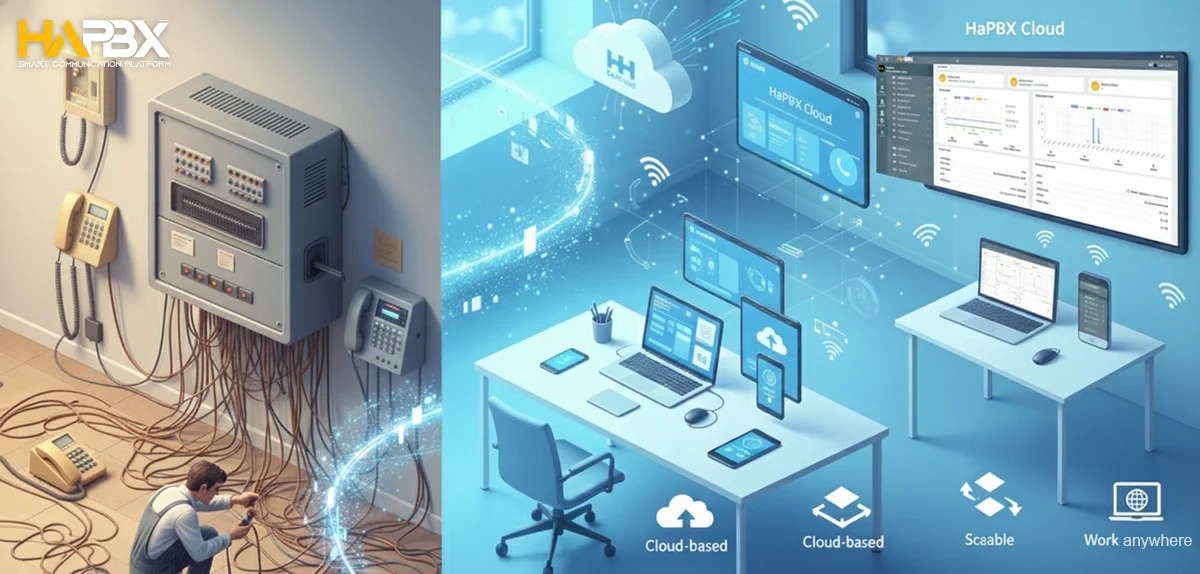
That’s why I made the move to HaPBX — the system that keeps the reliability of analog PBX, but adds the intelligence, mobility, and scalability of the cloud.
“The businesses that thrive are the ones that embrace technology not just to connect devices — but to empower people.”
With HaPBX, communication isn’t just a tool. It’s a strategy.