

As businesses move away from legacy phone systems, Hosted PBX like HaPBX has emerged as a flexible and scalable foundation for modern business communication. By delivering enterprise-grade calling features through the cloud, Hosted PBX enables organizations to simplify operations, support remote teams, and adapt quickly to change.
In this guide, we break down how Hosted PBX system works, when it makes sense for your business, and how platforms like HaPBX help companies transition to reliable, cloud-based phone systems – without the complexity of traditional infrastructure.
What Is Hosted PBX?
A Hosted PBX (Private Branch Exchange) is a cloud-based business phone system that is hosted, managed, and maintained by a VoIP service provider rather than installed on a company’s on-premises hardware. Instead of purchasing and maintaining physical PBX equipment, businesses access their phone system through the internet, allowing all call handling, routing, voicemail, and system management to take place in the cloud.
Because it operates entirely online, Hosted PBX is often referred to as Cloud PBX, Virtual PBX, or IP-based PBX. Advanced providers like HaPBX take this further by offering dedicated cloud instances, ensuring higher security than standard shared platforms. While it replicates the core functions of traditional PBX systems – such as extensions, call forwarding, conferencing, voicemail, intercom, and toll-free numbers – it extends them with modern capabilities like mobile and desktop apps, web dashboards, business SMS, video calls, analytics, and unified communications tools.
In a Hosted PBX environment, the provider houses the infrastructure in secure data centers and takes responsibility for system maintenance, updates, security, and scalability. This significantly reduces hardware expenses, ongoing IT labor, and the operational complexity associated with legacy PBX systems, which are often limited in functionality and difficult to maintain due to outdated documentation and rigid architectures.
One of the key advantages of the Hosted PBX phone system is location independence. Because the system is not tied to a physical office or local network, employees can make and receive business calls from anywhere with an internet connection through IP-PBX server. This makes Hosted PBX especially suitable for remote teams, hybrid workplaces, multi-location businesses, and growing organizations that require flexibility.
How Does a Hosted PBX Work?
A Hosted PBX moves your entire business phone system to the cloud, where it is hosted and managed by a VoIP service provider. Instead of on-premises hardware and landlines, all calls are handled digitally over the internet using VoIP technology.
How a Hosted PBX operates:
- Secure Cloud Connection: Your business connects to the provider’s cloud infrastructure, ensuring stable and always-on call performance across desk phones, softphones, and mobile apps.
- VoIP Call Processing: When a call is made, voice is converted into digital packets and transmitted securely over the internet.
- Cloud-Based Call Routing: The Hosted PBX analyzes call rules and routes internal calls between extensions or external calls to VoIP networks or the PSTN.
- Instant Call Delivery: Calls are delivered to VoIP or traditional phones with minimal latency and no noticeable delay.
- Intelligent Inbound Handling: Incoming calls follow IVR menus, call queues, ring groups, or forwarding rules to reach the right person or team.
- Web-Based Management: Administrators manage settings via an intuitive online dashboard. With systems like HaPBX, you can adjust routing, IVR, recording, and analytics instantly without needing technical expertise.
- Provider-Managed Maintenance & Scaling: Updates, security, and scalability are handled by the provider, allowing the system to grow without hardware changes.
In Simple Terms, Hosted PBX works like traditional telephony – calls are placed, routed, and delivered – but it does so over the internet instead of copper lines, making it more flexible, scalable, and cost-efficient for modern businesses.

Hosted PBX vs Other phone Systems: Understanding the differences
Hosted PBX vs On-Premises PBX
Convenience: Cloud Simplicity vs On-Site Complexity
- An on-premises PBX requires businesses to install dedicated hardware within their office environment. This setup process is often time-consuming and technically complex, involving physical space planning, cabling, configuration, and ongoing oversight by skilled technicians. Reliable performance depends heavily on in-house infrastructure and maintenance.
- Hosted PBX, by contrast, removes this complexity entirely. Because the system is hosted in the provider’s data centers, businesses can activate their phone system almost immediately after subscribing. Employees can start making and receiving calls from desktops, laptops, or mobile devices – without waiting for hardware installation. System updates, infrastructure scaling, and performance optimization are all handled by the provider, allowing the phone system to grow effortlessly alongside business demand.
Functionality: Incremental Upgrades vs Unified Communications
- While on-premises PBX systems can support advanced calling features beyond basic telephony, expanding functionality often comes at a high cost. Adding new capabilities may require hardware upgrades, software licenses, or complex integrations that are difficult to implement and maintain.
- Hosted PBX systems are designed for flexibility and integration. New features – such as call analytics, CRM integrations, or collaboration tools – can often be enabled instantly through a web-based interface. Many cloud services are built to work together by default, making it easier to unify voice, messaging, and collaboration into a single platform that evolves continuously with technology trends.
Cost: High Upfront Investment vs Pay-As-You-Grow Efficiency
- Deploying an on-premises PBX involves significant upfront expenses, including hardware purchases, installation, and training. Over time, maintenance, upgrades, and staffing costs can further increase the total cost of ownership – making it a challenging investment, especially for small or growing businesses.
- Hosted PBX offers a more cost-efficient alternative. With no on-site hardware to install, minimal training requirements, and automatic updates included, businesses pay only for the features and capacity they use. This subscription-based model lowers financial risk and makes enterprise-grade phone systems accessible even to small businesses, with the flexibility to scale investment as results justify expansion.
Hosted PBX vs Traditional Voice Systems
Cloud-based phone systems such as Hosted PBX hold a clear advantage over traditional voice systems in today’s business communications landscape, particularly in terms of security, scalability, and operational efficiency.
Traditional Voice Systems
- Higher Risk Exposure: Delayed hardware and software updates increase the risk of system failures, security vulnerabilities, malware, and cyberattacks.
- Limited Capabilities: Hardware-dependent systems offer fixed features with little room for customization based on evolving business needs.
- Complex Expansion Processes: Adding users, locations, or features often requires manual configuration, on-site installation, and additional hardware investment.
- Capacity Constraints: System capacity is restricted by physical servers and available ports, forcing costly upgrades to support growth.
Hosted PBX (Cloud-Based Voice)
- Enhanced Security: Built-in encryption for signaling and media, firewall traversal, and compliance-ready architectures help protect business communications.
- High Customizability: Centralized cloud management enables administrators to tailor features for different teams and deploy updates instantly across the organization.
- Simplified Management: Software updates, feature enhancements, and system maintenance are handled automatically by the provider.
- Virtually Unlimited Scalability: Businesses can add extensions, voicemail boxes, and conferencing capabilities as needed – without sacrificing core telephony features like call hold, voicemail, and call waiting.
Hosted PBX vs Non-Hosted PBX
The main difference between Hosted PBX and Non-Hosted PBX lies in system deployment and ongoing maintenance.
With a Hosted PBX, the service provider hosts and manages all infrastructure – including hardware, software, data, and updates – within off-site data centers. Businesses only need VoIP phones or mobile devices to access the system, making it easier to build distributed, location-independent phone networks with minimal operational effort.
A Non-Hosted PBX, on the other hand, is fully maintained on-site. While this approach gives organizations greater control over system configuration and data handling, it also requires in-house technical expertise, physical infrastructure, and ongoing maintenance. This model is typically better suited for businesses with strict customization or internal security requirements.
In terms of connectivity, Hosted PBX systems communicate seamlessly with traditional phones through the PSTN, while Non-Hosted PBX systems rely on internal extensions and SIP trunks to connect externally. As a result, Hosted PBX generally offers greater scalability and flexibility, making it a more practical choice for growing and distributed organizations.
Hosted PBX vs VoIP
VoIP (Voice over Internet Protocol) and Hosted PBX are closely related but serve different purposes within business communications.
VoIP is the underlying technology that enables voice calls to be transmitted over the internet instead of traditional copper phone lines. On its own, VoIP simply defines how calls are made and delivered.
Hosted PBX, on the other hand, is a cloud-based phone system that uses VoIP technology to manage all business calling functions. It provides a complete, provider-managed solution where call routing, extensions, voicemail, and advanced features are handled in the cloud – without requiring on-premises PBX hardware.
While some VoIP setups may involve local equipment or limited feature sets, Hosted PBX offers a fully managed environment. The service provider takes care of system hosting, maintenance, updates, and troubleshooting, making it easier for businesses to deploy, operate, and scale their phone system with minimal technical effort.
Hosted PBX vs SIP Trunking
SIP Trunking acts as a bridge between an existing on-premises PBX and the internet, allowing businesses to make and receive VoIP calls while keeping their current PBX hardware. This approach is often seen as a cost-effective transition to VoIP, especially for organizations that want to extend the life of their legacy systems.
However, SIP Trunking still requires businesses to maintain and manage on-site PBX infrastructure, along with dedicated IT resources. Feature expansion and scalability are also limited by the capabilities of the existing PBX system.
Hosted PBX, by contrast, is a fully cloud-based and provider-managed phone system. It delivers advanced calling features, flexibility, and scalability without the burden of on-premises hardware or complex IT management. For businesses focused on simplicity, growth, and long-term cost efficiency, Hosted PBX offers a more complete and future-ready solution.
Hosted PBX vs Other Phone Systems: Key Differences at a Glance
| Aspect | Hosted PBX | On-Premises PBX | Traditional Voice Systems | Non-Hosted PBX | VoIP | SIP Trunking |
| Hardware Requirement | None (cloud-based) | Dedicated on-site hardware required | Physical hardware / servers required | On-site hardware required | May require local equipment | Requires existing PBX hardware |
| Deployment / Installation | Almost immediate, no hardware setup | Time-consuming, complex install | Complex, hardware-dependent | On-site hardware & full setup | Varies (can be simple or require equipment) | Uses existing on-premises PBX |
| Management & Maintenance | Provider handles everything | In-house technicians, ongoing oversight | Often manual, delayed updates | Business maintains fully on-site | Varies, often user-managed | Business maintains on-site PBX |
| Upfront Cost / Investment | Low / none (subscription) | High (hardware, installation) | High (hardware & setup) | High (infrastructure & expertise) | Varies | Lower (reuse hardware) |
| Ongoing / Total Cost | Pay-as-you-grow, lower long-term | High (maintenance, upgrades, staff) | High (upgrades, repairs) | High (maintenance & staff) | Varies | Ongoing hardware + IT costs |
| Scalability | Virtually unlimited, effortless | Limited by hardware | Capacity constrained by physical servers | Limited by on-site infrastructure | Varies | Limited by existing PBX |
| Adding Features / Functionality | Instant via web, unified comms | Expensive upgrades, complex | Fixed / limited | Requires in-house changes | Basic call transport only | Limited by existing PBX |
| Security | Enhanced (encryption, compliance) | Depends on in-house management | Higher risk (vulnerabilities) | Greater control but in-house resp | Depends on implementation | Depends on on-premises PBX |
Key Features of Hosted PBX Systems
Hosted PBX systems are designed to improve productivity, connectivity, and customer experience by combining core telephony functions with advanced, cloud-based capabilities. Below are the most important features businesses should look for when choosing a Hosted PBX solution.
Core Call Management Features
- Call Management: Make and receive business calls with essential features such as voicemail, call forwarding, call transfer, call waiting, and caller ID.
- Call Routing: Automatically direct calls based on predefined rules such as business hours, agent availability, skills-based routing, VIP routing, or least-idle agent logic.
- Call Queuing: Place callers in virtual queues when agents are unavailable, provide estimated wait times, and offer callback options to reduce abandonment rates.
Automated Call Handling & Self-Service
- Auto Attendant: Acts as a virtual receptionist that greets callers and routes them to the correct department or extension.
- Interactive Voice Response (IVR): Enables self-service menus that allow callers to obtain information or complete simple actions without speaking to a live agent, helping reduce call volumes and improve efficiency.
- Automatic Call Distribution (ACD): Routes incoming calls intelligently to the most appropriate agents based on predefined criteria.
Collaboration & Unified Communications
- Conference Calling: Host multi-party audio conferences with ease, enabling teams and clients to collaborate regardless of location.
- Video Conferencing: Conduct face-to-face meetings through integrated video calling tools.
- Unified Communications: Bring voice, video, messaging, and email together into a single platform for seamless internal and external collaboration.
Mobility & Device Flexibility
- Mobile Apps & Softphones: Allow users to make and receive calls from smartphones, tablets, or computers using internet-connected devices. Employees stay connected on the go while using the same business number.
- Device Compatibility: Support for standard SIP phones ensures flexibility and avoids vendor lock-in.
Analytics, Monitoring & Quality Control
- Call Analytics & Reporting: Access real-time and historical data such as call volumes, peak hours, call duration, and agent performance to support data-driven decisions.
- Call Monitoring: Supervisors can listen to live calls, coach agents using whisper mode, or join calls when assistance is needed.
- Call Recording: Securely record and store calls for training, compliance, dispute resolution, and quality assurance.
Integrations, Automation & AI Capabilities
- CRM Integration: Automatically log calls, sync customer data, and provide agents with context during conversations to enhance customer service.
- Workflow Automations: Trigger automated actions such as updating CRM records, sending follow-up emails, scheduling callbacks, or generating post-call summaries.
- AI-Powered Tools: Use AI for sentiment analysis, predictive insights, agent assistance, and intelligent customer routing to enhance both agent performance and customer experience.
Benefits of Hosted PBX for Business
Businesses are increasingly moving from on-premises PBX systems to Hosted PBX phone system because cloud-based telephony delivers measurable advantages in flexibility, cost efficiency, reliability, and scalability.
Flexibility for Remote and Hybrid Teams
Hosted PBX enables employees to make and receive business calls from anywhere using VoIP apps on desktops, laptops, or mobile devices. Calls can be forwarded seamlessly across locations and devices while retaining a professional business number – something traditional PBX systems struggle to support.
Fast Setup and Minimal Maintenance
Unlike on-premises PBX, Hosted PBX requires no on-site hardware installation. Deployment can be completed in days, and ongoing maintenance, updates, and troubleshooting are handled by the service provider, significantly reducing IT workload.

Hosted PBX requires no on-site hardware installation
Lower Costs and Better ROI
Hosted PBX eliminates upfront hardware and licensing costs while reducing ongoing operational expenses. Businesses pay only for what they use, avoid overprovisioning phone lines, and save on maintenance and IT staffing – making enterprise-grade phone systems accessible even to small and growing companies.
Easy Customization and Administrative Control
Call routing, forwarding rules, voicemail settings, conference lines, and IVR menus can be adjusted instantly through a web-based dashboard. Businesses gain direct control over their communications without relying on phone carriers or technicians for every change.
High Reliability and Business Continuity
Because Hosted PBX systems operate across interconnected data centers, they offer built-in redundancy and failover. Even during power outages, natural disasters, or office closures, calls can be rerouted to mobile devices or voicemail – helping maintain uninterrupted operations.
Enhanced Security and Encryption
Modern Hosted PBX platforms secure voice traffic using encryption protocols such as SRTP and TLS, protecting call data without impacting call quality. Cloud-based infrastructure also reduces the risk of on-site hardware failures and physical security breaches.
Scalability That Grows With the Business
Adding new users, extensions, phone numbers, or locations is quick and cost-effective with Hosted PBX. Businesses can scale communications up or down as needed, without hardware upgrades or service disruption.
Feature-Rich Communication Platform
Hosted PBX systems typically include advanced features such as call routing, call queuing, IVR menus, conferencing, call recording, analytics, and unified communications – far beyond what traditional PBX systems usually provide.
Hosted PBX Use Cases & Industry Examples
Now that the fundamentals of the Hosted PBX system – how it works, its core platforms, and key benefits – are clear, it’s important to understand where Hosted PBX delivers the most value in real-world business scenarios. While many organizations can benefit from cloud-based phone systems, the following use cases are particularly well suited to Hosted PBX adoption.
Startups and Growing Businesses
Hosted PBX is an ideal choice for startups due to its low upfront costs and rapid scalability. Businesses can launch a professional phone system quickly, add or remove users as needed, and relocate offices without disrupting communications. This flexibility allows startups to grow without being locked into expensive hardware investments.
Call Centers and Customer Support Teams
Small and mid-sized call centers benefit from Hosted PBX features such as IVR menus, call routing, auto attendants, call queues, and recording. These capabilities can be deployed quickly and cost-effectively. For organizations with more advanced contact center requirements, Hosted PBX can also integrate with cloud contact center solutions to support higher call volumes and omnichannel workflows.
Remote and Field-Based Employees
Hosted PBX makes it easy to support remote employees and field teams by enabling professional call forwarding to mobile devices or softphones. Calls can be routed seamlessly to staff wherever they are, ensuring customers reach the right person without relying on personal phone numbers.
Multi-Location and International Businesses
Businesses operating across multiple offices – or in different countries – can significantly reduce communication costs with Hosted PBX. Cloud-based systems simplify long-distance calling and allow organizations to centralize and unify communications across locations, delivering a consistent calling experience regardless of geography.
Is Hosted PBX Right for Your Business?
Hosted PBX is a strong step up from traditional, on-premises phone systems – but it’s important to understand where it fits in today’s communications landscape.
For businesses whose primary need is reliable, flexible voice communication, Hosted PBX remains a practical and cost-effective solution. It modernizes calling, supports remote work, reduces IT overhead, and delivers professional features without the complexity of managing hardware.
However, many organizations today rely on more than voice alone. Collaboration platforms and UCaaS (Unified Communications as a Service) solutions extend beyond cloud PBX by combining calling with video meetings, messaging, SMS, integrations, and increasingly AI-powered tools – all within a single ecosystem.
If your business mainly needs a robust cloud phone system with scalability and ease of management, Hosted PBX may be exactly the right fit. If you’re looking for a fully unified, multi-channel communication platform, it may be worth evaluating more advanced, collaboration-centric solutions that build on – or replace – traditional Hosted PBX functionality.
How to Choose the Right Hosted PBX Provider: : Key Criteria to Consider
Choosing a Hosted PBX phone system provider is not just a technical decision – it directly affects your business communication quality, scalability, and long-term costs. To make the right choice, businesses should evaluate providers based on the following key criteria.
- Reliability and Uptime Guarantees: A Hosted PBX provider should demonstrate proven system stability. Look for uptime commitments backed by service-level agreements (SLAs), multiple data centers, and built-in redundancy to minimize downtime and service disruptions.
- Security and Data Protection: Security is critical for business communications. Evaluate whether the provider offers call encryption, secure signaling, strong authentication methods, and compliance with relevant industry standards. Data center security and privacy policies should also be clearly documented.
- Feature Set and Flexibility: Ensure the platform delivers essential calling features such as call routing, IVR, voicemail, conferencing, and analytics. Equally important is the ability to enable or disable features easily as business needs evolve – without complex configuration or additional hardware.
- Scalability and Growth Support: Your Hosted PBX should grow with your business. Adding users, extensions, phone numbers, or locations should be fast and cost-effective. Avoid providers that limit scalability or require system reconfiguration to support expansion.
- Integration with Business Software: A strong Hosted PBX provider should integrate seamlessly with your existing tools, including CRM, help desk, and productivity platforms. These integrations improve efficiency by centralizing customer data and communication workflows.
- Ease of Use and User Experience: An intuitive interface reduces training time and improves adoption. Evaluate the usability of admin dashboards, agent call controls, mobile apps, and softphones across devices.
- Pricing Transparency and Cost Structure: Compare both upfront and recurring costs. Look for clear pricing models without hidden fees, and ensure you only pay for the features and capacity you actually need.
- Customer Support and Onboarding: Reliable customer support is essential – especially during setup and scaling. Assess support availability, onboarding resources, documentation quality, and response times.
- Reviews, Reputation, and Industry Validation: Finally, research customer reviews, case studies, and third-party evaluations. A provider with a strong reputation and verified performance metrics is more likely to deliver consistent long-term value.
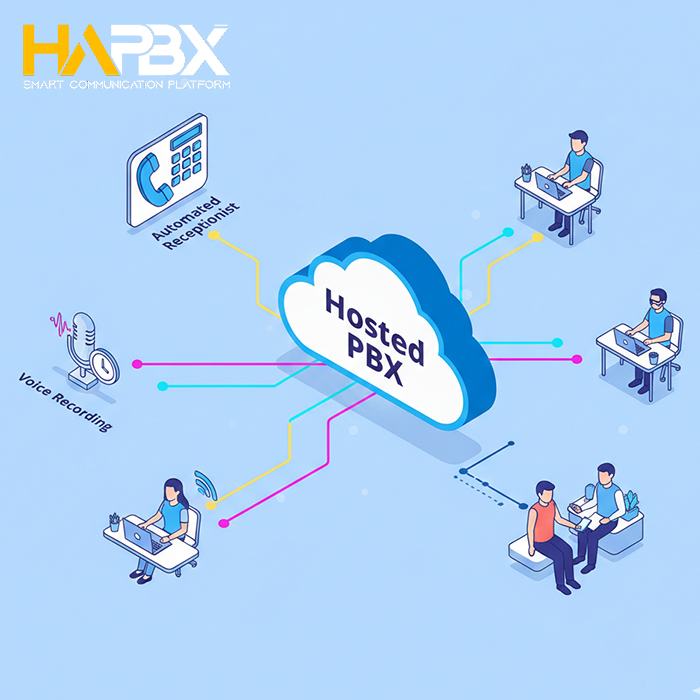
Why choose HaPBX for your Hosted PBX solution?
Choosing a Hosted PBX provider is ultimately about reliability, performance, and long-term scalability. HaPBX is built specifically for businesses that require enterprise-grade stability without the complexity and risks of traditional self-hosted VoIP systems.
Enterprise-Grade Cloud PBX on Dedicated Instance Infrastructure
HaPBX operates on a separate Dedicated Instance architecture, not shared or self-hosted environments. This ensures consistent performance, stronger isolation, and predictable system behavior – critical for businesses that rely heavily on voice communications.
True High Availability (HA) by Global Cluster Design
Unlike common VoIP solutions that run on single servers or isolated virtual machines, HaPBX is deployed on a Global Cluster Infrastructure. This architecture virtually eliminates single points of failure, ensuring continuous service even if one node encounters issues.
Low Latency for Superior Call Quality
HaPBX infrastructure is optimized for ultra-low latency, typically maintaining ~50ms globally to ensure crystal-clear voice quality.
Advanced Security Through System Isolation
HaPBX’s cluster-based design separates voice traffic and data, reducing risks associated with self-hosted deployments. This architecture enhances protection against security breaches while maintaining system integrity at scale.
Scalability Without Per-User or Per-Extension Limits
Unlike most VoIP pricing models that charge per user or extension, HaPBX places no limits on extensions. Businesses can scale freely without incremental per-user costs, making HaPBX ideal for fast-growing organizations.
Built for High Call Volumes
The current HaPBX configuration supports 100–200 concurrent calls, making it suitable for medium to large enterprises, call centers, and businesses with intensive communication demands.
Infrastructure Roadmap Focused on Global Stability
HaPBX’s primary operational cluster is based in the United States, ensuring global performance and stability. The roadmap includes expanding with dedicated regional clusters to further optimize latency and reliability for international markets.
In summary, HaPBX is designed for businesses that cannot afford downtime, unstable call quality, or infrastructure limitations. With true high availability, low latency, strong security, and unrestricted scalability, HaPBX delivers a Hosted PBX platform that is ready today – and built for long-term growth.
FAQs
Is PBX the same as VoIP?
No. PBX is a business phone system, while VoIP is the technology that delivers calls over the internet. Many modern PBX systems use VoIP, but they are not the same thing.
What’s the difference between Hosted PBX and Cloud PBX?
They are very similar in functionality. The main difference is architecture: Hosted PBX often runs on dedicated infrastructure for more control, while Cloud PBX typically uses shared cloud resources for better scalability and lower cost.
What challenges come with Hosted PBX?
Hosted PBX phone systems depend on internet connectivity. Using backup connections and providers with redundant data centers helps reduce downtime and security risks.
Are long-distance calls cheaper with Hosted PBX?
Yes. Internet-based calling significantly reduces long-distance and international call costs.
Can small businesses use Hosted PBX?
Yes. Hosted PBX is affordable, flexible, and scalable, making it suitable for businesses of any size.
Conclusion: Why Hosted PBX Is the Modern Business Phone System
Hosted PBX has become the standard for modern business communications because it delivers what traditional phone systems can no longer provide. By moving voice infrastructure to the cloud, businesses eliminate hardware limitations, reduce IT overhead, and enable teams to stay connected from anywhere – without sacrificing call quality or control.
As communication needs continue to evolve, the right Hosted PBX platform should not only support today’s operations but also be ready for future growth. HaPBX is built with this mindset – offering a secure, high-availability Cloud PBX platform running on dedicated infrastructure, designed for businesses that demand stability, performance, and freedom to scale.
Ready to experience enterprise-grade Hosted PBX without infrastructure risk? Explore how HaPBX can modernize your business communications with a free demo and see the difference a truly reliable Cloud PBX platform can make.