

Call centers are no longer confined to physical offices filled with desk phones and local servers. Today’s call centers operate across cities, countries, and time zones. Agents work remotely or in hybrid models, customers expect immediate responses, and managers rely on real-time data to optimize performance.
Yet many organizations still rely on on-premise PBX systems originally designed for static, office-based environments.
Modern call centers require more than basic telephony. They demand:
- Seamless CRM integration for data-driven conversations
- Call recording for quality assurance and compliance
- Flexible remote work capabilities without sacrificing performance
- High availability and scalability to handle peak demand
This is where hosted PBX solutions, particularly enterprise-grade platforms like HAPBX, fundamentally outperform traditional on-premise PBX systems.
What Is an On-Premise PBX System?
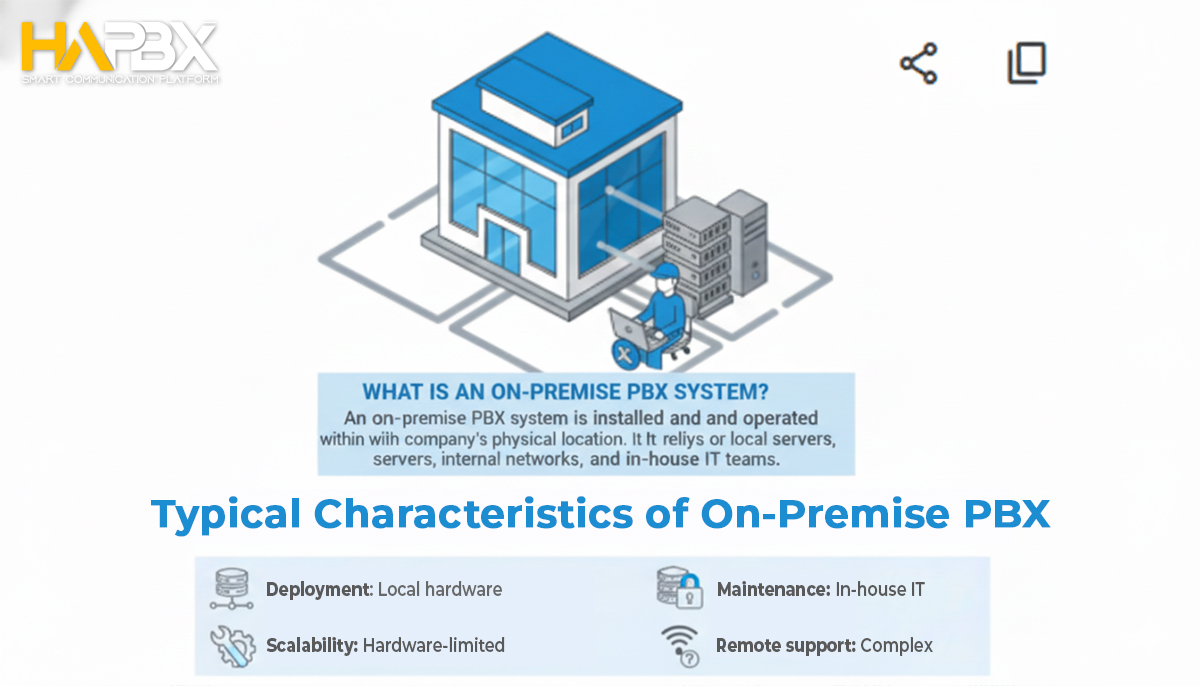
An on-premise PBX system is installed and operated within a company’s physical location. It relies on local servers, internal networks, and in-house IT teams to manage calls, users, and features.
Typical Characteristics of On-Premise PBX
| Aspect | On-Premise PBX |
| Deployment | Local hardware |
| Maintenance | In-house IT |
| Scalability | Hardware-limited |
| Remote support | Complex |
| CRM integration | Limited or custom |
| Upgrades | Manual |
While once considered the standard for call center PBX systems, on-premise solutions struggle to meet modern operational demands.
What Are Hosted PBX Solutions?
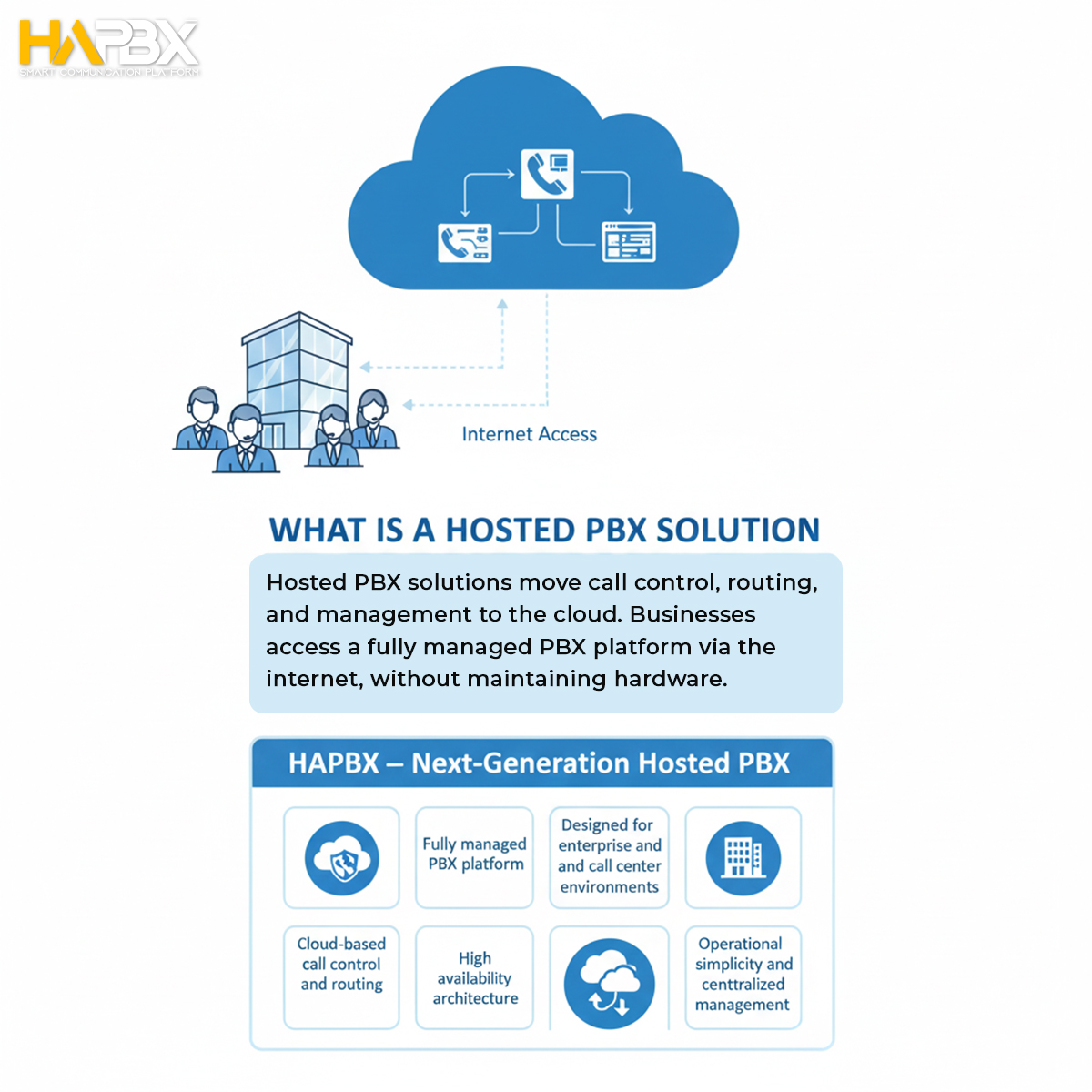
Hosted PBX solutions move call control, routing, and management to the cloud. Instead of maintaining hardware, businesses access a fully managed PBX platform via the internet.
HAPBX is a next-generation hosted PBX provider designed specifically for enterprise and call center use cases, combining advanced cloud PBX features with high availability and operational simplicity.
Infrastructure Comparison: Hosted PBX vs. On-Premise
| Infrastructure Area | On-Premise PBX | HAPBX Hosted PBX |
| Hosting | Local servers | Cloud-based |
| Architecture | Single location | GEO-distributed clusters |
| Failover | Manual/Limited | Automatic |
| Hardware dependency | High | None |
| Disaster recovery | Complex | Built-in |
Business Impact
HAPBX ensures continuous call center operations even during outages, office disruptions, or regional incidents.
CRM Integration: Manual Workflows vs. Data-Driven Conversations
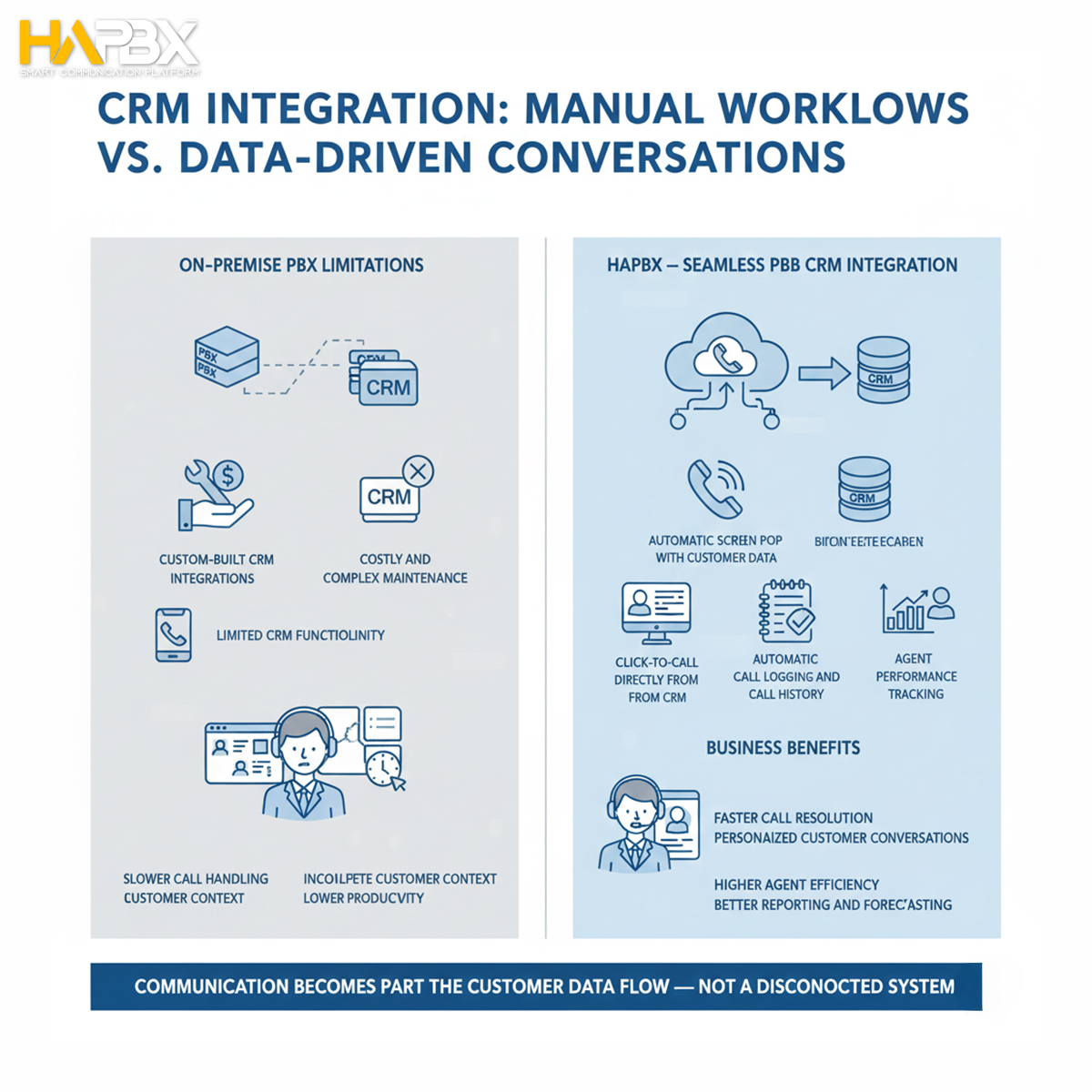
On-Premise PBX Limitations
CRM integration in on-premise systems is often:
- Custom-built
- Costly to maintain
- Limited in functionality
Agents frequently switch between systems, leading to:
- Slower call handling
- Incomplete customer context
- Lower productivity
HAPBX: Seamless PBX CRM Integration
HAPBX is designed with native and API-ready PBX CRM integration, allowing call centers to connect their phone system directly to popular CRM platforms.
Key CRM Integration Capabilities
- Automatic screen pop with customer data
- Click-to-call directly from CRM
- Automatic call logging and history
- Agent performance tracking tied to CRM records
Business Benefits
- Faster call resolution
- Personalized customer interactions
- Higher agent efficiency
- Better reporting and forecasting
Result: Communication becomes part of the customer data flow, not a disconnected system.
Call Recording: Compliance, Training, and Performance Optimization
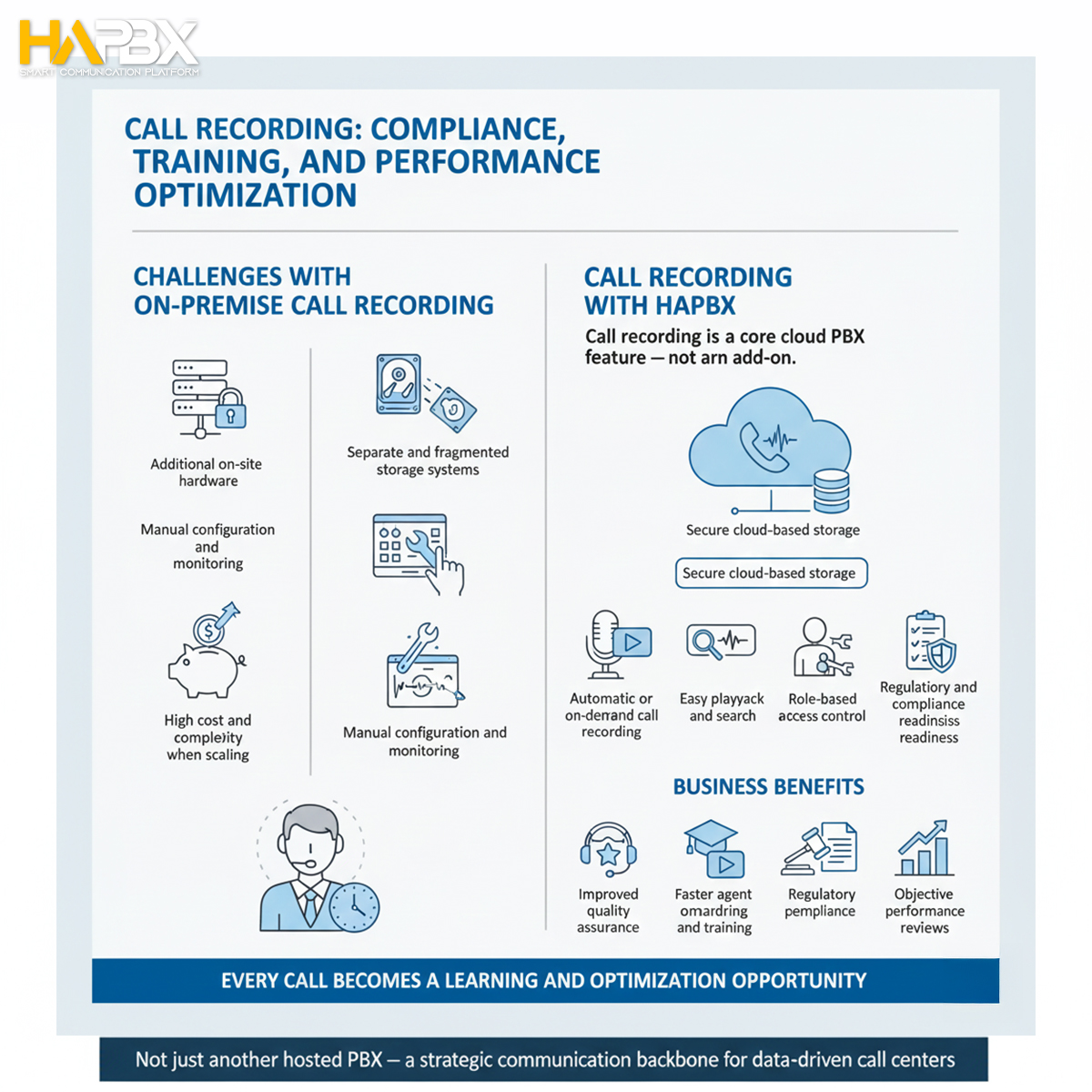
Challenges with On-Premise Call Recording
On-premise call recording often requires:
- Additional hardware
- Separate storage systems
- Manual configuration and monitoring
Scaling recording across large teams becomes expensive and complex.
Call Recording with HAPBX
Call recording is a core cloud PBX feature in HAPBX, not an afterthought.
Built-In Recording Capabilities
- Automatic or on-demand recording
- Secure cloud storage
- Easy playback and search
- Role-based access control
Business Benefits
- Improved quality assurance
- Faster agent onboarding and training
- Regulatory and compliance readiness
- Objective performance reviews
Result: Every call becomes a learning and optimization opportunity.
Remote Work Flexibility: Constraint vs. Competitive Advantage
On-Premise PBX and Remote Work
Supporting remote agents with on-premise PBX systems requires:
- VPNs
- Complex network configurations
- Reduced call quality
- Increased IT support
This often limits scalability and reliability.
HAPBX: Built for Remote and Hybrid Call Centers
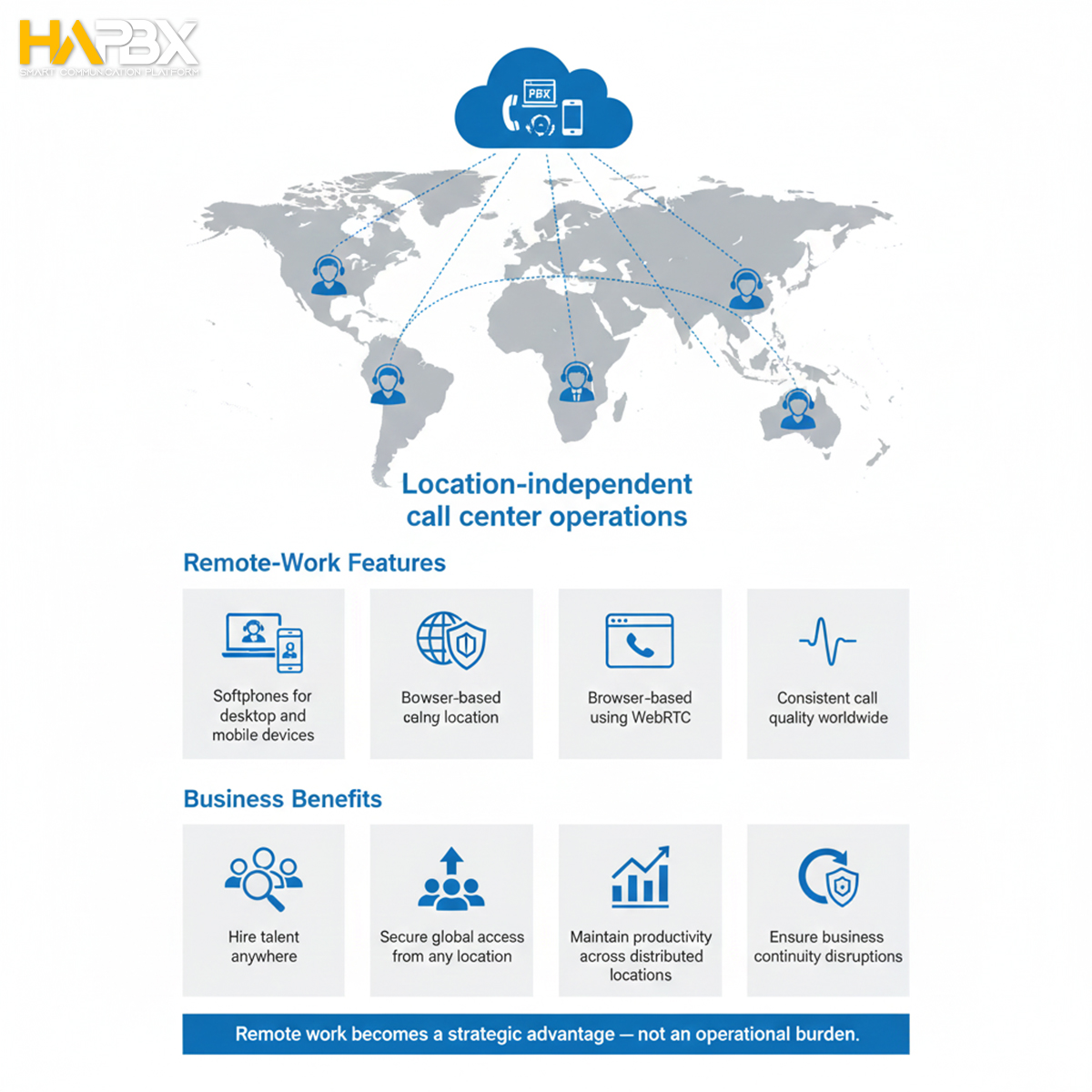
HAPBX enables location-independent call center operations.
Remote-Work Features
- Softphones for desktop and mobile
- Browser-based calling with WebRTC
- Secure global access
- Consistent call quality worldwide
Business Benefits
Hire talent anywhere
Maintain productivity across locations
Rapidly scale remote teams
Ensure business continuity during disruptions
Result: Remote work becomes a strategic advantage, not an operational burden.
Scalability: Hardware Limits vs. Cloud Elasticity
| Scalability Factor | On-Premise PBX | HAPBX Hosted PBX |
| Agents | Hardware-limited | Unlimited |
| Concurrent calls | Fixed | Elastic |
| Expansion time | Weeks | Instant |
| Peak handling | Risky | Automatic |
Business Benefit
HAPBX allows call centers to scale instantly for campaigns, seasonal peaks, or rapid growth.
Deployment Speed: Slow Rollouts vs. Immediate Readiness
| Deployment Stage | On-Premise PBX | HAPBX |
| Hardware setup | Required | None |
| Installation | On-site | Not needed |
| Configuration | Manual | Centralized |
| Go-live | Weeks | Minutes |
Business Benefit
Faster deployment means faster time-to-value for call center operations.
Cost Model: CAPEX Burden vs. Predictable OPEX
| Cost Category | On-Premise PBX | HAPBX Hosted PBX |
| Initial investment | High | Low |
| Maintenance | Ongoing | Included |
| Upgrades | Expensive | Included |
| Scalability cost | High | Minimal |
| Budget predictability | Low | High |
Financial Reality
Over 3–5 years, hosted PBX solutions like HAPBX typically reduce total communication costs by 30–50% compared to on-premise systems.
Security and Reliability
| Security Area | On-Premise Risk | HAPBX Model |
| Patching | Manual | Automatic |
| Encryption | Optional | Enforced |
| Monitoring | Limited | Continuous |
| Failure recovery | Manual | Automatic |
Business Benefit
Lower risk of breaches, outages, and compliance issues.
Why HAPBX Is the Best Choice for Modern Call Centers
| Call Center Need | How HAPBX Delivers |
| CRM integration | Native & API-ready |
| Call recording | Built-in |
| Remote workforce | Fully supported |
| Scalability | Unlimited |
| Reliability | High Availability |
| Cost efficiency | Optimized TCO |
HAPBX enables call centers to operate with enterprise-grade performance without enterprise complexity.
Hosted PBX vs. On-Premise: Final Verdict
| Area | On-Premise PBX | HAPBX Hosted PBX |
| Flexibility | Low | High |
| CRM integration | Limited | Seamless |
| Call recording | Complex | Built-in |
| Remote work | Difficult | Native |
| Scalability | Hardware-bound | Elastic |
| Future readiness | Low | High |
HAPBX: Powering the Next Generation of Call Centers
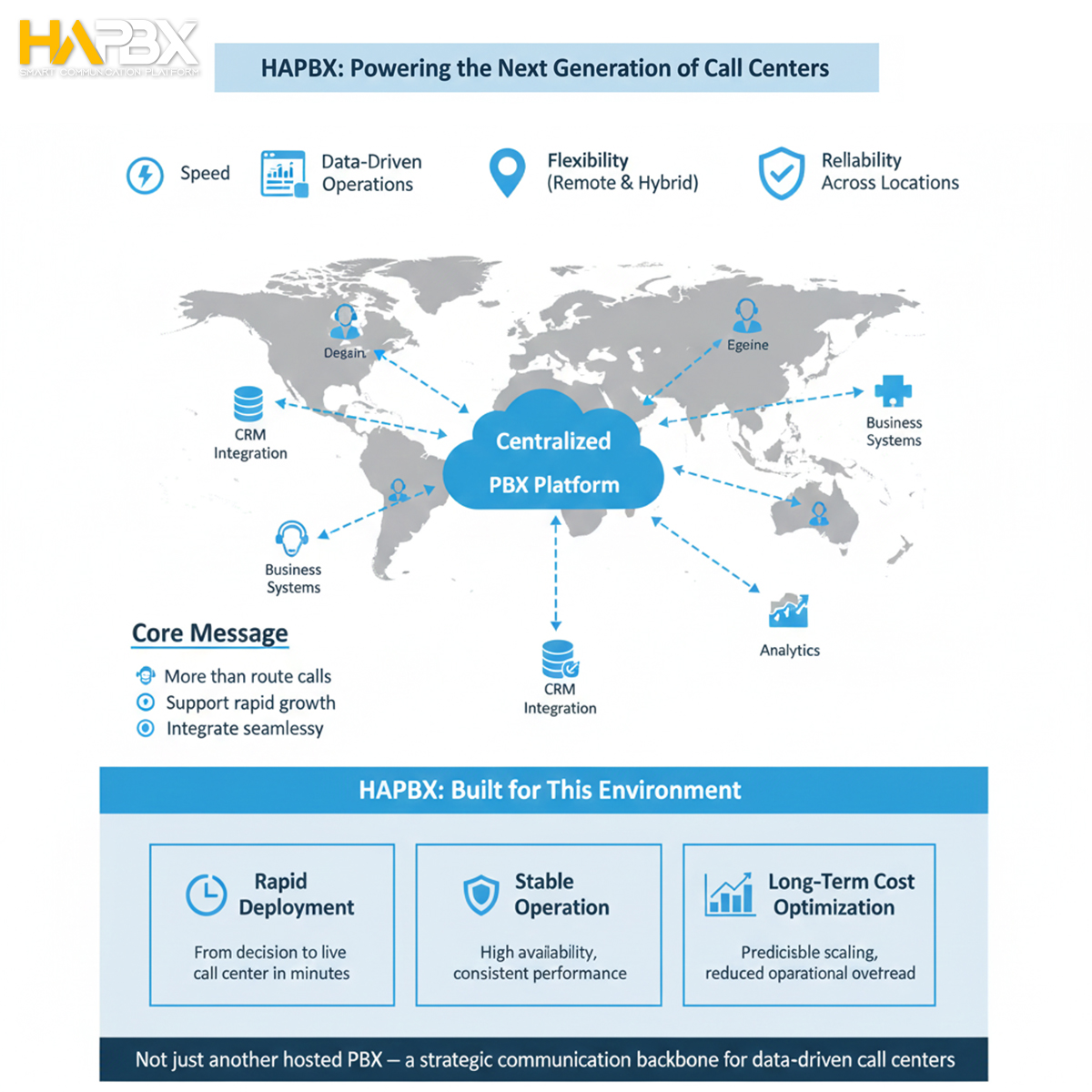
Modern call centers are no longer defined by physical offices, desk phones, or local switching hardware. They are defined by speed, data, flexibility, and reliability—and by their ability to deliver consistent customer experiences across locations, time zones, and working models.
In this new reality, communication infrastructure must do more than route calls. It must support rapid growth, integrate seamlessly with business systems, and remain operational under all conditions.
HAPBX was built specifically for this environment.
HAPBX is an enterprise-grade Cloud PBX platform designed to address the three core operational requirements of modern call center operations: rapid deployment, stable operation, and long-term cost optimization. These pillars define why HAPBX is not just another hosted PBX solution, but a strategic communication backbone for data-driven call centers.
1. Rapid Deployment: From Decision to Live Call Center in Minutes
Traditional call center PBX deployments are slow and resource-intensive. On-premise systems require hardware procurement, installation, network configuration, and extensive testing. Even many hosted PBX providers still depend on manual provisioning or complex setup processes.
HAPBX removes these barriers entirely.
How HAPBX Enables Rapid Deployment
- No on-premise hardware or PBX servers
- No complex system configuration or cabling
- Centralized cloud-based provisioning
- Pre-configured call center features ready out of the box
With HAPBX, businesses can activate a fully operational call center within minutes, not weeks.
Direct Operational Benefits
- Faster launch of new call center teams or campaigns
- Immediate readiness for sales, support, or outbound operations
- No dependency on internal IT or telecom specialists
- Ideal for BPOs, fast-scaling customer support teams, and distributed workforces
Result: Communication infrastructure stops being a bottleneck and becomes an accelerator for growth.
2. Stable Operation: High Availability Designed into the Platform
Call centers cannot afford downtime. Missed calls mean lost revenue, unresolved support cases, and damaged customer trust. Many PBX systems—both on-premise and cloud-based—still rely on single-instance architectures that introduce unavoidable points of failure.
HAPBX is fundamentally different.
High Availability Architecture of HAPBX
- GEO-distributed global cluster infrastructure
- Dedicated cloud instances per tenant
- Automatic failover between nodes and regions
- No single point of failure in call routing or control
If one node or location experiences an issue, calls are automatically rerouted without service interruption.
Why This Matters for Call Centers
- 99.99%+ availability with near-zero downtime
- Continuous inbound and outbound operations
- Consistent call quality during incidents or traffic spikes
- Reduced operational risk and reputational damage
Result: Call center operations remain reliable and predictable, even under adverse conditions.
3. Long-Term Cost Optimization: Lower TCO Without Sacrificing Capability
Traditional call center PBX systems are capital-intensive. Hardware investments, maintenance contracts, upgrades, and scaling costs create long-term financial inefficiencies. Even many popular PBX solutions introduce hidden costs when adding agents, features, or redundancy.
HAPBX is built on a dedicated cloud PBX model that optimizes total cost of ownership (TCO) over time.
How HAPBX Optimizes Costs
- No hardware purchase, replacement, or depreciation
- Subscription-based OPEX model with predictable pricing
- Built-in scalability without additional infrastructure
- Enterprise features included, not charged as add-ons
- Reduced IT workload and operational overhead
Compared to traditional PBX systems and common call center solutions, organizations can reduce communication-related costs by 30–60% over a 3–5 year period.
Financial Impact for Businesses
- Lower upfront investment
- Predictable monthly expenses
- Easier budgeting and forecasting
- Higher ROI as call volumes and teams grow
Result: Communication costs decrease over time, even as call center operations expand.
More Than a PBX: A Strategic Call Center Platform
HAPBX combines:
- Advanced cloud PBX features
- Seamless PBX CRM integration for data-driven conversations
- Enterprise-grade call recording for compliance and quality control
- Native support for remote and hybrid call center teams
All delivered through a fully managed hosted PBX service designed for real-world, high-volume call center environments.
For organizations evaluating hosted PBX providers, the decision is no longer about basic telephony. It is about building a communication platform that supports scalability, resilience, and operational efficiency.
HAPBX is not just a hosted PBX solution—it is the communication backbone for modern, scalable, and data-driven call centers.