

Understanding how a PBX works is essential for businesses that rely on phone communication to connect teams and customers. A Private Branch Exchange (PBX) acts as the control center of a business phone system, managing incoming, internal, and outgoing calls through a structured call flow. In this guide, we break down how PBX systems handle calls, explain the key components involved, and show how modern solutions like HaPBX apply PBX technology to support efficient and scalable business communication.
What a PBX Is and the Role It Plays in Business Call Management
What is a PBX?
A Private Branch Exchange (PBX) is a private telephone system that businesses use to manage incoming, outgoing, and internal calls. Rather than connecting each employee directly to the public telephone network, all calls pass through the PBX, which acts as a central hub for voice communication.
Within a business phone system, the PBX sits between users (desk phones or softphones) and external networks such as the PSTN or the internet. It receives calls, applies call-handling rules, and routes them to the appropriate extension, department, or external number, allowing organizations to manage voice traffic in a structured and efficient way.
Why Businesses Rely on a PBX to Manage Calls Efficiently
Businesses rely on PBX systems because they provide centralized control over all voice communication. Instead of managing calls individually on each phone line, organizations can handle all calls from a single system.
A PBX also enables efficient internal communication by allowing employees to call each other directly using extensions, without relying on public networks. This simplifies collaboration and reduces unnecessary call routing.
From a cost perspective, PBX systems help reduce business calling expenses by minimizing the number of external lines required and optimizing how outbound calls are placed. At the same time, features such as auto attendants, call queues, and voicemail contribute to a more professional calling experience, ensuring callers are greeted properly and routed to the right person without delay.
Inside a PBX System: Key Components That Control Call Flow
A PBX is made up of several core components that work together to receive calls, decide how they should be handled, and connect callers to the correct destination. Each component plays a specific role in keeping call flow organized and reliable.
Call Control and Switching Logic
This is the core of the PBX. Call control logic determines how calls are processed, while the switching function connects callers to extensions, trunks, or other endpoints. It evaluates dialing patterns, call status, and routing rules before establishing each connection.
Trunks (PSTN Lines or SIP Trunks)
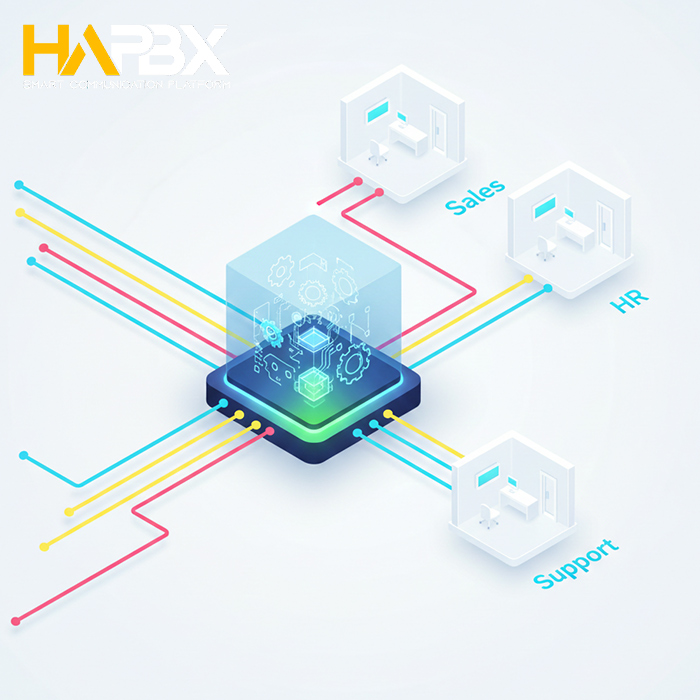
Trunks are the links between the PBX and external networks. Traditional PBX systems use PSTN lines, while modern systems rely on SIP trunks over the internet. Trunks allow the PBX to send and receive calls outside the organization.
Extensions and Endpoints
Extensions are the internal numbers assigned to users or devices. Endpoints can include desk phones, IP phones, softphones, or mobile apps. The PBX maps each extension to an endpoint so calls reach the correct user.
Auto Attendant and IVR Systems
Auto attendants and IVR systems automatically answer incoming calls and guide callers using recorded prompts and menus. They reduce the need for manual call handling and help route calls to the right department or extension.
Call Routing Rules and Policies
Routing rules define how the PBX handles calls in different situations. These policies control actions such as forwarding unanswered calls, routing calls based on time of day, or directing calls to backup destinations when users are unavailable.
How a PBX Works: From Incoming Calls to Outbound Connections
A PBX functions as the central system that receives, processes, and connects all business calls. For every call – whether inbound, internal, or outbound—the PBX applies predefined rules to determine where the call should go and how it should be handled.
How Incoming Calls Are Handled
External calls reach a business through the public telephone network or the internet and are delivered first to the PBX, not directly to an employee’s phone. The PBX answers the call and applies routing logic based on factors such as the dialed number, business hours, or availability.
Using this logic, the PBX directs callers to the appropriate destination, such as an individual extension, a department, or an automated menu.
Call flow: External caller → PBX → extension / department / IVR menu
How Internal Calls Work
When an employee dials an internal extension, the call is handled entirely by the PBX. The system matches the extension to the correct user and establishes a direct connection between the two endpoints.
Because the call stays within the PBX, it does not need to pass through public telephone networks.
Call flow: Extension A → PBX → Extension B
How Outgoing Calls Are Made
For outbound calls, the user’s phone sends the call to the PBX first. The PBX analyzes the dialed number and selects an appropriate trunk—such as a traditional phone line or a SIP trunk—to reach the external network.
The PBX can also control and track outbound calls by applying dialing rules and logging call activity.
Call flow: User extension → PBX → trunk line → external number

How Different PBX Architectures Handle Business Calls
While all PBX systems perform the same core function – routing and managing business calls – the way they operate depends on the underlying technology. Traditional, IP-based, and cloud PBX systems differ mainly in how calls are processed and where the system is hosted.
Traditional PBX
A traditional PBX relies on dedicated hardware installed on-site to switch and route calls. Incoming and outgoing calls are handled through analog or digital phone lines connected directly to the public telephone network.
All call processing takes place within the organization’s physical location, which means the PBX manages calls locally using fixed wiring and proprietary equipment.
Call flow: External line → on-premise PBX hardware → internal extension
IP PBX
An IP PBX handles voice calls over IP networks instead of traditional phone lines. Calls are converted into data packets and transmitted over the company’s local network or the internet.
Call management is performed by software-based systems, which makes IP PBX more flexible and easier to scale. Because it operates on the same infrastructure as other business applications, an IP PBX can integrate smoothly with existing data networks.
Call flow: IP phone / softphone → IP PBX → IP network / SIP trunk
Hosted or Cloud PBX
With a hosted or cloud PBX, the PBX system is hosted in the cloud by a service provider rather than installed on-site. Calls are processed over the internet, and users connect to the PBX from any location.
This model allows for remote access and centralized management, since the PBX can be configured and monitored through a web interface without maintaining physical hardware.
Call flow: User device → internet → cloud PBX → external or internal destination
HaPBX: A Modern PBX Built for Business Communication
HaPBX is a modern PBX solution designed to help businesses manage voice communication in a centralized, flexible, and scalable way. Built around IP and VoIP technologies, HaPBX performs all the core functions of a PBX – call routing, extension management, and trunk control – while aligning with how today’s businesses operate.
At its core, HaPBX acts as the central call control system for an organization. Incoming calls are received, processed, and routed based on predefined rules, while internal calls are handled entirely within the system for fast and efficient communication. For outbound calls, HaPBX connects users to external networks through SIP trunks, allowing businesses to control call flow and usage from a single platform.
HaPBX is designed with enterprise call management in mind. It supports structured call routing, auto attendants, call queues, and flexible extension setups, making it suitable for growing teams and multi-department environments. Because it is software-based, HaPBX can be deployed on modern infrastructure and managed centrally, reducing reliance on complex on-premise hardware.
By combining core PBX functionality with modern IP-based architecture, HaPBX provides businesses with a reliable foundation for handling calls today while remaining adaptable to future communication needs.

Understanding How a PBX Works and How HaPBX Supports Smarter Business Call Management
A PBX plays a central role in business communication by controlling how calls are received, routed, and connected. From handling incoming calls and enabling internal communication to managing outbound traffic, a PBX ensures that voice communication remains organized, efficient, and professional as a business grows. While the underlying technology has evolved – from traditional hardware-based systems to IP and cloud-based solutions – the core purpose of a PBX remains the same: acting as the control center for business calls.
Why HaPBX Is the Right Choice
HaPBX brings this proven PBX model into a modern, IP-based environment. By combining centralized call control with flexible deployment and advanced call management features, HaPBX helps businesses build a reliable communication system that scales with their needs.
Start a free demo to learn how HaPBX can support your business phone system and explore a smarter way to manage calls with a modern PBX solution.