

On-premise PBX systems have been the traditional choice for business telecommunications for decades, offering complete control over communications infrastructure. But in 2026, is investing in on-premise PBX still the right decision for your organization? This comprehensive guide explores what on-premise PBX is, how it works, the true cost of ownership, key features, and critical pros and cons. We’ll also compare it with modern hosted alternatives like HaPBX to help you make an informed decision that aligns with your business needs, budget, and growth trajectory.
Understanding On-Premise PBX
What is an On-Premise PBX
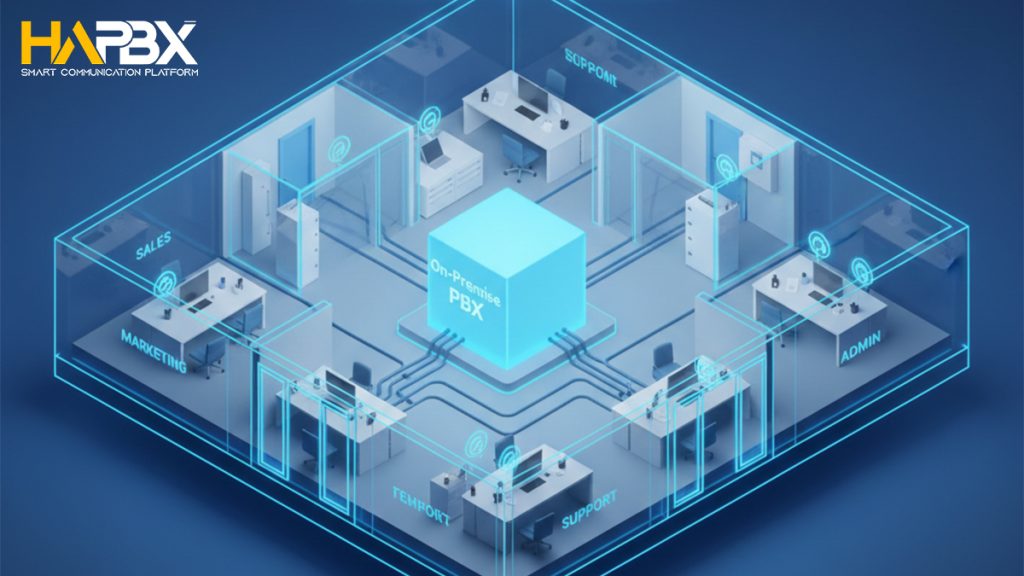
An on-premise PBX is a telecommunications system that is physically installed and operated at your business location. Unlike cloud-based alternatives, you own and directly manage all the hardware and software components that power your phone system, giving you complete control over its configuration, security, and operation.
Modern on-premise PBX systems in 2026 are sophisticated IP-PBX solutions that leverage Voice over IP (VoIP) technology. This means phone calls are transmitted over the internet rather than traditional phone lines, enabling advanced features and greater flexibility compared to older analog systems.
Core components of an on-premise PBX include:
- PBX Server: The central hub running the PBX software that manages call routing and system operations
- Telephony Gateways: Connect your system to the Public Switched Telephone Network (PSTN) via traditional lines or SIP trunks
- IP Phones or Analog Phones: The physical devices your employees use for daily communication
- Network Infrastructure: Your local area network (LAN) that connects all system components
Because the hardware is housed onsite, your business is fully responsible for maintenance, upgrades, and expansion. This on-premises hosting approach offers enhanced features like voicemail-to-email, simultaneous ring across multiple devices, and detailed call analytics. Organizations typically pay only for internet service rather than separate phone and internet bills, while maintaining complete control over their communication infrastructure and call data
Why Businesses Still Consider On-Premise PBX Solutions in 2026
Despite the growing popularity of cloud-based phone systems, on-premise PBX solutions remain a viable choice for many organizations. Here’s why businesses continue to invest in on-premise systems:
- Complete Control and Customization: On-premise PBX gives you full autonomy over system configuration, security protocols, and integration with other on-site applications. This level of control is essential for organizations with unique workflows, specialized requirements, or complex operational needs that off-the-shelf cloud solutions can’t fully address.
- Enhanced Data Security and Privacy: For industries handling sensitive information – such as healthcare, finance, legal, or government sectors – keeping communications infrastructure in-house provides greater control over data privacy. You’re not relying on third-party providers’ security measures, which is critical for organizations with stringent compliance requirements or those operating under strict data sovereignty regulations.
- Long-Term Cost Predictability: While the initial investment is substantially higher, once the system is fully paid for, ongoing operational costs can be lower than monthly subscription-based cloud services. This is particularly advantageous for stable organizations with minimal changes in user count or feature requirements over time.
- Internet Independence for Internal Calls: Internal communications within an on-premise system don’t rely on internet connectivity. This ensures business continuity and uninterrupted internal communication even during internet outages – a crucial advantage for mission-critical operations.
- Leveraging Existing Infrastructure: Businesses with significant existing network infrastructure or established in-house IT expertise can find it more economical to build upon their current setup rather than transitioning to a cloud model that doesn’t fully utilize their existing investments and capabilities.
Calculating the True Cost of Ownership (TCO) for On-Premise PBX
Understanding the true cost of ownership for an on-premise PBX in 2026 goes far beyond the initial hardware purchase. A comprehensive TCO analysis must account for all direct and indirect expenses throughout the system’s entire lifespan, which typically spans 5-7 years.
Upfront Investment: Hardware, Software, and Initial Setup Costs
The initial investment represents the most significant barrier to entry for on-premise PBX systems:
- PBX Hardware: The server, telephony interface cards for PSTN connections, gateways for SIP trunking, and uninterruptible power supplies (UPS).
- Costs range from several hundred to many thousands of dollars depending on capacity and redundancy requirements.
- Handsets and Endpoints: IP phones, conference phones, and softphone licenses for each user, with costs varying significantly based on features and quality.
- PBX Software Licensing: Enterprise editions with advanced features typically require licensing fees – either perpetual licenses or annual renewals for support and updates.
- Professional Installation and Configuration: Network configuration, system programming, and user training to ensure optimal performance and prevent future issues.
- Infrastructure Upgrades: Network cabling upgrades (Cat5e/6 for VoIP) and other improvements if your existing setup isn’t adequate for modern IP telephony.

Ongoing Operational Expenses: Maintenance, Upgrades, and IT Staff
Operational costs continue long after installation:
- Maintenance Contracts: Support agreements covering hardware replacement, software updates, and technical support can add 15-20% of the initial system cost annually.
- Software Updates and Upgrades: Major version upgrades and new feature modules often incur additional costs beyond basic maintenance.
- IT Staff Time and Training: Continuous management, troubleshooting, monitoring, patching, and user support represent significant opportunity costs for your IT team.
- Carrier Charges: Ongoing costs for SIP trunks or traditional phone lines (PRI/BRI) from telecommunications providers.
- Energy Consumption: 24/7 operation of servers and hardware creates continuous electricity costs that accumulate over time.
Hidden Costs: Downtime, Scalability Limitations, and End-of-Life
These often-overlooked expenses can significantly impact your TCO:
- Downtime Costs: System failures without robust redundancy can result in substantial lost business, plus time required for hardware repair or replacement.
- Scalability Constraints: Adding users may require additional hardware, licenses, or more powerful servers. Scaling down leaves you with underutilized, already-paid-for equipment.
- Security Management: Full responsibility for protecting against toll fraud, denial-of-service attacks, and other threats requires ongoing vigilance and potentially additional security tools.
- Hardware End-of-Life: PBX hardware typically lasts 5-7 years before requiring complete replacement or major overhauls, creating cyclical capital expenditures.
- Opportunity Cost: Capital invested in on-premise infrastructure could potentially generate returns if deployed elsewhere in your business.
When evaluating the financial commitment of an on-premise PBX, it’s crucial to look at the complete picture. Industry analyses suggest that the TCO of IT infrastructure can often reach 3-5 times the initial purchase price over its lifespan when all these factors are properly accounted for. This comprehensive view – encompassing upfront costs, ongoing operations, and hidden expenses – is essential for making an informed decision that aligns with your organization’s budget, technical capabilities, and long-term strategic goals.
How On-Premise Phone Systems Operate
The defining characteristic of on-premise phone systems is that the hardware is physically located at your business premises. However, the underlying technology and operational methodology can vary significantly depending on the type of system you choose.
At the core, business telephony operates on three fundamental technologies: analog, digital, and VoIP (Voice over Internet Protocol) – and on-premise systems can utilize any of these approaches.
- Analog Telephony (POTS): Also known as Plain Old Telephone Service, this is the longest-standing technology. It works by converting audio into analog electrical signals that travel along copper telephone lines to the end user. Traditional landline phones and fax machines use this technology, though it’s becoming less common in modern business environments.
- Digital Telephony: This technology converts audio into digital signals, which can handle more data and maintain quality over long distances far better than analog. Digital signals can be transmitted through traditional telephone lines, the internet, or as radio waves. Most cellular networks use digital telephony, with cell phones converting audio to digital signals and transmitting them through the air as radio waves.
- VoIP (Voice over Internet Protocol): A type of digital telephony that uses the internet for calls rather than traditional telephone lines. VoIP is the technology behind modern business phone systems and popular communication apps, making it possible to make and receive calls with just an internet connection. This is the most common choice for new on-premise deployments in 2026.
Regardless of which technology powers your system, an on-premises phone system hosts all hardware and software within your organization’s physical location. This setup provides maximum administrative control over your unified communications infrastructure and allows you to leverage existing desktop phones and hardware investments, potentially resulting in significant cost savings over time compared to starting from scratch with cloud solutions.
Essential Features of On-Premise PBX Solutions
Modern on-premise PBX systems in 2026 offer a comprehensive suite of features that rival and often exceed cloud-based alternatives, giving businesses powerful tools to manage their communications effectively.
- Advanced Call Control: Manage calls efficiently with features including flexible call routing, call transfer, park and intercom, ring groups, paging and group paging capabilities. These features ensure calls reach the right person at the right time, improving response times and customer satisfaction.
- Contact Center Capabilities: Transform your team into a departmental contact center with professional-grade features such as call recording, queue management, switchboard functionality, hot desking for flexible workspace management, and real-time monitoring tools including whisper and barge modes that allow supervisors to coach agents during live calls.
- Interactive Voice Response (IVR) and Call Management: Create sophisticated call flows with IVR systems, custom music or messages on hold (MOH), enhanced caller ID, and presence management that shows real-time availability status across your organization.
- Voicemail, Messaging and Collaboration: Stay connected with voicemail-to-email transcription, SMS integration, and instant messaging features. Modern on-premise systems support unlimited conference calling, video conferencing capabilities, and integration with popular collaboration platforms like Microsoft Teams, creating a truly unified communications environment.
- Virtualization and Scalability: Deploy your system in virtual environments using Hyper-V or VMware, eliminating the need for dedicated PBX server appliances. Virtualization provides enterprise-grade power, scalability, and disaster recovery capabilities at a fraction of traditional costs, while making it easier to manage resources and expand capacity as your business grows.
These comprehensive features ensure that on-premise PBX systems remain competitive and capable of meeting the diverse communication needs of modern businesses, from small offices to large enterprises.
Pros and cons of On-Premise Phone Systems
Now that you understand what an on-premise phone system is and how it operates, let’s examine the advantages and disadvantages to help you determine if this solution aligns with your business needs.
Key Benefits of On-Premise PBX
- Complete Control and Customization: All decisions regarding installation, customization, management, maintenance, and security rest entirely in your hands. This autonomy allows you to tailor the system precisely to your business requirements and security standards without relying on third-party providers.
- Internet Independence: Unlike hosted solutions, on-premise phone systems don’t require high-speed internet connectivity to function. This makes them a reliable option for businesses in areas with limited internet access or those requiring guaranteed internal communication continuity regardless of internet availability.
- Long-Term Cost Potential: While the upfront investment is substantial, once the system is paid for, ongoing costs can be significantly lower than recurring monthly subscription fees for cloud-based alternatives. For stable organizations with minimal changes, this can translate to considerable savings over the system’s lifespan.
- Data Privacy and Security Control: Keeping your communications infrastructure in-house provides direct oversight of sensitive call data, which is particularly valuable for industries with strict compliance requirements or data sovereignty concerns.
Major Drawbacks of On-Premise PBX
- High Upfront Investment: The initial costs of purchasing and installing hardware, software, and infrastructure can be prohibitively steep for many businesses. Additionally, rapid technological advancement creates the risk that your system could become outdated, potentially diminishing the value of your initial investment.
- Ongoing Maintenance Responsibility: You bear full responsibility for system maintenance, upgrades, and troubleshooting. This requires either dedicated in-house IT professionals or costly outsourced IT support providers, adding to your operational burden and expenses.
- Limited Flexibility and Mobility: On-premise systems tie your business to a physical location, making relocation complex and expensive. They also restrict remote working capabilities since employees typically need to use specific on-premise phones. Even simple tasks like adding phone lines or reconfiguring extensions when employees move within the same building can be cumbersome.
- Scalability Challenges: Growing or downsizing your workforce often requires hardware purchases or upgrades. Unlike cloud systems that can instantly add or remove users, on-premise systems may need additional equipment, creating delays and unexpected costs.
- Potential Feature Limitations: Traditional on-premise systems, especially those relying on older analog technology, may lack the advanced communication features that modern businesses expect – such as seamless video conferencing, SMS integration, instant messaging, and mobile app functionality that feature-rich hosted systems readily provide.
Ultimately, whether an on-premise or hosted phone system is right for your business depends on your specific circumstances, including budget, IT resources, scalability needs, and workforce mobility requirements. Understanding these trade-offs is essential for making an informed decision that supports your organization’s communication goals.

Comparing On-Premise PBX with Cloud-Based Alternatives
Key Difference Between Cloud PBX vs Onsite PBX
Choosing between cloud/hosted PBX and onsite PBX is one of the most critical decisions your business will make regarding its communication infrastructure. This choice goes beyond simply comparing features – it requires careful consideration of how the system will integrate with your organization’s existing IT infrastructure, business practices, and plans for future growth and expansion.
For businesses moving away from legacy phone systems, the features and functionality offered by modern solutions – whether hosted or onsite – will dramatically exceed current capabilities. In these cases, the decision often comes down to fundamental operational considerations rather than specific features, since both options provide substantial improvements.
- Operational Philosophy and Business Strategy: Your decision may be influenced by your organization’s underlying business philosophy. Some companies operate with a principle of outsourcing all non-core functions, making hosted PBX the natural choice. Others prefer maintaining direct control over critical infrastructure, leading them toward on-premise solutions.
- Integration and Growth Considerations: How your new PBX system integrates with existing IT systems, workflows, and business processes is crucial. You must also consider scalability requirements – both for anticipated growth and potential downsizing – and whether your chosen solution can adapt to changing business needs without significant disruption or investment.
- Decision-Making Factors: The most important factors that distinguish hosted from onsite PBX include cost structure (upfront vs. subscription), scalability and flexibility, level of control, feature availability, implementation complexity, maintenance responsibility, and disaster recovery capabilities. Each of these factors carries different weight depending on your organization’s size, industry, technical expertise, and strategic priorities.
Understanding these key differences and how they align with your specific business requirements is essential for making an informed decision between hosted and onsite PBX systems.
Side-by-Side Comparison: Hosted PBX vs Onsite PBX Benefits and Limitations
Understanding the trade-offs between hosted and onsite PBX systems is essential for making an informed decision. Here’s a comprehensive comparison of the advantages and disadvantages of each approach:
| On-Premise PBX Pros | On-Premise PBX Cons |
| Long-Term Cost Savings: Lower ongoing costs after initial investment is recovered; no perpetual monthly fees | High Initial Investment: Significant upfront costs for hardware, software, installation, and dedicated data room space |
| Complete Control: Full authority over system configuration, security protocols, customization, and feature selection | IT Expertise Required: Need dedicated, trained IT personnel for maintenance, troubleshooting, and system updates |
| Enhanced Security: Apply your own security solutions and meet strict compliance requirements for sensitive data | Maintenance Responsibility: All maintenance costs, hardware replacements, and upgrades fall on your organization |
| Internet Independence: Internal calls remain operational during internet outages, ensuring business continuity | Scalability Challenges: Adding capacity may require purchasing additional hardware, creating delays and unexpected costs |
| Network Ownership: Use your current carrier, integrate VoIP, implement SIP trunking for lower-cost calls | Single Point of Failure: System failure can halt operations entirely without backup solutions or redundancy |
| Predictable Costs: Fees remain stable and won’t unexpectedly increase over time | Physical Infrastructure: Must maintain suitable premises to host the system, complicating relocation plans |
| Hosted PBX Pros | Hosted PBX Cons |
| Minimal Upfront Costs: Low initial setup with no on-premises hardware required | Perpetual Subscription Costs: Recurring monthly payments continue indefinitely, potentially more expensive long-term |
| Zero Maintenance: Provider handles all updates, maintenance, and technical support | Internet Dependency: Call quality tied directly to internet connection strength; poor bandwidth affects performance |
| Rapid Deployment: Quick setup with near-instant addition of new lines and users | Limited Control: Customization depends entirely on provider offerings; cannot source features from alternative vendors |
| Superior Scalability: Easily scale up or down at will with no long-term commitment or hardware purchases | Security Concerns: Data hosted by third-party may not meet requirements for highly regulated industries |
| Business Continuity: Calls automatically route to voicemail or alternate numbers during internet outages | Provider Dependency: System stability relies on provider’s business continuity; service disruptions directly impact operations |
| Exceptional Flexibility: Users connect via desktops, smartphones, or VoIP phones from anywhere | Feature Upgrade Costs: Advanced features or capacity increases often come at additional monthly costs |
| Easy Relocation: Moving offices is simple with no physical hardware to relocate | Network Qualification: Your organization must ensure network infrastructure meets provider requirements |
The choice between hosted and onsite PBX depends on your organization’s size, budget structure, IT capabilities, security requirements, and growth plans. Larger organizations with in-house IT expertise often prefer on-premise solutions for long-term cost-effectiveness and control, while smaller businesses typically benefit from hosted solutions’ lower barriers to entry and minimal maintenance requirements.
Critical Decision Factors When Choosing Between Hosted and Onsite PBX
Making the right choice between hosted and onsite PBX requires careful evaluation of your organization’s specific circumstances. While features and functionality are important, the decision often comes down to fundamental operational considerations and how the system will integrate with your existing IT infrastructure and business practices.
Your business philosophy may also guide this decision. Organizations that outsource all non-core functions will naturally gravitate toward hosted solutions, while those preferring direct control over critical infrastructure lean toward on-premise systems. Consider these key decision factors:
Costs
Initial Investment vs. Long-Term Expenses: Hosted PBX requires minimal upfront costs compared to the substantial capital expenditure needed for on-premise implementation. However, the financial picture becomes more complex when considering long-term factors.
You must evaluate the lifetime and maintenance costs of in-house equipment against perpetual monthly fees from hosted providers, how quickly on-premise equipment becomes obsolete with technological advances, and the comparative costs of scaling each solution as your business grows. For stable businesses with 50+ users and predictable growth, on-premise systems often prove more economical after the initial investment is recovered. Conversely, startups or businesses with fluctuating user counts typically benefit from the predictable OpEx model of hosted solutions.
Budget Structure: Can your organization absorb significant upfront CapEx, or would a predictable monthly OpEx model better suit your cash flow management?
Scalability
Growth Flexibility and Risk Management: Every business plans for growth, making scalability a decisive factor. Both solutions accommodate expansion, though they handle it differently and each involves additional costs.
The major advantage of hosted PBX is risk mitigation – you can increase or decrease service at will without long-term commitments. If your business doesn’t grow as projected, you’re not stuck with underutilized equipment investments. With on-premise systems, expansion requires purchasing additional hardware and capacity upfront, creating long-term financial risk if growth expectations aren’t met.
Rapidly growing or shrinking businesses, or those with seasonal fluctuations, typically benefit more from cloud scalability. Established businesses with stable, predictable user counts can justify the fixed investment of on-premise infrastructure.
Features and Customization
Feature Access and Control: On-premise systems provide complete control and flexibility, allowing you to add any VoIP features and functionality your business requires – though costs for these additions accumulate quickly. You can also implement deep integrations with legacy on-site applications or create highly specific custom call routing logic that cloud providers may not support.
Hosted PBX solutions spread feature development costs across hundreds or thousands of customers, potentially giving you access to a broader range of advanced features at lower individual cost. However, customization is limited to what your provider offers.
Critical Consideration: What truly matters is whether your business actually requires specific features. Depending on how critical desired capabilities are to your operations, what an individual solution offers may be more important than whether it’s hosted or on-premise.
Additional Decision Factors
IT Infrastructure and Expertise: Do you have a skilled IT team capable of managing, securing, and troubleshooting a PBX system? If yes, on-premise becomes feasible. If IT resources are limited, the managed nature of cloud PBX is often more practical.
Security and Compliance: Highly regulated industries (healthcare with HIPAA, finance with PCI DSS) with specific data handling mandates may require the direct control of on-premise systems. However, ensure your team can actually implement and maintain these strict security measures – sometimes specialized cloud providers have more robust compliance certifications.
Internet Reliability: If internal communication is mission-critical and your internet connection is unreliable, on-premise PBX ensures internal calls continue functioning. For cloud PBX, stable, high-quality internet connectivity is non-negotiable.
The optimal choice emerges from honestly assessing your organization’s current capabilities, future plans, financial position, and operational priorities rather than following industry trends or conventional wisdom.
When Should You Choose HaPBX Over On-Premise PBX?
While on-premise PBX systems offer control and long-term cost benefits for certain organizations, they’re not the optimal solution for every business. HaPBX provides a sophisticated hosted PBX alternative that combines cloud infrastructure advantages with enterprise-grade security, particularly suited for businesses operating in the US and European markets.
Who Benefits Most from HaPBX?
- Small to Medium Enterprises: Organizations lacking capital for substantial upfront hardware investments or dedicated IT staff to manage complex infrastructure find HaPBX’s hosted model more practical and cost-effective.
- Rapidly Growing Businesses: Companies experiencing fast expansion benefit from instant scalability – add or remove users without purchasing hardware or waiting for installation.
- Multi-Location Operations: Businesses with offices across the US or Europe can unify communications without deploying separate PBX systems at each location, creating seamless organization-wide connectivity with centralized management.
- Remote and Hybrid Workforces: Organizations supporting distributed teams need flexible solutions. HaPBX enables employees to connect via desktop, mobile, or IP phones from anywhere with internet connectivity.
- Quick Deployment Needs: If you need a phone system operational within days rather than weeks, HaPBX’s cloud-based deployment eliminates lengthy hardware installation processes.
Key Advantages of HaPBX Hosted PBX Over On-Premise
- Zero Maintenance Burden: HaPBX handles all updates, security patches, and technical support, freeing your team for core business activities.
- Predictable Costs: Transparent monthly pricing eliminates unexpected hardware failures, emergency repairs, or costly upgrade cycles.
- Built-in Redundancy: Automatic failover and backup systems provide business continuity that would require significant additional investment with on-premise solutions.
- Always Current: Access the latest features automatically without purchasing new hardware or performing complex upgrades.
- Geographic Coverage: Regional data centers across the US and Europe ensure optimal call quality and local data residency compliance.
Making the Decision
Choose HaPBX if you:
- Need rapid deployment with minimal upfront investment
- Lack dedicated IT resources for system management
- Require scalability for growth or seasonal changes
- Support remote or multi-location workforces
- Want enterprise-grade security without on-premise complexity
Consider On-Premise if you:
- Have 100+ stable users with minimal growth fluctuations
- Employ skilled IT staff for telecommunications infrastructure
- Can absorb significant upfront capital investment
- Require highly customized legacy system integrations
For most modern businesses prioritizing agility, security, and operational efficiency, HaPBX’s dedicated instance infrastructure offers the optimal balance between control and cloud flexibility.
Conclusion: Making the Right Choice for Your Business Communications
Choosing between on-premise and hosted PBX is a key strategic decision. On-premise systems offer control and potential long-term savings but demand high upfront costs, IT expertise, and ongoing maintenance – diverting focus from core business.
Modern hosted PBX solutions have changed the game, delivering enterprise-grade features without the complexity, risk, or capital investment.
HaPBX stands out by combining on-premise-level security (via Dedicated Instance Infrastructure) with true high availability through global redundant clusters in the US and different regional markets. It ensures consistent ~50ms latency, flawless call quality, and seamless scaling beyond 100 concurrent calls.
Ready to eliminate downtime, cut costs, and scale effortlessly? Schedule a demo or start your free trial today to see why growing businesses choose HaPBX.