

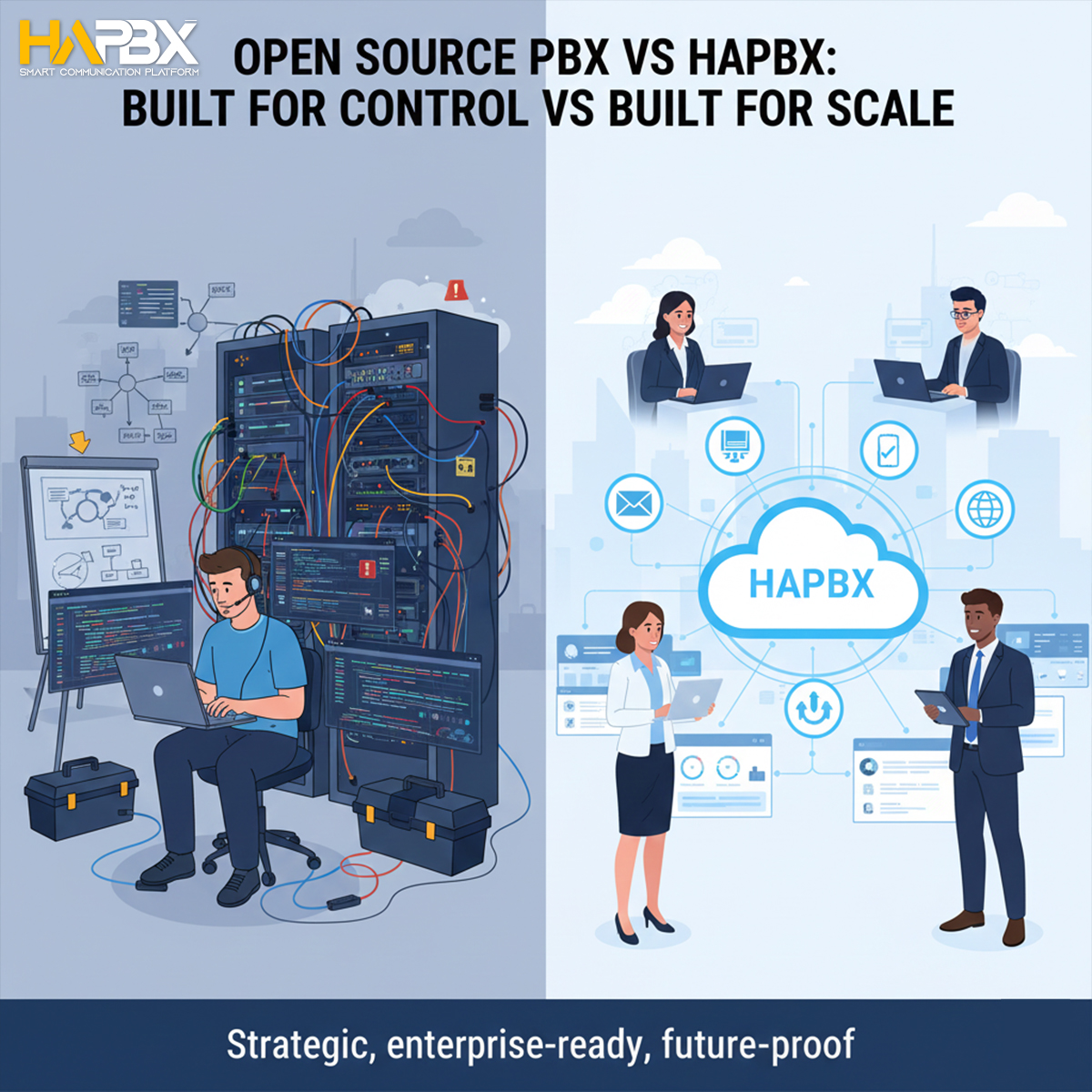
Open source PBX platforms such as Asterisk, FreePBX, or similar systems are often promoted as a free PBX system—a tempting proposition for businesses looking to reduce communication costs. At first glance, the promise is appealing: no license fees, full control, and endless customization.
However, modern enterprises operate in an environment where availability, scalability, security, and operational efficiency matter far more than software licensing costs.
Today’s business communication reality includes:
- Distributed and remote teams across multiple locations
- Customers expecting instant response and 24/7 availability
- Zero tolerance for downtime or degraded call quality
- Growing compliance and security requirements
In this environment, “free” PBX software can quickly become one of the most expensive infrastructure decisions a company makes.
This article compares open source PBX systems with HAPBX, a high-availability, cloud-native enterprise PBX platform, and explains why HAPBX is a better long-term solution for growing businesses.
What Is an Open Source PBX System?
An open source PBX is a software-based phone system built on publicly available source code. Popular examples include Asterisk-based solutions deployed using FreePBX or custom configurations.
Key Characteristics of Open Source PBX
| Aspect | Open Source PBX |
| Licensing | Free software |
| Deployment | Self-hosted (on-prem or cloud VM) |
| Architecture | Single server or manual HA |
| Maintenance | In-house IT responsibility |
| Customization | High (requires expertise) |
| Reliability | Depends on implementation |
While the software itself is free, everything else is not.
The Hidden Costs Behind a “Free PBX System”
1. Infrastructure and Hosting Costs
Open source PBX systems require servers, whether on-premise or in the cloud.
Typical infrastructure expenses include:
Virtual machines or physical servers
Redundant storage and backups
Load balancers for availability
SIP trunking and bandwidth
These costs grow quickly as call volume and user count increase.

2. High IT and Operational Overhead
Unlike a hosted PBX service, open source PBX platforms place full operational responsibility on the business.
| Responsibility | Open Source PBX |
| Installation | Manual |
| Updates & patches | Manual |
| Security hardening | Manual |
| Monitoring | Self-managed |
| Troubleshooting | Internal IT or consultants |
Enterprises often require:
- Dedicated VoIP engineers
- External consultants for upgrades or failures
- Emergency support during outages
3. Downtime Risk and Single Points of Failure
Most open source PBX deployments operate on:
- A single server
- Or a complex DIY HA setup
Even well-designed systems remain vulnerable to:
- OS failures
- Network issues
- Human error during updates
Downtime equals lost revenue, lost calls, and lost trust.
What Is HAPBX?
HAPBX (High Available Private Branch Exchange) is a cloud-native, enterprise-grade PBX platform designed for continuous availability, scalability, and operational simplicity.
Unlike open source PBX systems, HAPBX is not a self-hosted software stack. It is a fully managed hosted PBX service built on a GEO-distributed cluster architecture.
Infrastructure Comparison: Open Source PBX vs HAPBX
| Infrastructure Area | Open Source PBX | HAPBX |
| Hosting | Self-managed server/VM | Managed cloud platform |
| Architecture | Single instance or DIY HA | GEO-distributed clusters |
| Failover | Manual / complex | Automatic |
| Single point of failure | Often yes | No |
| Power & hardware dependency | Yes | No |
Business Impact
HAPBX eliminates infrastructure risk and ensures uninterrupted communication—even during failures.
Reliability & Availability: DIY vs Built-In HA
| Reliability Factor | Open Source PBX | HAPBX |
| Typical uptime | 98.5–99.5% | 99.99%+ |
| Failover | Manual or partial | Automatic |
| Downtime per year | 20–60 hours | Near zero |
| Recovery effort | High | None required |
Business Benefit
High availability directly protects revenue, customer experience, and brand reputation.
Scalability: Engineering Effort vs Instant Elasticity
Open source PBX scalability depends on:
- Server capacity
- Database tuning
- Network design
| Scalability Aspect | Open Source PBX | HAPBX |
| Extensions | Limited by server | Unlimited |
| Concurrent calls | Hardware-dependent | Unlimited |
| Scaling speed | Days or weeks | Instant |
| Cost to scale | High | Minimal |
Business Benefit
HAPBX enables rapid growth without infrastructure redesign or downtime.
Deployment Speed: Weeks vs Minutes
| Deployment Stage | Open Source PBX | HAPBX |
| Server provisioning | Required | Not required |
| Software installation | Manual | None |
| Security configuration | Manual | Pre-secured |
| Go-live timeline | Days to weeks | Minutes |
Business Benefit
Faster deployment accelerates sales, support readiness, and business expansion.
Cost Model: False Savings vs Optimized TCO
| Cost Category | Open Source PBX | HAPBX |
| Software license | Free | Included |
| Hardware / hosting | Required | Included |
| Maintenance | High | Included |
| HA & redundancy | Expensive | Built-in |
| Cost predictability | Low | High |
Total Cost Reality
Over 3–5 years, many enterprises spend 30–70% more maintaining open source PBX systems than using a managed enterprise PBX platform like HAPBX.
Feature Comparison: Core vs Enterprise-Ready
| Feature | Open Source PBX | HAPBX |
| Voice calling | ✔ | ✔ |
| Call recording | Add-on | Included |
| Switchboard | Basic | Advanced |
| IVR | Manual setup | Advanced |
| Analytics & billing | Limited | Built-in |
| Call center features | Custom build | Included (plans) |
| WebRTC | Complex | Native |
Business Benefit
HAPBX turns communication into a data-driven business system, not just a dial tone.
Security & Compliance: Reactive vs Proactive
| Security Area | Open Source PBX Risk | HAPBX Model |
| Patch management | Manual & delayed | Automatic |
| Encryption | Optional | Enforced |
| Exposure to attacks | High if misconfigured | Actively monitored |
| Isolation | Shared environments | Dedicated cloud instance |
| Compliance readiness | DIY | Enterprise-ready |
Business Benefit
Reduced exposure to breaches, fraud, and compliance violations.
Maintenance & IT Focus
| Maintenance Aspect | Open Source PBX | HAPBX |
| Updates | Manual | Automatic |
| IT workload | High | Minimal |
| Downtime during upgrades | Common | None |
| Support model | Internal / consultants | Provider-managed |
Business Benefit
IT teams focus on innovation and growth—not phone systems.
Why HAPBX Is the Best PBX Software for Enterprises
| Enterprise Need | How HAPBX Delivers |
| Reliability | High Availability by design |
| Scalability | Unlimited & elastic |
| Security | Built-in enterprise protection |
| Cost efficiency | Optimized TCO |
| Remote readiness | Native global access |
| Future readiness | Cloud-native & API-ready |
HAPBX enables organizations to operate at enterprise scale without enterprise complexity.
Future-Proofing Business Communication
| Future Factor | Open Source PBX | HAPBX |
| Remote workforce | Complex | Native |
| PSTN phase-out | Risk | Not affected |
| Software evolution | Manual | Continuous |
| Integration readiness | Limited | Strong |
Final Verdict: HAPBX vs Open Source PBX
| Area | Open Source PBX | HAPBX |
| Cost perception | “Free” software | Transparent pricing |
| Availability | Variable | Enterprise HA |
| Scalability | Engineering-dependent | Instant |
| Deployment | Slow | Minutes |
| Risk level | High | Low |
| Enterprise readiness | Limited | Full |
HAPBX: When “Free” Is No Longer Good Enough
Open source PBX systems played a critical role in the early evolution of VoIP. They gave businesses access to modern telephony without expensive licensing fees and offered a level of flexibility that traditional phone systems could not match at the time.
However, as business communication has become mission-critical, software freedom alone is no longer sufficient.
Today’s enterprises require more than just a free PBX system.
They require:
- Continuous availability, where communication never stops
- Predictable performance, regardless of traffic or location
- Built-in security, not dependent on manual configuration
- Operational simplicity, without constant IT intervention
- Long-term cost efficiency, not short-term savings with hidden risks
This is where HAPBX fundamentally differs from open source PBX solutions.
HAPBX is a cloud-native, enterprise PBX system purpose-built to address the three core operational requirements of modern business communication: rapid deployment, stable operation, and long-term cost optimization.
1. Rapid Deployment: From Decision to Live System in Minutes
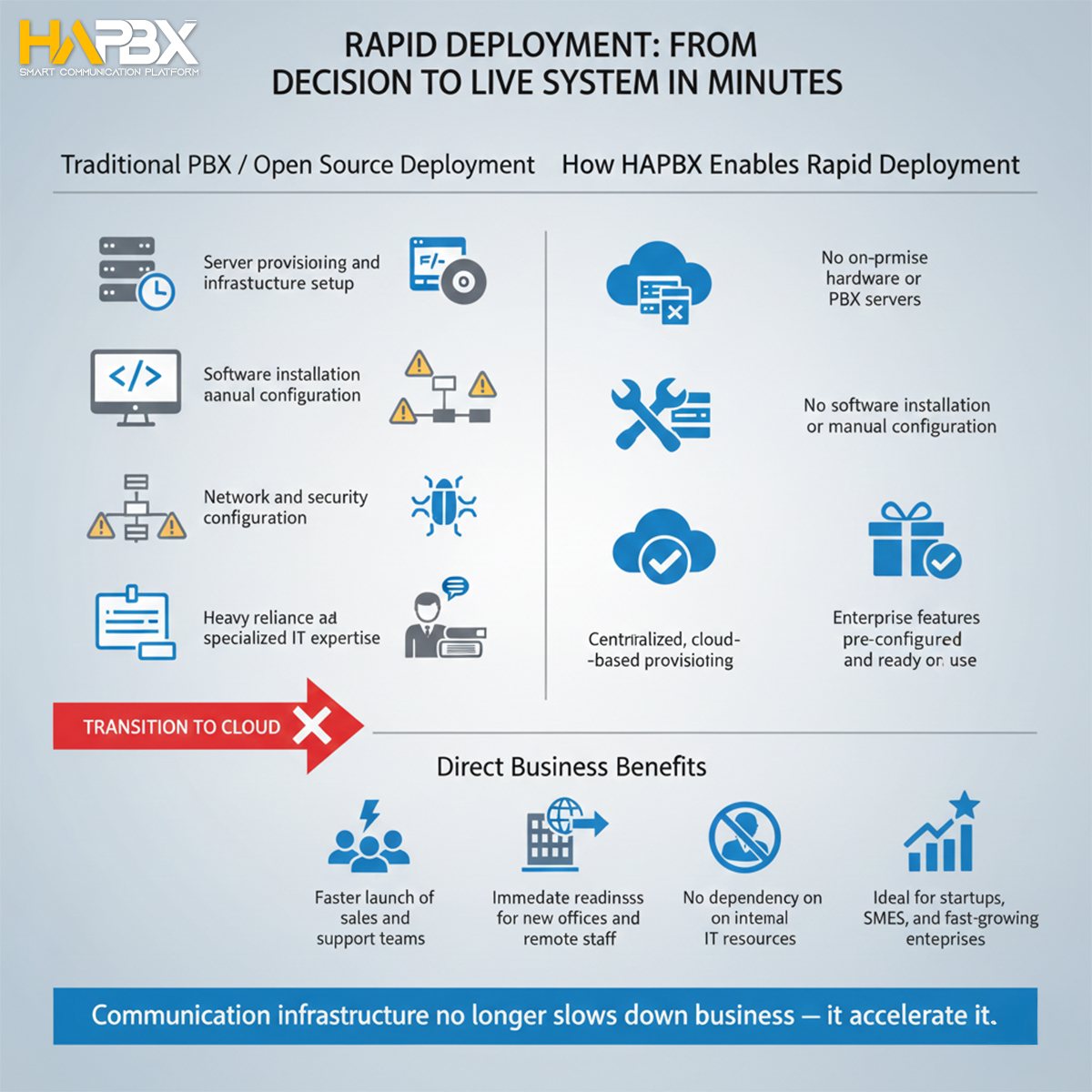
Traditional PBX deployment—especially with open source PBX platforms—requires significant preparation. Businesses must provision servers, install software, configure networks, secure the system, and test call flows. Even in the best scenarios, this process takes days or weeks and depends heavily on specialized IT expertise.
HAPBX removes these barriers entirely.
How HAPBX Enables Rapid Deployment
- No on-premise hardware or PBX servers
- No software installation or manual configuration
- Centralized, cloud-based provisioning
- Enterprise features pre-configured and ready to use
With HAPBX, businesses can activate a fully functional PBX system within minutes, not weeks.
Direct Business Benefits
- Faster launch of sales and support teams
- Immediate readiness for new offices or remote staff
- No dependency on internal IT resources
- Ideal for startups, SMEs, and fast-growing enterprises
Result: Communication infrastructure no longer slows down business—it accelerates it.
2. Stable Operation: High Availability Built into the Core
Open source PBX systems are typically deployed on a single server or a manually configured redundancy setup. While high availability is theoretically possible, it is complex, expensive, and highly dependent on correct implementation and ongoing maintenance.
HAPBX is designed differently.
High Availability Architecture of HAPBX
- GEO-distributed global cluster infrastructure
- Dedicated cloud instances per tenant
- Automatic failover between nodes
- No single point of failure
If one node or region experiences an issue, calls are automatically rerouted without service interruption.
Why This Matters for Enterprises
- 99.99%+ availability with near-zero downtime
- No lost customer calls or missed sales opportunities
- Consistent service quality during outages or incidents
- Reduced operational risk and brand damage
Result: Communication becomes a reliable foundation for daily operations, not a source of uncertainty.
3. Long-Term Cost Optimization: Lower TCO, Higher ROI
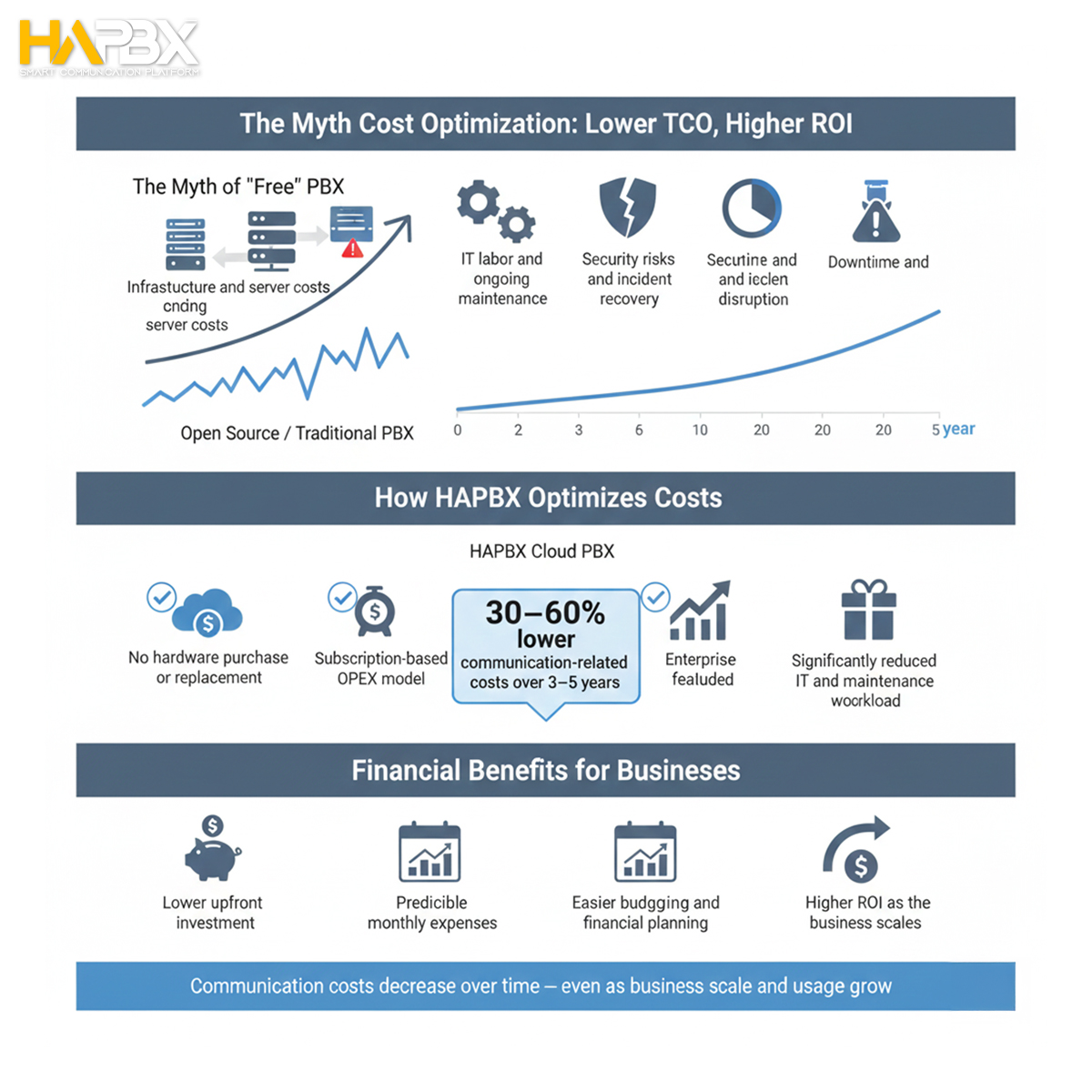
Open source PBX software is free, but operating it at scale is not. Infrastructure costs, IT labor, security risks, downtime, and ongoing maintenance quickly add up. Over time, these hidden costs often exceed the cost of a managed enterprise PBX platform.
HAPBX is built on a dedicated cloud PBX model that optimizes total cost of ownership (TCO) over the long term.
How HAPBX Optimizes Costs
- No hardware purchase or replacement
- Subscription-based OPEX model
- Built-in scalability without additional infrastructure
- Enterprise features included, not sold as add-ons
- Significantly reduced IT and maintenance workload
Compared to traditional PBX systems and common open source PBX deployments, organizations can reduce communication-related costs by 30–60% over a 3–5 year period.
Financial Benefits for Businesses
- Lower upfront investment
- Predictable monthly expenses
- Easier budgeting and financial planning
- Higher ROI as the business scales
Result: Communication costs decrease over time, even as usage and business size increase.
More Than an Upgrade: A Strategic Enterprise Platform
For organizations evaluating the best PBX software, the real decision is no longer about free versus paid.
It is about:
- Risk vs reliability
- Complexity vs efficiency
- Short-term savings vs long-term success
HAPBX is not simply an alternative to open source PBX.
It is a strategic communication platform designed for enterprises that cannot afford downtime, security gaps, or operational inefficiency.
By combining rapid deployment, built-in high availability, and long-term cost optimization, HAPBX delivers what modern enterprises truly need from a PBX system.
HAPBX is not just an upgrade from open source PBX—it is the foundation for scalable, secure, and future-ready business communication.