

Most businesses are vastly overpaying for their phone systems through rigid contracts and per-user fees. Switching to PBX software is the most effective way to eliminate these costs and regain administrative control.
Due to strict budgets and the need for customization, many IT teams turn to free options like open source PBX software as a solution. This guide ranks the top platforms available in 2025 to help you choose the right fit.
However, while the software itself is free, the burden of security, updates, and server uptime shifts entirely to your internal team. We will also compare these DIY options against managed dedicated solutions like HAPBX, for those seeking open-standard flexibility without the maintenance headache.
7 Best Open Source PBX Software Solutions
Choosing the right platform depends entirely on your technical expertise and infrastructure needs. Some solutions offer a simple graphical interface, while others require deep knowledge of command-line coding.
We have tested and ranked the top contenders in the open source PBX comparison to help you decide. Here are the best platforms driving the VoIP industry in 2025.
1. Asterisk (The Engine of VoIP)

Asterisk is considered the grandfather of the open source PBX
Asterisk is widely considered the grandfather of the open source VoIP PBX world. Developed by Digium, it functions more as a telephony toolkit than a ready-to-use product.
It turns an ordinary computer into a communications server. Asterisk powers many other systems on this list, acting as the core engine that handles voice, video, and data.
However, it lacks a native Graphical User Interface (GUI). To use Asterisk directly, you must be comfortable writing dial plans in configuration files.
Best For: Developers and engineers building a custom open source PBX system from scratch.
2. FreePBX (The Industry Standard)
If Asterisk is the engine, FreePBX is the dashboard. It is currently the best free PBX software globally in terms of install base.
Built on top of Asterisk, FreePBX provides a user-friendly web GUI. This allows administrators to set up extensions, IVRs, and trunks without touching a single line of code.
The ecosystem is massive, with a vast library of commercial and free modules. You can easily find a PBX download ISO that bundles the Linux OS, Asterisk, and FreePBX together for a quick install.
Best For: SMBs and IT admins who want the power of Asterisk without the complexity of the command line.
*FreePBX is powerful, but it requires you to be the system administrator. If you want the features of FreePBX (private instance, total control) but don’t want to manage Linux servers yourself, consider looking at HAPBX later in this guide. HAPBX offers the same dedicated architecture but is fully managed for you.
3. FusionPBX (High Scalability)
FusionPBX differs from the options above because it runs on FreeSWITCH, not Asterisk. It is a highly scalable open source SIP PBX designed for carrier-grade performance.
Its defining feature is multi-tenancy. This allows a single server to host multiple separate domains for different clients, keeping their data and traffic completely isolated.
The interface is modern and highly responsive. For businesses expecting high call volumes, FusionPBX offers superior stability compared to many Asterisk-based forks.
Best For: Service providers (ITSPs) and large enterprises needing a multi-tenant environment.
4. Issabel (The Unified Communications Hub)
Rising from the ashes of the popular Elastix project, Issabel is a comprehensive PBX application. It goes beyond just voice calling.
Issabel integrates fax servers, email, instant messaging, and CRM features into a single open source PBX software suite. It creates a true Unified Communications environment out of the box.
The platform includes FOP2 (Flash Operator Panel) for real-time switchboard monitoring. This makes it an excellent choice for call centers that need visual management tools without extra costs.
Best For: Call centers and offices needing all-in-one communication tools.
5. Kamailio (The SIP Proxy)

Kamailio is a robust open source PBX server
Kamailio is not a traditional media server. It is a robust open source PBX server designed to handle thousands of call setups per second.
It functions primarily as a SIP proxy, load balancer, and routing engine. Kamailio sits in front of your media servers (like Asterisk or FreeSWITCH) to distribute traffic efficiently.
You wouldn’t use this as a standalone office phone system. Instead, it is the security and routing layer for massive VoIP networks.
Best For: Large ISPs and carriers managing massive traffic loads.
6. SIP Foundry / sipXecs
sipXecs (formerly SIP Foundry) takes a different architectural approach. It replaces the traditional media server model with a MongoDB-driven configuration.
This IP PBX open source solution focuses on routing calls directly between endpoints whenever possible. This reduces the load on the central server and improves audio quality.
It creates a highly resilient cluster for redundancy. If one node fails, the system heals itself, ensuring better uptime than single-server setups.
Best For: Enterprises prioritizing audio quality and decentralized architecture.
7. 3CX (Free Standard)
While not strictly open source, 3CX often appears when users search for the best free IP PBX software. It offers a free tier for small businesses.
Unlike the Linux-heavy tools above, 3CX is known for its excellent Windows support. It provides a polished, commercial-grade experience with zero configuration hassles.
However, note that it is proprietary. You cannot modify the core code, and the free version has limitations on simultaneous calls compared to a true free open source PBX.
Best For: Windows-centric businesses that prefer ease of use over code modification.
Quick Comparison: Top Open Source PBX Platforms
| Platform | Core Engine | Interface (GUI) | Difficulty | Best For |
| Asterisk | Asterisk | No (CLI only) | Expert | Developers building custom apps |
| FreePBX | Asterisk | Yes (Web) | Medium | SMBs & Standard Office VoIP |
| FusionPBX | FreeSWITCH | Yes (Modern) | High | Multi-tenant Service Providers |
| Issabel | Asterisk | Yes (Suite) | Medium | Call Centers (Unified Comms) |
| Kamailio | SIP Proxy | No (Config) | Expert | Massive Carrier Routing |
| sipXecs | MongoDB | Yes | High | Distributed Enterprises |
| 3CX | Proprietary | Yes (Polished) | Low | Windows Users (Non-Tech) |
Windows vs. Linux: Choosing Your OS
When searching for open source PBX windows solutions, many IT administrators hit a wall. The reality of the VoIP industry is that the vast majority of open-source telephony is built natively for Linux.
Asterisk, the core engine behind most systems, was designed for Unix-like environments. Linux offers superior handling of real-time audio packets and significantly lower resource overhead compared to Windows.
“There is almost no true open source PBX software windows version that runs natively. Most solutions requiring Windows are proprietary, not open source.”
However, if your infrastructure is strictly Microsoft-based, you still have two viable paths forward. You can either choose a proprietary Windows-native application or use virtualization technology.
Native Windows Options (Proprietary)
If you absolutely need a free IP PBX for Windows that installs directly on the OS, your choices are limited. The most prominent option is 3CX.
While not open source, 3CX offers a free standard license that runs smoothly on Windows 10 and Server editions. It is often the go-to for users searching for a free VoIP PBX software windows solution due to its ease of setup.
Another option is Brekeke. However, modern businesses are bypassing the OS limitations entirely by choosing Cloud-Native Dedicated Solutions like HAPBX. Since HAPBX runs in a managed cloud environment, your team can access the system from any Windows PC via a web browser without needing to install or maintain complex server software locally
Virtualization: The Best Workaround
To get the full power of an open source PBX system on a Windows machine, virtualization is the professional standard.
By using Hyper-V (built into Windows Server and Pro) or VMware Workstation, you can create a virtual Linux machine. This allows you to install FreePBX, Issabel, or Asterisk right on top of your Windows hardware.
This method gives you a software based PBX for windows environment without compromising stability. You get the reliable Linux engine for telephony while managing the physical server through your familiar Windows interface.
Quick Comparison: OS Suitability for PBX
| Feature | Linux Native (Recommended) | Windows Native (Proprietary) | Windows + Virtualization |
| Open Source | 100% Support | Rare / Non-existent | 100% Support |
| Stability | High (Uptime focused) | Medium (Reboot updates) | High (Dependent on VM) |
| Cost | Free (OS + App) | License Fees (OS + App) | Free App / Paid OS |
| Setup | Command Line / ISO | MSI Installer (Easy) | ISO Install (Medium) |
Recommendation: Unless you have a specific requirement for a free Windows IP PBX, we strongly recommend running your telephony stack on Linux or a dedicated virtual instance for maximum uptime.
Deploying Your PBX: Virtual vs. Physical Server
Once you have selected your open source PBX software, the next critical decision is deployment. Where will this software live?
Unlike proprietary cloud services where the vendor hosts everything, open source puts the infrastructure responsibility on you. You generally have two architectural choices: On-Premise or Virtual (Cloud).
On-Premise (Bare Metal)
This is the traditional method. You install the PBX server software directly on a physical server located in your office.
- Pros: You have absolute control over the hardware. Voice traffic stays on the local LAN, which can sometimes offer lower latency if your internet connection is poor.
- Cons: You are vulnerable to hardware failure. If that server’s power supply dies, your entire company loses phone service. You also need expensive interface cards for legacy phone lines.
Virtual PBX (Cloud Hosted)
The modern trend is to deploy virtual PBX open source solutions. Instead of buying hardware, you rent a VPS (Virtual Private Server) from providers like AWS, Google Cloud, or DigitalOcean.
- Pros: High flexibility and no hardware to buy. This is the architecture used by next-generation platforms like HAPBX. By using a Dedicated Instance in the cloud, HAPBX allows businesses to scale instantly without the hardware risks of on-premise setups, effectively perfecting the virtual PBX model.
- Cons: You are now responsible for cloud security. If you don’t configure the firewall correctly, your software based PBX is exposed to the public internet, making it a prime target for SIP scanners and hackers.
Which Architecture is Best?
For most modern businesses, the virtual PBX software route is superior due to disaster recovery capabilities. However, both methods share a common flaw: YOU are the system administrator. Whether it’s a physical box or a cloud VPS, if the open source SIP PBX service crashes at 2:00 AM, you are the one who has to wake up and fix it.
This reliance on self-management leads us to the biggest overlooked factor in open source telephony: the hidden costs.
For most modern businesses, the virtual open source PBX software route is superior due to disaster recovery capabilities
The Hidden Costs of Open Source VoIP
The allure of zero licensing fees is undeniable. However, experienced IT managers know that “free software” rarely means “free to operate.”
When you deploy a self-hosted PBX open source system, you trade money for labor. The Total Cost of Ownership (TCO) often creeps up in unexpected ways, turning a cheap project into an expensive burden.
Security is Your Responsibility
Security is the most immediate risk. In a DIY environment, you are the only line of defense against toll fraud and SIP scanners.
You must manually configure firewalls, manage SSL certificates, and set up Fail2Ban rules. If a hacker breaches your PBX VoIP open source server, your company is liable for thousands of dollars in fraudulent international calls. There is no vendor safety net to absorb the cost.
The Maintenance Nightmare
Software does not stay static. Linux kernels need patching, and Asterisk modules require regular updates to stay secure.
This maintenance consumes valuable IT hours. If a bad update breaks your routing configurations, there is no support hotline to call. You are left searching community forums while your office phones sit silent.
Performance Instability
Finally, consider the infrastructure risk. If you host on a generic shared cloud VPS, you suffer from the “noisy neighbor” problem.
Another user on the same physical server can hog resources, causing jitter or dropped calls on your system. Unlike a dedicated open source PBX VoIP appliance, shared environments cannot guarantee the consistent low latency that voice traffic demands.
Is saving on license fees worth the risk of a critical business outage? For many enterprises, the answer is no.
HAPBX: The Dedicated Cloud Alternative to DIY
If your business demands the control of a private system but cannot afford the downtime or complexity of a DIY project, HAPBX (High Available Private Branch Exchange) is the engineered answer.
Operating on a Dedicated Instance Infrastructure, HAPBX bridges the gap between open-source flexibility and enterprise reliability. We define our value through three core pillars: Rapid Deployment, Unwavering Stability, and Optimized Operational Costs.
1. Rapid Deployment (No Technical Complexity)
Building an open-source PBX from scratch typically takes weeks of hardware procurement, Linux configuration, and security hardening. HAPBX eliminates this friction entirely.
- Instant Readiness: We provide a fully configured, “ready-to-use” Cloud PBX environment. You get the power of a private system without ever touching a command line.
- Seamless Expansion: Need to add extensions or integrate CRM? It’s handled instantly via our modern interface, allowing businesses to launch complex call flows in hours, not months.
2. Unwavering Stability (High Availability)
For IT teams, uptime is the single most critical metric. Unlike self-hosted servers that act as a single point of failure, HAPBX guarantees continuous operation through our Global Cluster Infrastructure.
- Zero Downtime: Data is synchronized across multiple nodes. If one node encounters an issue, the system executes an automatic failover instantly, keeping your lines active.
- Guaranteed Performance: By isolating resources, we maintain a stable latency of approximately 50ms and support 100+ concurrent calls by default. Your sales team never drops a critical connection due to “noisy neighbors” or server overload.
3. Cost Optimization (Reduced IT Burden)
While “free” software seems cheap initially, the hidden costs of IT salaries and maintenance are massive. HAPBX shifts your budget from unpredictable maintenance to a predictable, high-value investment.
- Eliminate IT Overheads: Your IT team no longer needs to act as 24/7 server guards. We handle all security patching, DDoS mitigation (TLS/SRTP), and updates. This significantly reduces your operational expenses (OpEx) related to specialized personnel.
- Unlimited Growth: Unlike competitors charging per user, HAPBX offers Unlimited Extensions. You can scale from 10 to 1,000 employees without your phone bill exploding, ensuring the lowest Total Cost of Ownership (TCO) as you grow.
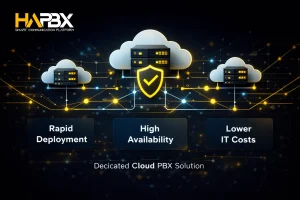
HAPBX – The Dedicated Cloud Alternative to DIY
Comparison: Open Source vs. HAPBX Managed Cloud
To make the final decision easier, look at the fundamental differences between building your own system and deploying a dedicated HAPBX instance.
| Feature | DIY Open Source PBX | HAPBX (High Availability Cloud) |
| Infrastructure | Your Hardware or generic VPS | Dedicated Isolated Cloud Instance |
| Management | You fix bugs & patches | Fully Managed by Provider |
| Downtime Risk | High (Single Point of Failure) | Near-Zero (Global Cluster) |
| Security | You configure firewalls | Enterprise Security Included |
| Scalability | Manual hardware upgrades | Instant Cloud Scaling |
| Cost Model | “Free” software + High Labor | Predictable Subscription |
Frequently Asked Questions
- Is open source PBX software truly free?
The software PBX code is free to download, but the system is not free to operate. You still need to pay for the server hardware (or cloud VPS hosting), SIP trunking services for outside calls, and the electricity to run it. The biggest hidden cost is the IT labor required for maintenance.
- Can I run free PBX software on Windows?
Most true open source PBX projects are designed for Linux. However, you can use virtualization software (like VMware or Hyper-V) to run a Linux PBX on a Windows machine. Alternatively, proprietary tools like 3CX offer a free standard version that runs natively on Windows.
- What is the difference between a virtual PBX and an on-premise PBX?
An on-premise system runs on a physical server inside your office. A virtual PBX open source solution runs on a cloud server (VPS) like AWS or DigitalOcean. Virtual options offer better flexibility and disaster recovery since they don’t rely on your office building’s power or internet.
- Why should I choose HAPBX over a free open source system?
While open source offers control, it lacks guaranteed reliability. HAPBX provides the same dedicated control (private instance, private IP) but removes the technical risk. We handle the security and updates, guaranteeing High Availability uptime that a DIY server cannot match.
Conclusion: Securing Your Future
The choice between the best free IP PBX software and a managed solution comes down to your priorities.
If you are a developer or a hobbyist who loves tinkering with code, downloading an open source PBX is a fantastic learning experience. It offers unmatched freedom for those with the time to manage it.
However, for modern enterprises, downtime is not just an inconvenience—it is a critical failure.
If your goal is to have a communication system that is “Always Available,” secure, and maintenance-free, HAPBX is the superior choice. Stop struggling with infrastructure and start communicating with confidence.
Ready to upgrade to High Availability? Contact HAPBX today to see how our Dedicated Instance Cloud PBX can transform your business connectivity.