
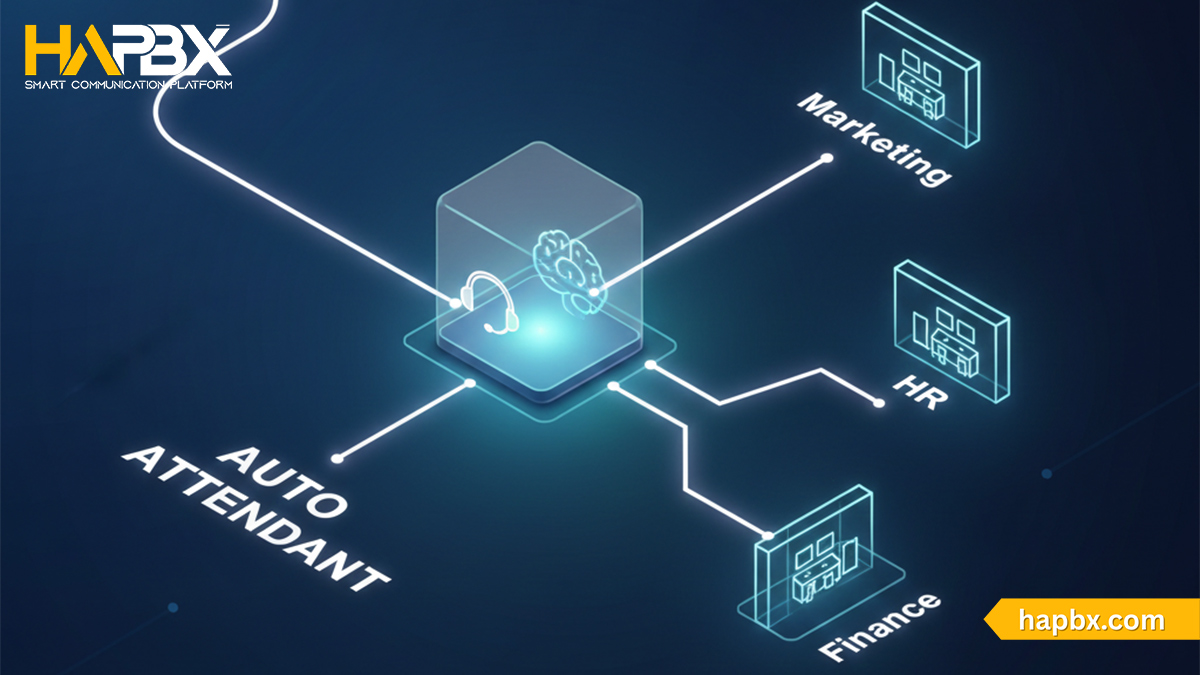
Missing important customer calls, struggling with high reception costs, or projecting an unprofessional image during peak hours? A PBX auto attendant solves these critical business challenges by automating call management with intelligent routing, professional greetings, and 24/7 availability. This automated system ensures every caller receives immediate attention and reaches the right person or department without delays – dramatically improving customer satisfaction while freeing your team for strategic work.
In this complete guide, we’ll demystify PBX auto attendant technology, reveal implementation strategies proven to work, and show how HaPBX delivers enterprise-grade reliability with AI-powered intelligence and seamless scalability for businesses of all sizes.
Auto Attendant
Complete Definition: Understanding PBX Auto Attendant Technology
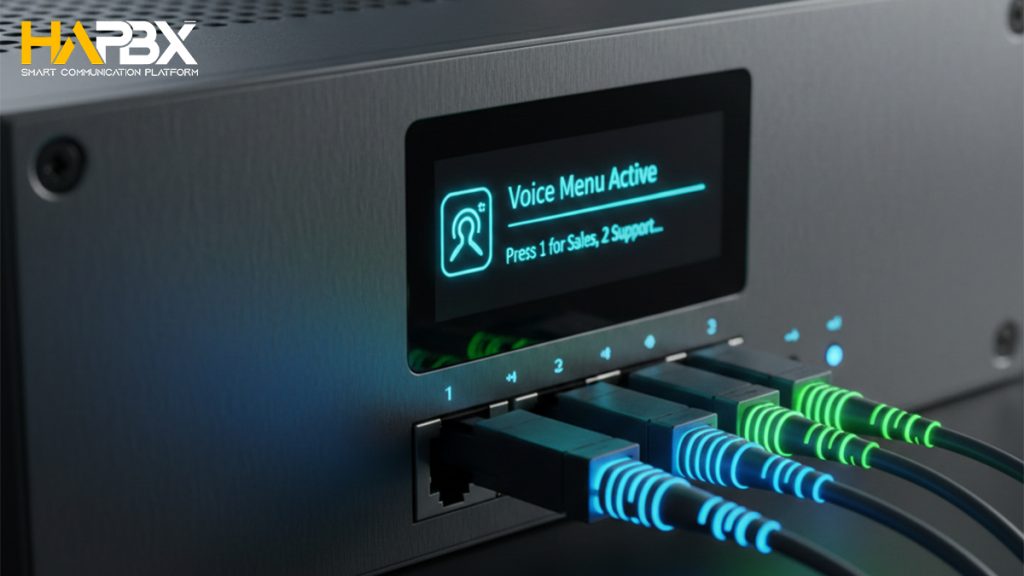
An auto attendant, also known as a virtual receptionist or automated attendant, is an automated phone system feature that answers incoming calls and directs them to the appropriate department or individual without requiring a live operator. When callers reach your business, they hear a pre-recorded greeting with menu options, typically instructing them to press specific keypad numbers to reach different destinations. For example: “Press 1 for Sales, Press 2 for Support, Press 0 for an operator.”
The system works primarily through keypad input rather than voice recognition, making it similar to an Interactive Voice Response system but more straightforward. Modern auto attendants can create multi-level menus with submenus, allowing callers to navigate through multiple layers of options to reach their intended destination. The technology replaces the need for human receptionists to manually answer and transfer every call, enabling businesses to handle multiple simultaneous calls efficiently regardless of call volume.
HaPBX offers highly customizable auto attendants that route calls based on various criteria. You can configure the system to direct sales inquiries differently from support requests, or automatically redirect overflow calls to another department when primary teams are busy. This ensures customers connect quickly to the right person without waiting on hold or going through multiple transfers.
By implementing an auto attendant, businesses project a more professional image while making themselves easier to reach. The system operates around the clock, properly handling calls even outside regular business hours when live operators are unavailable. This combination of efficiency, professionalism, and availability makes auto attendants an essential feature for businesses looking to optimize their phone communications.
Auto Attendant vs IVR vs Virtual Receptionist: Key Differences Explained
While these terms are often used interchangeably in business communications, they represent different levels of automation and functionality. Understanding these distinctions helps you select the most appropriate solution for your organization’s needs.
An auto attendant provides foundational call routing based on keypad inputs, directing callers to departments or extensions through menu options. An Interactive Voice Response system extends this capability significantly, enabling callers to complete complex transactions such as processing payments, checking account balances, or retrieving specific information through voice or keypad commands. The term virtual receptionist typically refers to auto attendant technology but emphasizes its role as a digital replacement for human operators.
| Feature | Auto Attendant | IVR System | Virtual Receptionist |
| Primary Function | Basic call routing and menu navigation | Advanced self-service transactions and information retrieval | Cloud-based call management with receptionist-like capabilities |
| Complexity Level | Simple to moderate | Moderate to highly complex | Simple to moderate |
| Self-Service Capabilities | Limited (call routing only) | Extensive (payments, account access, data retrieval) | Moderate (routing, voicemail, basic information) |
| Deployment Model | On-premise or cloud | On-premise or cloud | Cloud-based only |
| Setup & Maintenance | Low setup, low to moderate maintenance | High setup, high maintenance requirements | Low setup, minimal maintenance (provider-managed) |
| Cost Structure | One-time or subscription | Higher implementation and ongoing costs | Subscription-based, lower total cost of ownership |
| Scalability | Moderate | High | Very high |
| Integration Capabilities | Minimal | Extensive (CRM, payment systems, databases) | Moderate (business applications, CRM) |
| Analytics & Reporting | Basic call metrics | Comprehensive interaction analytics | Detailed call analytics and reporting |
| Best Suited For | Small to medium businesses with straightforward routing needs | Large enterprises and contact centers requiring self-service automation | Businesses of all sizes seeking flexible, cloud-based solutions |
The choice between these technologies should align with your organization’s operational priorities and customer service strategy. The optimal approach involves a hybrid strategy that leverages the strengths of each technology. A virtual receptionist can handle initial call routing and common inquiries, while integrated IVR functionality addresses specific self-service needs for particular customer segments. This layered approach maximizes automation benefits while maintaining the flexibility to adjust as business requirements evolve.
Essential knowledge for getting started with PBX Auto Attendant
Core Concepts Every Business Owner Should Know
At the heart of any auto attendant is the Private Branch Exchange (PBX), which serves as your organization’s internal telephone network. This system manages incoming and outgoing calls while providing features like call routing, conferencing, and voicemail.
Extension systems work within the PBX framework, assigning unique numbers to each user or department, allowing callers to reach specific destinations without going through a central operator.
SIP trunk technology replaces traditional phone lines with internet-based connections, offering greater flexibility and cost savings.
Menu structure design determines how callers navigate through your auto attendant – a well-planned hierarchy ensures callers can quickly reach their desired destination without frustration.
Technical Basics: What You Need to Understand
DTMF (Dual-Tone Multi-Frequency) protocols form the backbone of keypad-based navigation in auto attendant systems. When callers press buttons on their phone, DTMF generates specific audio tones that the system recognizes and processes to execute commands.
VoIP (Voice over Internet Protocol) technology converts voice signals into digital data packets transmitted over internet connections, enabling cost-effective, feature-rich communication solutions.
Bandwidth and network requirements vary based on call volume and quality expectations. As a general guideline, each concurrent call requires approximately 100 kbps of bandwidth. Businesses must ensure their internet connection can accommodate peak call volumes while maintaining quality for other business applications. Network stability and low latency are equally important for preventing dropped calls and ensuring clear audio quality.
How does an Auto Attendant work?
An auto attendant operates as an automated telephony system that greets incoming callers with a pre-recorded message and presents menu options for routing. When a call arrives, the system automatically answers and plays a customized greeting, instructing callers to select their desired destination using their phone keypad. This streamlined process enables businesses to handle large call volumes efficiently without requiring human operators.
The technical mechanism relies on dual tone multi-frequency (DTMF) signals, commonly known as touch tones. When callers press keypad numbers, these inputs generate DTMF signals that the telephony application program interface (TAPI) detects and interprets. The system then routes calls to various destinations including specific extensions, department call queues, VoIP virtual phones, mobile devices, external numbers, voicemail boxes, or other interactive voice response systems. During transfers, callers may hear hold music or informational messages while connections are established.
Modern auto attendant systems like HaPBX provide flexible configuration options for different business scenarios. Organizations can establish separate call handling rules for normal business hours versus after-hours periods. When employees are unavailable, the system automatically provides alternative actions such as voicemail routing, callback options, or redirection to after-hours support teams. This ensures continuous professional call handling around the clock, maintaining service quality regardless of when customers reach out while eliminating the need for staff availability outside regular working hours.
Key features and capabilities of professional PBX Auto Attendant
Modern auto attendant systems deliver a comprehensive suite of features designed to streamline call management while enhancing customer experience. These capabilities transform how businesses handle incoming communications, ensuring every caller reaches the right destination efficiently.
- Self-Service IVR System allows callers to navigate customizable menus using keypad inputs or voice commands. Callers can self-direct to appropriate departments without waiting for a live operator. Advanced systems handle complex tasks like providing account information or processing transactions, reducing agent workload.
- Intelligent Call Routing and Call Queue Management directs calls to the most qualified agents based on skills, availability, and workload. When all agents are busy, queue management organizes callers, provides wait time estimates, and offers callback options to minimize abandonment. This ensures efficient call distribution and prevents bottlenecks.
- Time-Based Routing automatically adjusts call handling based on your schedule. Calls route to departments during business hours, to voicemail or on-call staff after hours, and provide closure information during holidays. This maintains professional communication regardless of office availability.
- Multi-Level Menu Systems create hierarchical navigation with progressively specific options. While this allows complex organizational structures, best practices recommend limiting depth to 3-4 levels to prevent caller frustration.
- Dial-by-Name and Dial-by-Extension enable direct access to specific individuals. Callers can enter name letters via keypad to reach employees through the directory, or dial extension numbers directly when known, bypassing menu navigation entirely.
- Voicemail Integration captures messages when employees are unavailable, directing calls to individual, departmental, or group mailboxes. Cloud-based systems often include voicemail-to-email transcription, allowing recipients to read messages as text for faster processing.
- Call Forwarding and Transfer provide flexible routing to mobile devices, external numbers, or alternative locations. Systems support both attended transfers (with caller announcement) and unattended transfers (direct routing), ensuring seamless communication regardless of employee location.

Benefits & Why Businesses Use Auto Attendants
Auto attendant systems deliver measurable benefits that improve customer experience, operational efficiency, and cost management across organizations of all sizes:
Enhanced Customer Experience and Professional Image
Auto attendants ensure every call receives immediate attention with no ringing or busy signals, demonstrating respect for caller time. Professional greetings make businesses of any size sound established and trustworthy, while callers navigate directly to departments without unnecessary hold times. Custom messaging for different hours, holidays, and promotions ensures relevant, professional responses always.
24/7 Availability and Never Missing Opportunities
Unlike human receptionists, auto attendants operate continuously without breaks, ensuring round-the-clock call handling. After-hours callers can leave messages, access information, or request callbacks, preventing missed sales opportunities and service requests.
Increased Productivity and Operational Efficiency
Automating call handling frees staff to focus on higher-value tasks like customer support and project management. Consistent call processing eliminates human routing errors, while advanced routing options based on agent skills and availability optimize resource allocation. IVR analytics reveal caller patterns, enabling continuous menu refinement.
Significant Cost Savings
Auto attendants reduce or eliminate dedicated reception staff costs, offering professional call handling at a fraction of traditional staffing expenses. Small businesses gain enterprise-level capabilities without full-time receptionists, while larger organizations reallocate staff to strategic roles. Elimination of onboarding and training costs further enhances ROI.
Versatile Call Management and Scalability
Modern systems handle high call volumes effortlessly, managing multiple simultaneous callers without service degradation. Flexible routing to queues, voicemail, external numbers, and directories accommodates complex organizational structures. Businesses can prioritize emergency calls, create VIP pathways, or route toll-free calls differently, with systems scaling seamlessly as operations expand.
Industry-Specific Applications
Contact centers use auto attendants to filter calls and improve first-call resolution, while healthcare providers handle appointment scheduling and prescription refills. Financial institutions process account inquiries, and retail businesses manage order status and store information, demonstrating versatility across industries.
Complete Guide: How to Choose, Set Up & Optimize Your Auto Attendant
Implementing an auto attendant system requires careful planning across selection, setup, and ongoing optimization to maximize effectiveness. Below are the steps to set up a complete Auto Attendant solution that you can refer to:
Step 1: Choosing the Right Auto Attendant Solution
Evaluate on-premise versus cloud-based systems based on your business needs and resources. Cloud solutions eliminate hardware costs, provide automatic updates, and offer superior scalability with subscription-based pricing, making them ideal for most businesses. Evaluate features like multi-level menus, time-based routing, CRM integration, and analytics to ensure alignment with your call handling needs.
Step 2: Planning and Implementation Process
Map your call flow by identifying common caller needs and designing intuitive pathways with 2-3 selections maximum to reach destinations. Create a visual diagram documenting routing rules for business hours, after-hours, and holidays. Design user-friendly menus with 5-7 options maximum, organized by call frequency, and always include “Press 0 for operator” as a safety net.
Step 3: Best Practices for Optimization
Limit menu depth to 3-4 levels maximum and present 5-7 options per menu to prevent caller frustration. Write conversational scripts that begin with brief greetings, present options clearly with distinct pauses, and avoid lengthy preambles.
Avoid common mistakes like forcing callers through promotional messages before menu access, using ambiguous descriptions, creating dead-end menus, or implementing untested routing paths that damage customer trust.
Step 4: Ongoing Management and Improvement
Monitor call analytics monthly including call volume, peak times, menu navigation patterns, and abandonment rates to identify optimization opportunities. Conduct weekly testing of all menu paths from external numbers, especially after configuration changes. Keep employee directories current, train staff on system features, and document all configurations for reference.

HaPBX Auto Attendant Solution: Enterprise-Grade Cloud Communication
HaPBX delivers enterprise-grade cloud PBX solutions with advanced auto attendant capabilities designed for businesses requiring maximum reliability and operational efficiency. Built on dedicated instance architecture with global cluster infrastructure, HaPBX ensures stable connectivity with ultra-low latency and virtually zero downtime, making it ideal for organizations where communication continuity directly impacts customer satisfaction and revenue.
Key Features and Competitive Advantages
- High Availability Architecture: HaPBX’s distributed infrastructure with automatic failover ensures your auto attendant operates continuously even during server failures or network outages, preventing missed calls and protecting brand reputation.
- AI-Powered Intelligence: Integrated AI capabilities provide intelligent call routing analysis, pattern recognition, and comprehensive analytics that reveal caller behavior trends for continuous menu optimization.
- Zero Installation WebRTC: Browser-based communication enables employees to receive auto attendant-routed calls on any device without software downloads, perfect for remote teams and multi-location operations.
- Unlimited Scalability: Instantly add extensions, queues, and routing options through the web portal – scale seamlessly from dozens to thousands of daily calls without system redesign.
- Expert Technical Support: Access engineers who understand advanced routing logic and can help optimize complex auto attendant configurations, troubleshoot issues, and implement sophisticated call handling strategies.
- Comprehensive Features: Built-in call recording, detailed menu analytics, advanced IVR with database integration, and multi-tenant support for managing separate auto attendants across different brands or departments.
Whether you’re a growing startup seeking professional call handling or an established enterprise requiring sophisticated routing with guaranteed uptime, HaPBX provides the infrastructure, features, and support necessary to deliver exceptional caller experiences. With transparent pricing, rapid deployment, and no long-term contracts, businesses can implement enterprise-grade auto attendant capabilities without the traditional complexity and capital investment associated with advanced communication systems.
FAQs
What’s the main purpose of an auto attendant?
The primary purpose is to automate and streamline inbound call routing by professionally greeting every caller and directing them to the correct person or department quickly and efficiently. This improves customer service while freeing staff from manual call-handling tasks, increasing overall productivity.
What does ACD mean in a call center?
Automatic Call Distribution (ACD) routes callers to the most appropriate agent based on criteria like availability, queue times, and skill sets. After callers select options from the auto-attendant menu, ACD takes over to efficiently distribute calls among available agents, ensuring optimal resource utilization.
Can an auto attendant play music on hold?
Yes, most PBX systems can play music or custom marketing messages while callers are being transferred or waiting in queue. This is an effective opportunity to share information about new products, promotions, or company updates.
Is setting up an auto attendant difficult?
Modern PBX solutions feature intuitive, user-friendly interfaces with drag-and-drop or menu-driven setup that requires no advanced technical skills. Most businesses can configure basic auto attendants within hours, with more complex call flows taking a day or two to design and test.
Transform Your Business Communication with HaPBX Auto Attendant
Professional auto attendants have become essential for delivering the responsive, efficient service customers expect while reducing operational costs and projecting enterprise-level professionalism. Modern systems provide 24/7 availability, intelligent call routing, and seamless scalability – competitive advantages that directly impact customer satisfaction and business growth.
HaPBX delivers enterprise-grade reliability with AI-powered intelligence, native CRM integration, and expert support at accessible pricing. Whether handling dozens or thousands of daily calls, HaPBX ensures consistent, professional caller experiences that build customer trust and loyalty.
Experience the HaPBX difference firsthand with a free demo – where you can explore our intuitive interface, test intelligent call routing in real-time, design custom call flows for your business, and see how enterprise-grade features transform your customer interactions without any commitment. Don’t let outdated systems cost you customers. Join organizations worldwide using HaPBX’s intelligent auto attendant solution.