

Is your VoIP system struggling with random dropped calls, one-way audio issues, or the frustration of not being able to register a mobile app and a desk phone simultaneously?
If you are still relying on legacy configurations, you are likely fighting a losing battle against deprecated software.The industry has officially moved on, leaving administrators with a critical choice: upgrade your infrastructure or risk a total communication breakdown. The solution to these stability nightmares lies in the modern protocol stack known as PJSIP.
In this guide, we will break down exactly what PJSIP is, compare it to the old architecture, and explain the essential components of a robust configuration. Finally, we will help you decide whether to build this stack yourself or leverage an enterprise-grade solution like HAPBX to secure your communication infrastructure immediately.
What is PJSIP?
PJSIP (Project PJSIP) is a free, open-source, high-performance multimedia communication library written in C language. It implements standard-based protocols including SIP (Session Initiation Protocol), SDP, RTP, STUN, TURN, and ICE.
It is not just a simple driver; it is a comprehensive protocol stack that serves as the backbone for the modern version of Asterisk—the world’s most popular open-source PBX software. Because of its modularity and efficiency, PJSIP is the engine of choice for enterprise-grade platforms and managed solutions like HAPBX, which rely on it to deliver robust, high-availability service.
PJSIP vs. SIP: Clearing the Confusion
One of the most common questions for those new to VoIP is regarding the difference between pjsip vs sip. To understand the architecture, it is important to distinguish the tool from the rules:
- SIP is the protocol (the language). It is the set of rules defined by the IETF that dictates how a call is set up and torn down.
- PJSIP is the implementation (the software). It is the specific library that “speaks” the SIP language efficiently.
Think of SIP as “English grammar” and PJSIP as a “Professional Translator” who speaks it fluently.
PJSIP is designed to be modular. It doesn’t just handle the signaling; it utilizes PJMEDIA (the media component of the library) to manage the actual audio and video flow (pjmedia pjsip). This separation of duties allows for cleaner code, better media handling, and superior integration with modern network infrastructures.
PJSIP vs Chan SIP: Why the Industry Has Shifted
If you have managed an Asterisk server for more than five years, you are likely familiar with chan sip, the original SIP channel driver. However, the industry has aggressively shifted away from it. In fact, in recent versions of Asterisk, chan_sip has been deprecated and removed entirely.
Understanding the battle of chan sip vs pjsip is crucial for anyone maintaining a PBX or looking to upgrade their business communication infrastructure. The shift isn’t just about “new vs. old”—it is about architecture, performance, and the demands of the modern workforce.
1. Monolithic vs. Modular Architecture
The legacy chan sip driver was built as a monolithic block of code. It handled everything—SIP parsing, transaction management, and dialog management—in one giant, tangled mess. This made it incredibly difficult to maintain, patch bugs, or add new features without breaking something else.
PJSIP, conversely, utilizes a modular design. It breaks down functionality into interchangeable components. This object-oriented approach means that authentication, location services (AOR), and endpoint configurations are handled separately. This structure makes the system significantly more stable and easier for developers to debug.
2. Multi-Device Support ( The “AOR” Revolution)
The biggest operational limitation of chan sip was its inability to handle multiple devices on a single extension easily. If a user wanted a desk phone and a softphone on their laptop, you often had to create two separate extensions and create ring groups to ring them simultaneously.
PJSIP solves this with the Address of Record (AOR) concept. With PJSIP, one “Endpoint” (user) can be associated with multiple contacts. This means a single extension configuration can support a desk phone, a mobile app, and a desktop softphone simultaneously without complex dialplan hacks.
3. Performance and Asynchronous Processing
In high-load environments, chan_sip often struggled because it processed messages synchronously. If a database lookup or a DNS request hung, it could block the processing of other calls, leading to dropped audio or system unresponsiveness.
PJSIP uses an asynchronous transaction model. It can handle a massive volume of concurrent calls and signaling traffic without locking up the system threads. This efficiency is why high-availability platforms like HAPBX can guarantee enterprise-grade uptime and call quality—they are built on a stack designed for volume.
4. Security and Modern Transport
Security in the VoIP world is non-negotiable. Configuring secure calling (TLS/SRTP) on the old driver was often frustrating and prone to certificate errors. PJSIP was built with modern security in mind, offering native and robust support for TLS, SRTP, and IPv6.
PJSIP vs Chan SIP Comparison Table
| Feature | Legacy Chan_SIP | Modern PJSIP |
| Architecture | Monolithic (Hard to update) | Modular (Flexible & Scalable) |
| Device Support | Single device per extension | Multiple devices per extension (AOR) |
| Transport | Limited (UDP/TCP issues) | Robust (UDP, TCP, TLS, WebSocket) |
| Performance | Synchronous (Can block threads) | Asynchronous (High concurrency) |
| Status | Deprecated / Removed | Active Standard |
By moving to a PJSIP-based architecture, businesses eliminate the “technical debt” of the past. However, implementing it requires a new way of thinking about configuration, which we will break down in the next section.
Mastering Asterisk PJSIP Configuration (A Technical Guide)
Moving from the legacy driver to a modern Asterisk PJSIP configuration requires a shift in mindset. Unlike the old sip.conf where every setting for a user was crammed into a single block, PJSIP uses a modular, object-oriented approach.
In a standard pjsip configuration, a single “extension” is actually composed of multiple independent sections (objects) linked together. This might seem more complex initially, but it offers granular control that is impossible with older drivers.
To configure a basic extension, you must define four key objects:
- Endpoint: This acts as the core profile (pjsip endpoint). It defines the device’s capabilities, such as supported codecs, the dialplan context it belongs to, and which AOR and Auth sections it should use.
- Auth: This section strictly handles security—specifically the username and password (credentials) used for inbound or outbound authentication.
- AOR (Address of Record): This tells the system “where” the phone is. It manages the contact URI and tracks the IP address of the device. This is where the magic of multi-device support happens—you can bind multiple contacts to one AOR.
- Identify: This object tells Asterisk how to recognize incoming traffic. For a standard extension, this usually matches by username, but for SIP trunks, it often matches by IP address.
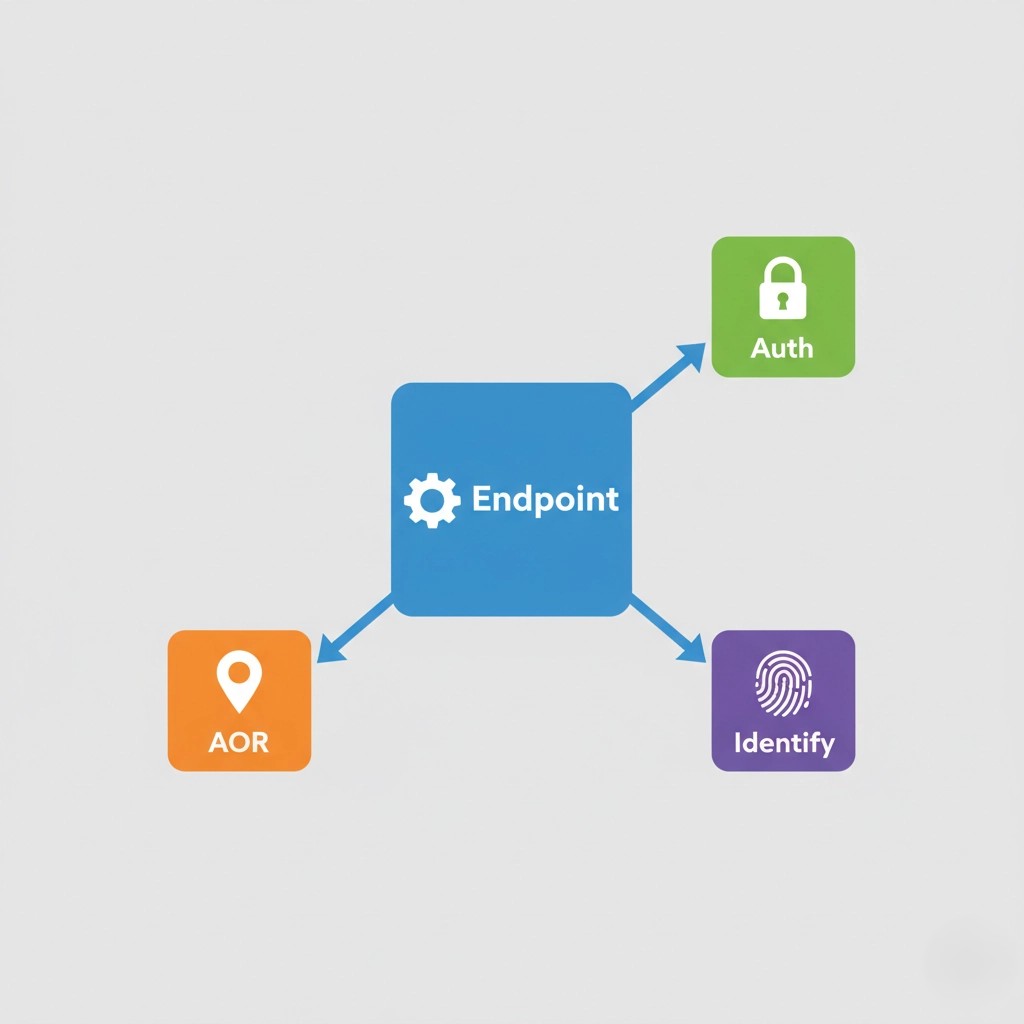
PJSIP Architecture Diagram
Practical PJSIP Examples
Below is a standard template for a secure extension (Extension 100). You would typically place this in your pjsip.conf file.
; — TRANSPORT SECTION —
; Defines the protocol (UDP) and the bind port (usually 5060 or 5160)
[transport-udp]
type=transport
protocol=udp
bind=0.0.0.0:5060
; — EXTENSION 100 SETUP —
; 1. The Auth Section (Credentials)
[100-auth]
type=auth
auth_type=userpass
password=StrongPassword123!
username=100
; 2. The AOR Section (Location & Contacts)
[100-aor]
type=aor
max_contacts=2 ; Allows a Desk Phone AND a Softphone
remove_existing=yes
; 3. The Endpoint Section (The main profile)
[100]
type=endpoint
aors=100-aor ; Links to the AOR above
auth=100-auth ; Links to the Auth above
context=from-internal ; The Dialplan context
disallow=all
allow=ulaw,alaw,g722 ; Codec priority
direct_media=no ; Critical for NAT traversal
While these pjsip examples cover a basic extension, configuring SIP Trunks (connectivity to the outside world) requires even more precision, particularly regarding the Identify section to prevent unauthorized calls.
The Hidden Challenges of Self-Hosting a PJSIP Stack
Writing the configuration files is only the first step. The true challenge of adopting PJSIP lies in the ongoing maintenance and “Day 2” operations. While PJSIP is powerful, it is also unforgiving.
Many IT teams fall into the trap of thinking, “We can build this ourselves to save money.” However, self-hosting a VoIP stack introduces a layer of operational complexity that often overwhelms internal resources.
1. The NAT Traversal Nightmare
The most common complaint in VoIP is “One-way Audio” (I can hear them, but they can’t hear me). This is almost always caused by NAT (Network Address Translation) issues.
Because PJSIP separates signaling from media (via pjmedia pjsip), your firewall must correctly handle RTP ports. If your server is behind a NAT without perfect configuration, the audio stream will be blocked. Debugging these packet flows requires deep networking knowledge and tools like tcpdump or sngrep.
2. Security and “SIP Scanners”
As soon as you open port 5060 to the internet, your server will be bombarded by SIP scanners and bots attempting to brute-force passwords.
- The DIY Burden: You must configure Fail2Ban, set up complex iptables rules, and constantly monitor logs.
- The Risk: A single misconfiguration in your PJSIP Access Control List (ACL) can lead to “Toll Fraud,” where hackers use your system to pump thousands of dollars in international calls overnight.
3. Scalability and High Availability (HA)
This is the breaking point for most businesses. A standard Asterisk/PJSIP server is a single point of failure. If the hardware fails or the OS crashes, your entire phone system goes dark.
Building a true high availability cluster (where a second server takes over instantly if the first one fails) is incredibly difficult with PJSIP. It involves shared databases, floating IP addresses, and real-time state replication.
This complexity forces a critical question:
Do you want to be a VoIP engineering company, or do you just want a phone system that works?
For businesses that need the power of PJSIP without the risk of managing it, the industry solution is shifting toward Dedicated Cloud architectures.
HAPBX: The Enterprise Approach to PJSIP & High Availability
The transition to modern VoIP standards is necessary, but as we have outlined, the road to a stable self-hosted environment is paved with technical hurdles. This is where HAPBX changes the equation.
HAPBX (High Available Private Branch Exchange) is the enterprise answer to the complexities of PJSIP. It is designed for businesses that demand the advanced feature set and security of a modern SIP stack but refuse to accept the risks associated with managing it themselves.
Instead of hiring a DevOps team to manage pjsip.conf files and firewall rules, HAPBX provides a fully managed High Availability PBX platform that works out of the box.
1. The Power of Dedicated Instances
Unlike standard “Shared Cloud” PBX providers where your data and calls fight for resources on a crowded server, HAPBX operates on a dedicated instance model.
- Performance: Your system runs on isolated infrastructure. This means your call quality is never affected by another customer’s usage spikes (the “noisy neighbor” effect).
- Security: With a dedicated environment, the surface area for attacks is drastically reduced, ensuring your communication data remains private.
2. Solving the Availability Puzzle
We mentioned earlier that clustering PJSIP for redundancy is incredibly difficult. HAPBX solves this with its Global Cluster Infrastructure.
HAPBX is built for Zero Downtime. If a node encounters an issue, the system automatically routes calls through a redundant path without human intervention. This delivers a level of reliability that a single DIY Asterisk server simply cannot match.
3. Managed Security and Updates
With HAPBX, the burden of “Day 2” operations vanishes. We handle the SIP hardening, DDoS mitigation, and firmware patching. You get all the benefits of the robust PJSIP architecture—multi-device support, encryption, and HD audio—without ever needing to look at a command line.
Frequently Asked Questions (FAQ)
Q: Is chan_sip completely dead?
A: Yes, effectively. It has been deprecated in Asterisk for years and was completely removed in Asterisk 21 (2023). New installations must use PJSIP.
Q: What is the main difference between PJSIP and SIP?
A: SIP is the protocol (the language used for signaling), while PJSIP is the library/software stack that implements that protocol. You use PJSIP software to make SIP calls.
Q: Can HAPBX work with my existing IP Phones?
A: Absolutely. Because HAPBX is built on standard SIP/PJSIP protocols, it is compatible with virtually all major IP phone brands (Yealink, Fanvil, Poly) and software-based endpoints.
Q: Why is PJSIP considered more secure?
A: PJSIP was built with modern security as a priority. It has native, robust support for TLS (Transport Layer Security) and SRTP (Secure Real-Time Transport Protocol), making it much easier to encrypt calls compared to legacy drivers.
Conclusion
The telecommunications industry has made its decision: the era of legacy drivers is over. PJSIP is the undisputed standard for the future of VoIP, offering the modularity, security, and performance that modern businesses require.
However, recognizing the standard is only half the battle. The real decision lies in implementation. You can choose to navigate the steep learning curve of VoIP migration yourself, wrestling with configuration files (pjsip.conf) and complex network diagnostics. Or, you can choose a partner that has already mastered this architecture.
Ready to upgrade your communication infrastructure?
Don’t let technical complexity or reliability risks hold your business back. If you need a phone system that guarantees enterprise-grade security and Zero Downtime without the headache of manual configuration, contact HAPBX today.
Let our experts deploy your Dedicated Instance Cloud PBX, powered by the modern stability of PJSIP and backed by our Global Cluster Infrastructure. Reach out now for a consultation and secure the future of your business communication.