
The breaking point of a “flexible” system
At 2:17 a.m., my phone lit up with a message every infrastructure lead learns to hate: “Calls are breaking up. Agents can’t hear customers.”
We were in the middle of a time-sensitive rerouting operation — a container delay in Singapore, a customs deadline in London, and a customer who wanted updates every ten minutes. Our PBX had been “good enough” for years. We ran VitalPBX because it was flexible, familiar, and felt controllable.
But that night, controllable turned into fragile.
Audio jitter. SIP registrations flapping. Queue wait times ballooning. In 20 minutes, we had a small disaster: missed SLAs, a spike in escalations, and an internal loss estimate of ~£4,800 (overtime + SLA penalties + churn risk). The worst part wasn’t the money — it was the realization that our “communications backbone” behaved like an experiment.
That was the moment I began searching for VitalPBX alternatives — platforms that could survive our reality: 24/7 operations, global teams, and 100–200 concurrent calls with zero tolerance for drama.
TL;DR (what changed after switching to HAPBX)
- We reduced missed-call incidents during peak periods by ~28% within the first month.
- After cutover, agent escalations tied to call-quality complaints dropped ~35%.
- Our telecom runbook got dramatically smaller because the platform is fully managed.
- The biggest difference wasn’t a feature: it was native HA + dedicated instance isolation (less “noisy neighbor” chaos).
- HAPBX scaled more predictably because growth was measured against concurrent calls, not headcount.
(Numbers above are from our internal post-migration review. Your mileage will vary based on network, trunk providers, and call-flow design.)
1) The hidden “downtime tax” behind VitalPBX alternatives
When people evaluate VitalPBX alternatives, they often compare UI, extensions, and call flows. That’s fine at 10–20 users. At 200 agents, it’s a trap.
1.1 Resource contention: the noisy-neighbor problem
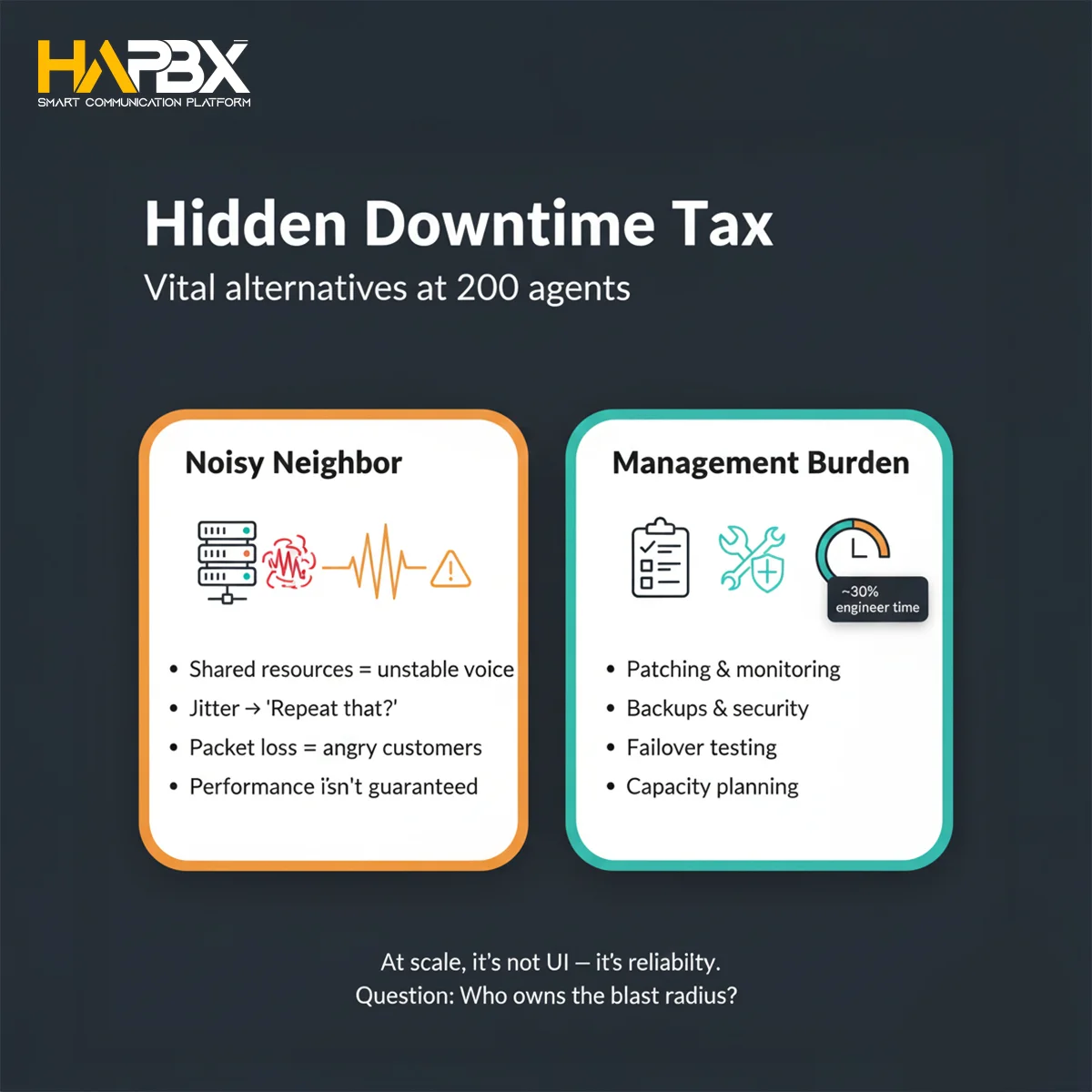
Self-hosted PBX setups typically run on a VPS, a private VM, or a shared cloud environment. Even when you pay for “dedicated CPU,” real performance can still be affected by scheduling, storage, and network contention. In voice, small instability becomes big pain: jitter becomes “Can you repeat that?” and packet loss becomes angry customers.
We tuned codecs, tweaked jitter buffers, and overprovisioned CPU — but we couldn’t tune away the fundamental problem: in a shared or self-managed environment, performance isn’t guaranteed. It’s negotiated every hour.
1.2 The management burden nobody budgets for
VitalPBX is powerful, but power comes with responsibility. Patching, monitoring, backups, intrusion prevention, failover testing, and capacity planning all land on your team. In our case, about 30% of one engineer’s week went to “keeping the PBX safe” instead of building systems that moved the business forward.
So my VoIP platform comparison started with a blunt question: if the PBX fails, who owns the blast radius — and how fast can we recover without heroics?
2) The HA illusion: why “self-managed high availability” fails when it matters
Every vendor says “supports HA.” In practice, there are two categories:
- HA you configure (and therefore must maintain)
- HA that is native (and therefore behaves consistently)
VitalPBX can be made highly available — but achieving that usually means multiple instances, database replication, synchronized configs, heartbeat checks, and a failover plan you must test continuously. One misstep turns “HA” into a single point of failure.
After our 2:17 a.m. incident, I realized we didn’t have an HA problem — we had an HA ownership problem. Our uptime depended on internal expertise, internal time, and internal vigilance.
When I widened my search for VitalPBX alternatives, I wrote down four non-negotiables:
- Native HA with automated failover (not a DIY project)
- Isolation by design (no “noisy neighbor” surprises)
- Predictable performance across regions (not “best effort”)
- A cost model that scales with real usage, not headcount
Those criteria led me to HAPBX.
3) The discovery: why HAPBX didn’t feel like another PBX
HAPBX (High Available Private Branch Exchange) was the first platform in my VoIP platform comparison that spoke my language: infrastructure, isolation, and failure domains.
3.1 Dedicated instance model (isolation by design)
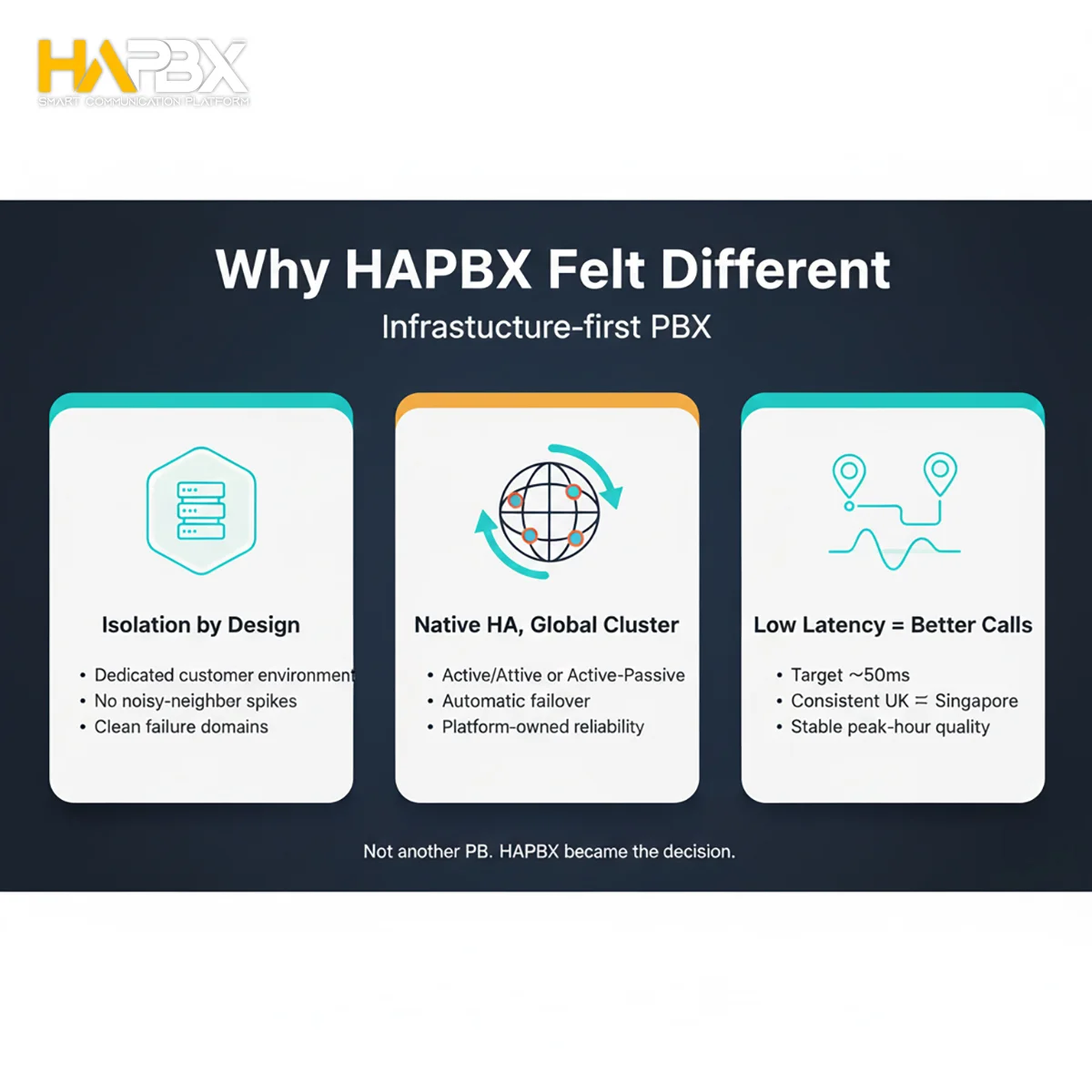
Instead of sharing resources across many customers, HAPBX runs each customer on a dedicated instance environment.
That changes the operational story: your performance isn’t fighting a neighbor’s traffic spike, and your risk isn’t intertwined with someone else’s configuration.
3.2 Native High Availability on a global cluster
HAPBX is designed around a global cluster with native HA, supporting enterprise-grade designs such as Active/Active or Active/Passive, with automatic failover built into the platform.
It moved HA from “a thing we do” to “a thing the platform is.” Reliability no longer depended on whether my best engineer was awake.
3.3 Low-latency design (measured like an operator, not promised like a brochure)
In our environment, latency is not a nerd metric — it’s a customer experience metric. HAPBX is optimized on a global cluster and is designed for low latency (target ~50ms).
In our testing, it translated into more consistent call quality across UK–Singapore traffic patterns—especially during peak-hour bursts.
At this point, my VitalPBX alternatives shortlist basically became a HAPBX vs Vital decision.
4) My 14-day proof-of-concept: the VoIP platform comparison that actually mattered
Demos lie. So I ran a POC.
Day 1–3: baseline and failure testing
- Simulated traffic spikes and queue bursts
- Triggered failure events to observe recovery behavior
- Measured quality trends (jitter, packet-loss moments, supervisor complaints)
Day 4–7: operational readiness
- Access controls for admins vs supervisors
- Monitoring expectations and alert patterns
- Update behavior and operational overhead
Day 8–14: agent workflow and call-center reality
- Queue routing behaviors and edge cases
- Reporting visibility for supervisors
- Integrations we actually use (CRM signals, ticketing workflows, internal dashboards)
This is where HAPBX stopped being “another PBX” and started feeling like a call-center-ready platform: routing, CRM integration, ticketing, dashboards, and dialer capabilities were part of the suite, not an afterthought.
And because the platform is fully managed (updates, monitoring, HA behavior), our internal runbook got simpler overnight.
5) HAPBX vs Vital: the differences that changed my week (not just my stack)
If you’re searching for VitalPBX alternatives, here’s the honest HAPBX vs Vital summary from an operator’s perspective.
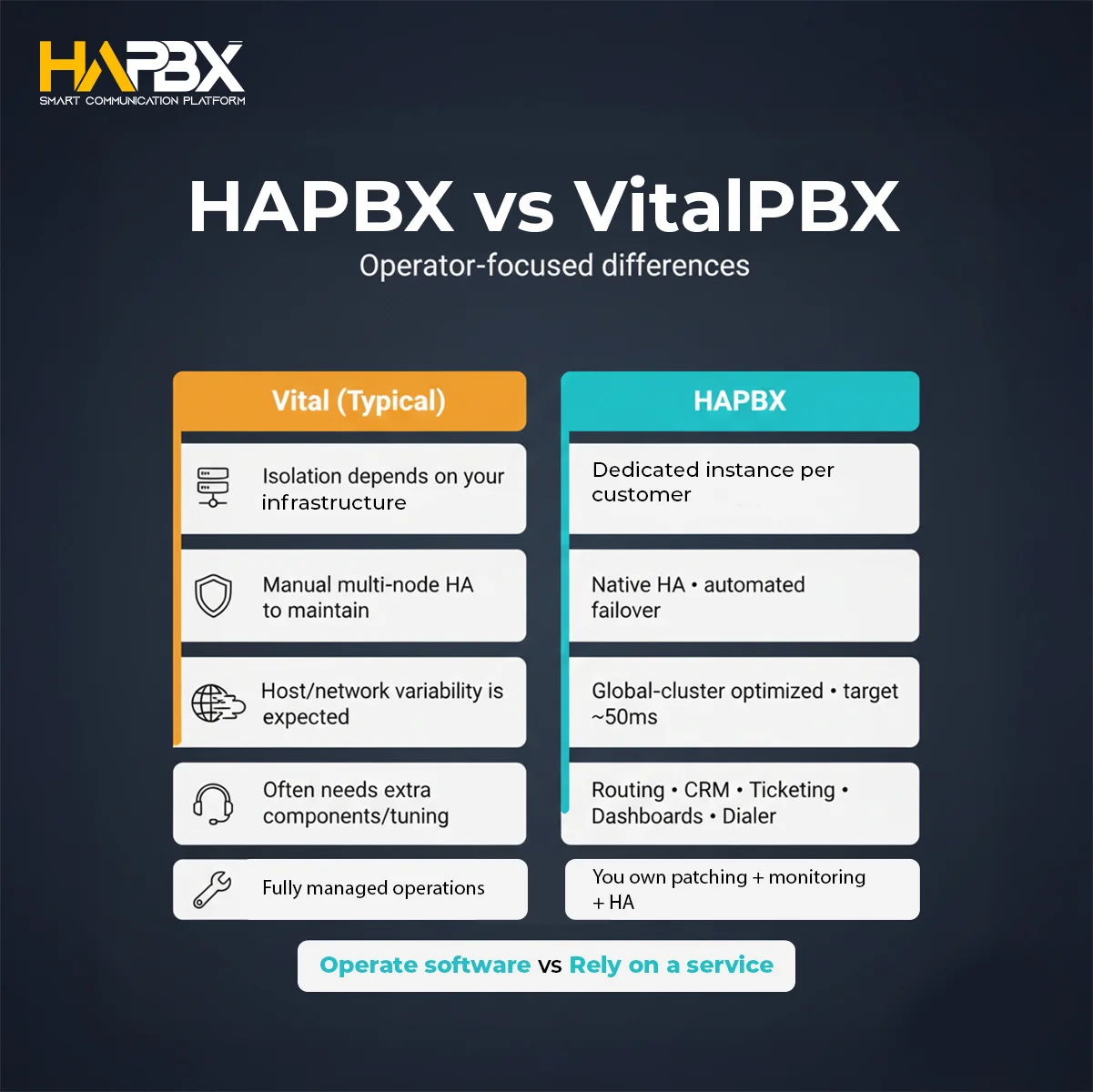
Operator-focused comparison
Architecture & isolation
- VitalPBX (typical): isolation depends on your infrastructure choices
- HAPBX: cloud-native dedicated instance per customer; separation by design
High Availability
- Vital: HA is a manual multi-node project you must test and maintain
- HAPBX: native HA on a global cluster with automated failover; supports Active/Active or Active/Passive
Performance & latency
- VitalPBX: depends heavily on host and network; variability is expected
- HAPBX: global-cluster optimized; designed for low latency (target ~50ms)
Call-center tooling
- VitalPBX: extendable, but often requires extra components or careful tuning
- HAPBX: suite includes routing, CRM integration, ticketing, dashboards, dialers
Operations
Vital: your team owns patching, monitoring, and HA stability
HAPBX: fully managed operations
In plain language: the difference is whether your PBX behaves like software you operate — or like a service you rely on.
6) Security and compliance: why dedicated environments matter more than checklists
Security docs are easy to write. Secure operations are hard to sustain.
In our risk model, the biggest problem with many VitalPBX alternatives wasn’t “lack of encryption.” It was environmental uncertainty. Multi-tenant mixing, variable host quality, and the human factor in manual operations are where incidents are born.
HAPBX’s dedicated instance approach reduced our threat surface in a practical way:
- Isolation: voice and data separation by design in an independent environment
- Less admin sprawl: fewer scripts, fewer “one-off” HA adjustments, fewer places for mistakes
- Enterprise support expectations: predictable support behavior and SLA-aligned processes
7) The money conversation: scaling without punishing growth
The most uncomfortable moment in my VoIP platform comparison wasn’t technical — it was budgeting.
Many platforms make growth painful:
- more users → more licenses
- more features → more add-ons
- more concurrency → another tier jump
HAPBX’s model made more operational sense for a call-heavy business: it scales with concurrent calls and doesn’t punish you just for adding more users.
That difference becomes massive at 150–200 agents, where headcount changes monthly but concurrency is the real constraint.
8) Migration night: how we switched without betting the business
We treated migration like a production release.
Week 1: inventory and cleanup
- audited extensions, trunks, call flows
- removed complexity before moving anything
Week 2: parallel run
- mirrored inbound routes
- trained supervisors on dashboards and reporting
- ran a limited agent group in production
Week 3: cutover with rollback
- staged trunk and routing changes
- rehearsed rollback steps
- scheduled cutover in the lowest-risk operational window
The key difference: we weren’t building HA and hoping it worked. We moved onto a platform where HA and monitoring were part of the service.
9) Decision checklist: how to choose between VitalPBX alternatives (fast)
Use this checklist before you commit to any VitalPBX alternatives:
- Do you need native HA with automated failover (not DIY)?
- Can you accept shared-resource unpredictability, or do you need dedicated isolation?
- Are you scaling by headcount, or by concurrent calls?
- Do supervisors need dashboards/reporting baked in?
- Do you have the appetite to own patching + monitoring + HA testing? Or do you need fully managed ops?
- Is your call quality sensitive to cross-region latency? (Measure it, don’t assume.)
If you answered “yes” to most of the left-hand questions, you’ll feel the gap immediately in a HAPBX vs Vital evaluation.
Who HAPBX is best for (and when it’s not)
Best for
- Call centers with 100+ agents and high concurrency need
- Teams that require native HA and predictable recovery behavior
- Organizations that want dedicated instance isolation for stability and risk control
- Ops teams that don’t want PBX maintenance to be a permanent job
Not ideal if
- You want to tinker endlessly with a self-hosted PBX as a hobby project
- Your environment is tiny (single office, low concurrency) and you truly don’t care about HA ownership
- You need a niche integration that only exists in your current customized stack (in that case, run a POC first)
Conclusion: If your PBX is a job, it’s not a platform
My journey through VitalPBX alternatives ended when I stopped optimizing for flexibility and started optimizing for reliability.
In this VoIP platform comparison, HAPBX stood out because reliability is baked into the architecture:
- Dedicated instance isolation
- Native HA on a global cluster with automated failover
- Fully managed operations
- Scaling aligned with concurrent calls
If you’re evaluating VitalPBX alternatives and you can’t afford another 2:17 a.m. incident, make the decision your future self will thank you for.
Want to test HAPBX the same way I did — without overthinking it?
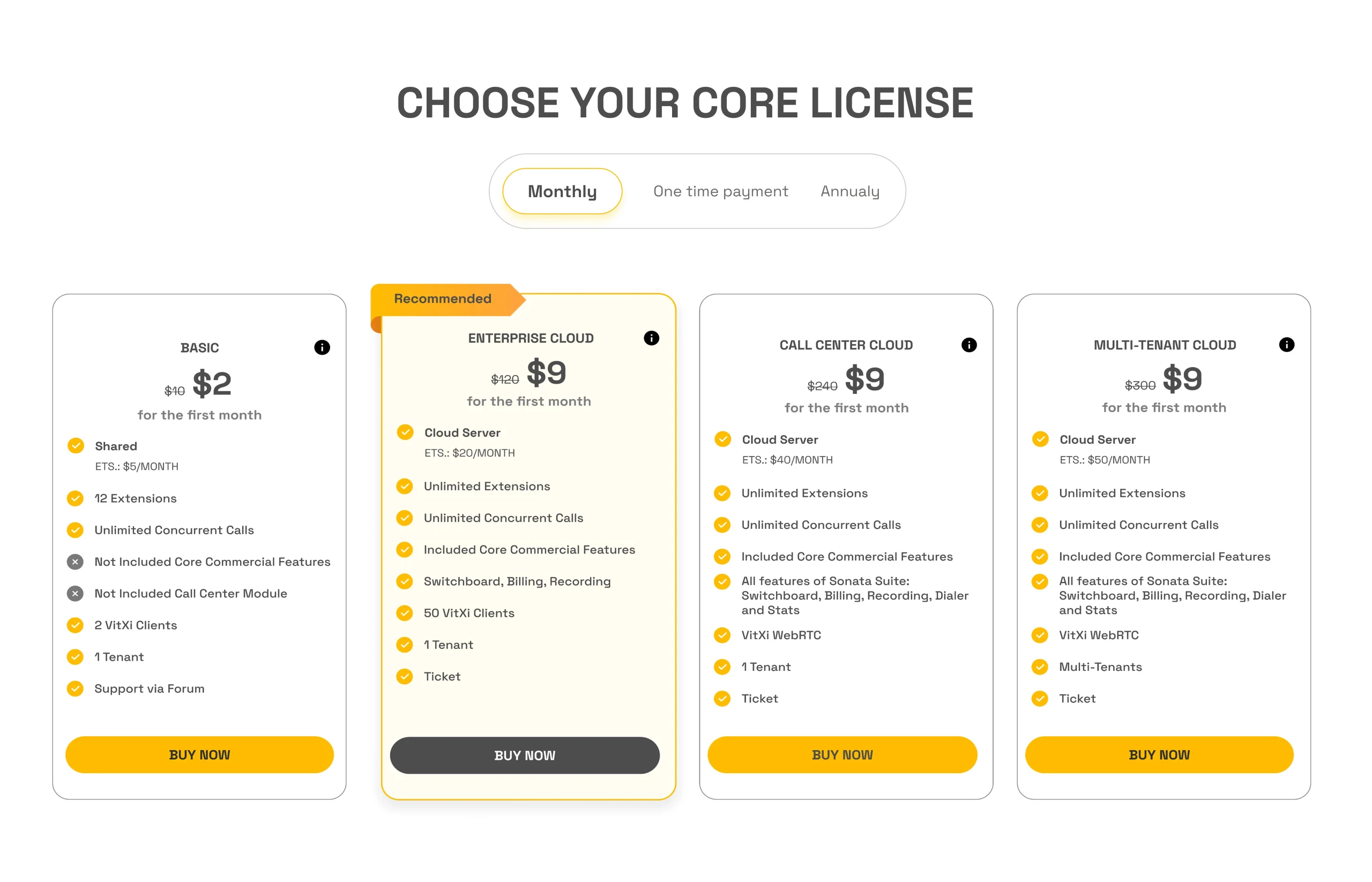
Start with the Premium (Multi-Tenant Cloud) plan for just $9 in your first month (promo pricing). It’s the fastest way to experience the platform at its highest tier before making any long-term decision.
Here’s the practical path:
- Try Premium for $9 (first month) to feel the real difference in stability, call quality, and enterprise-grade operations.
- Or request a demo and ask specifically about Dedicated Instance, native HA, and your target concurrent calls.
(Image below: my pricing table for reference.)