

FreePBX is a flexible open-source PBX, but it comes with operational limits. This in-depth comparison explains when FreePBX works—and why many businesses upgrade to HAPBX for reliability, scalability, and long-term stability.
Introduction: FreePBX and the Reality of Business Communication Growth
When businesses search for a PBX solution, FreePBX is often one of the first platforms they encounter. As an open-source PBX framework built on Asterisk, FreePBX offers flexibility, low entry costs, and a high level of customization. These characteristics make it attractive to startups, small businesses, and technical teams looking for control over their telephony systems.
However, as communication becomes increasingly central to sales, customer support, and daily operations, the limitations of a self-managed PBX platform begin to surface. At this stage, many organizations start evaluating alternatives such as HAPBX, a managed, high-availability Cloud PBX designed for predictable enterprise workloads.
This article provides a neutral, technical comparison of FreePBX PBX and HAPBX, explaining where FreePBX fits well, where it falls short, and why growing businesses often transition to HAPBX.
Understanding FreePBX: Strengths and Practical Constraints
What FreePBX Does Well
FreePBX remains a capable solution in the right context. Its main strengths include:
- Open-source flexibility
Businesses can customize call flows, dial plans, and integrations without licensing restrictions.
- No per-user limitations
FreePBX does not enforce user- or extension-based licensing, which helps control initial costs.
- Full infrastructure control
Organizations maintain complete ownership over servers, data, and configurations.
- Large community ecosystem
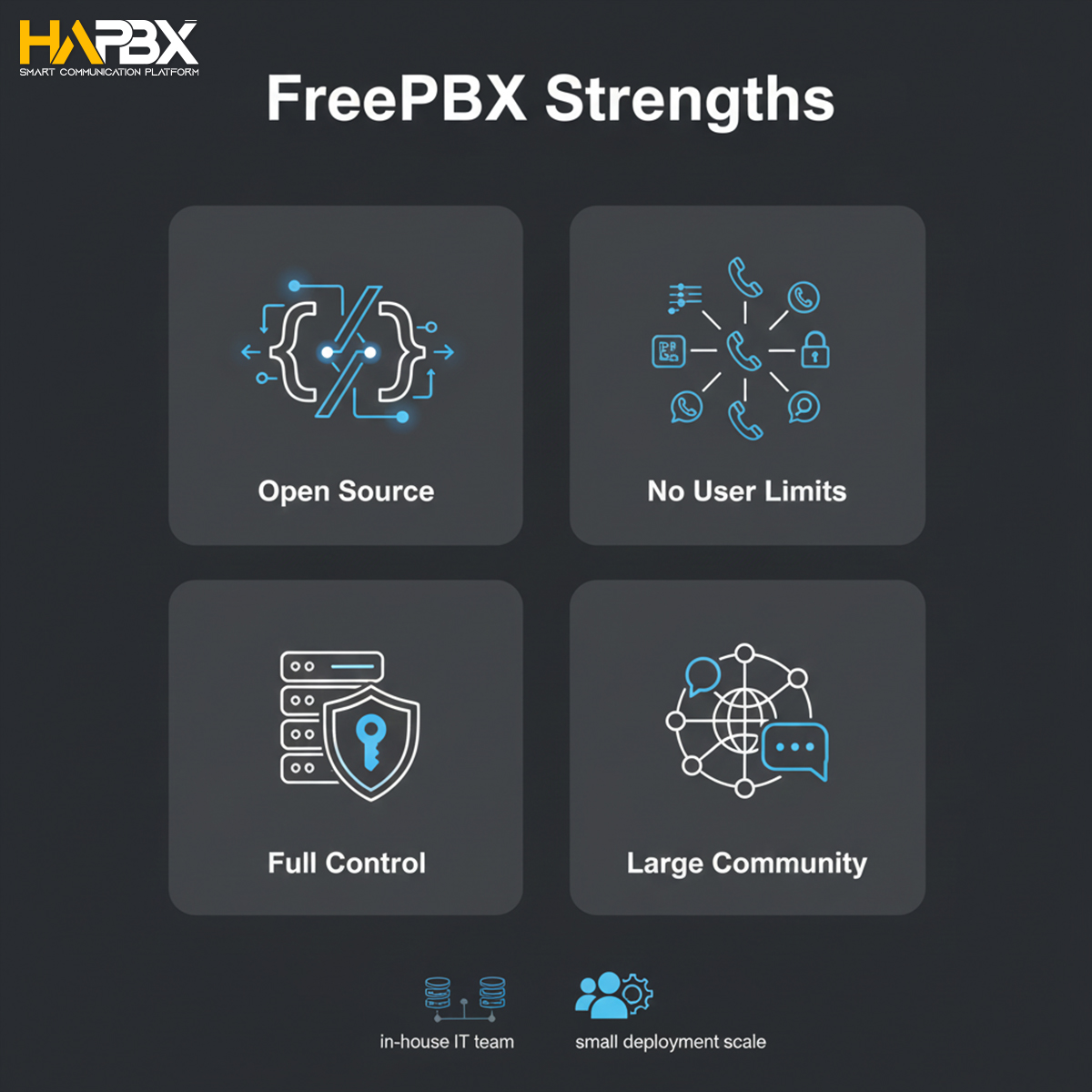
Documentation, forums, and third-party modules are widely available.
For small deployments or teams with in-house VoIP expertise, FreePBX software can meet basic PBX requirements effectively.
Where FreePBX Becomes Challenging at Scale
As call volumes and business dependency increase, several structural limitations become apparent.
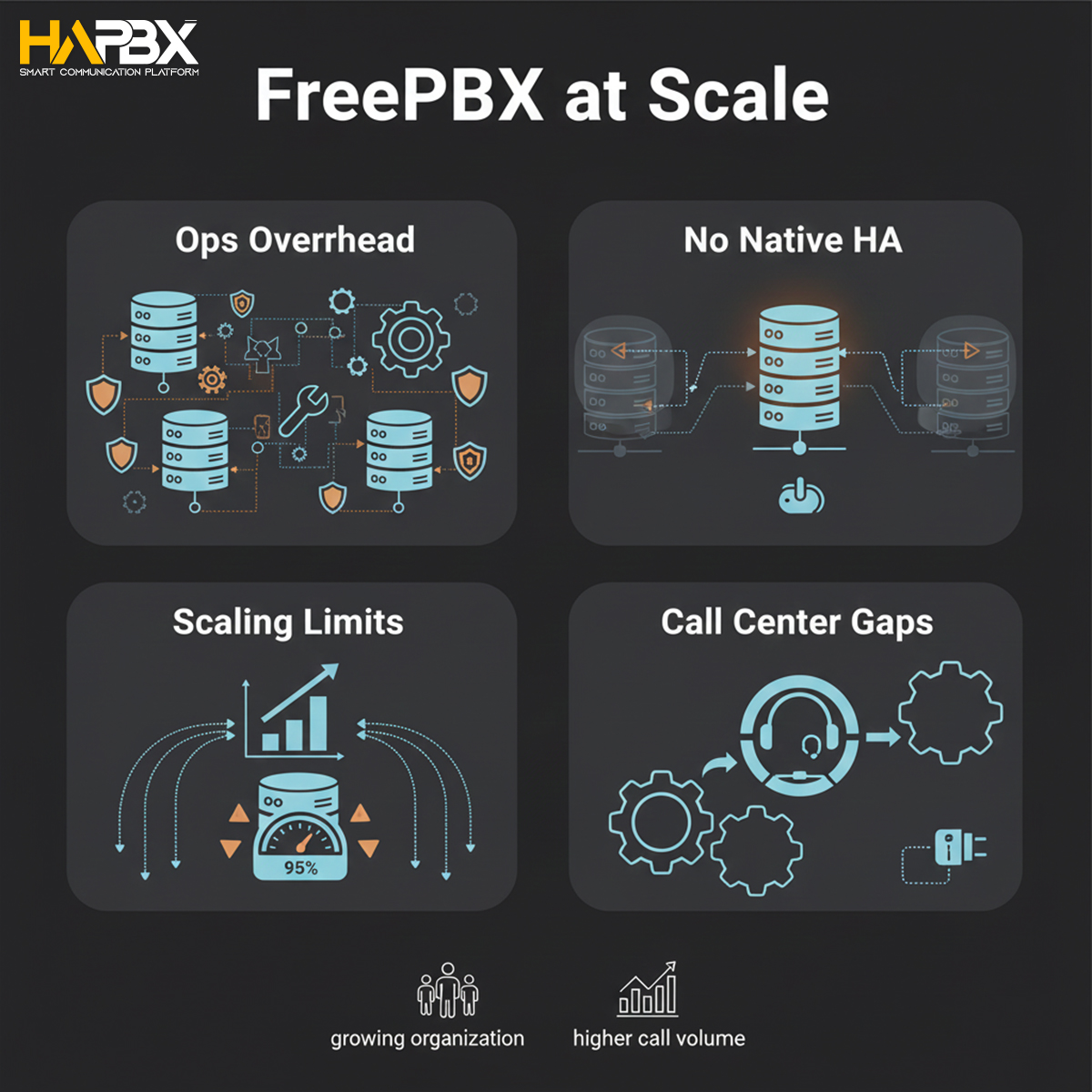
Infrastructure and Operational Responsibility
FreePBX is not a managed service. Businesses are responsible for provisioning servers, securing SIP traffic, maintaining operating systems, handling updates, and implementing backup and recovery strategies. Over time, these tasks require dedicated resources and expertise, increasing operational overhead.
High Availability Is Not Native
By default, FreePBX operates on a single-server architecture. While high availability can be implemented, it requires additional tools, custom clustering, and manual failover logic. This approach introduces complexity and still lacks built-in geo-redundancy.
Performance and Scalability Constraints
Call quality, latency, and concurrency depend entirely on server specifications and hosting quality. Scaling often means upgrading hardware or migrating systems—processes that can involve downtime and operational risk.
Limited Enterprise Call Center Capabilities
FreePBX supports queues and basic reporting, but advanced call center features typically require paid modules or external integrations. This adds cost and complexity as requirements grow.
Introducing HAPBX: A Managed Enterprise Cloud PBX
HAPBX approaches the PBX problem from a different angle. Rather than offering flexibility through self-management, it focuses on stability, predictability, and operational simplicity.
HAPBX is a dedicated-instance Cloud PBX built with native high availability and enterprise-grade architecture. Each customer operates on isolated resources, removing the risks associated with shared environments and manual scaling.
How HAPBX Addresses FreePBX Limitations
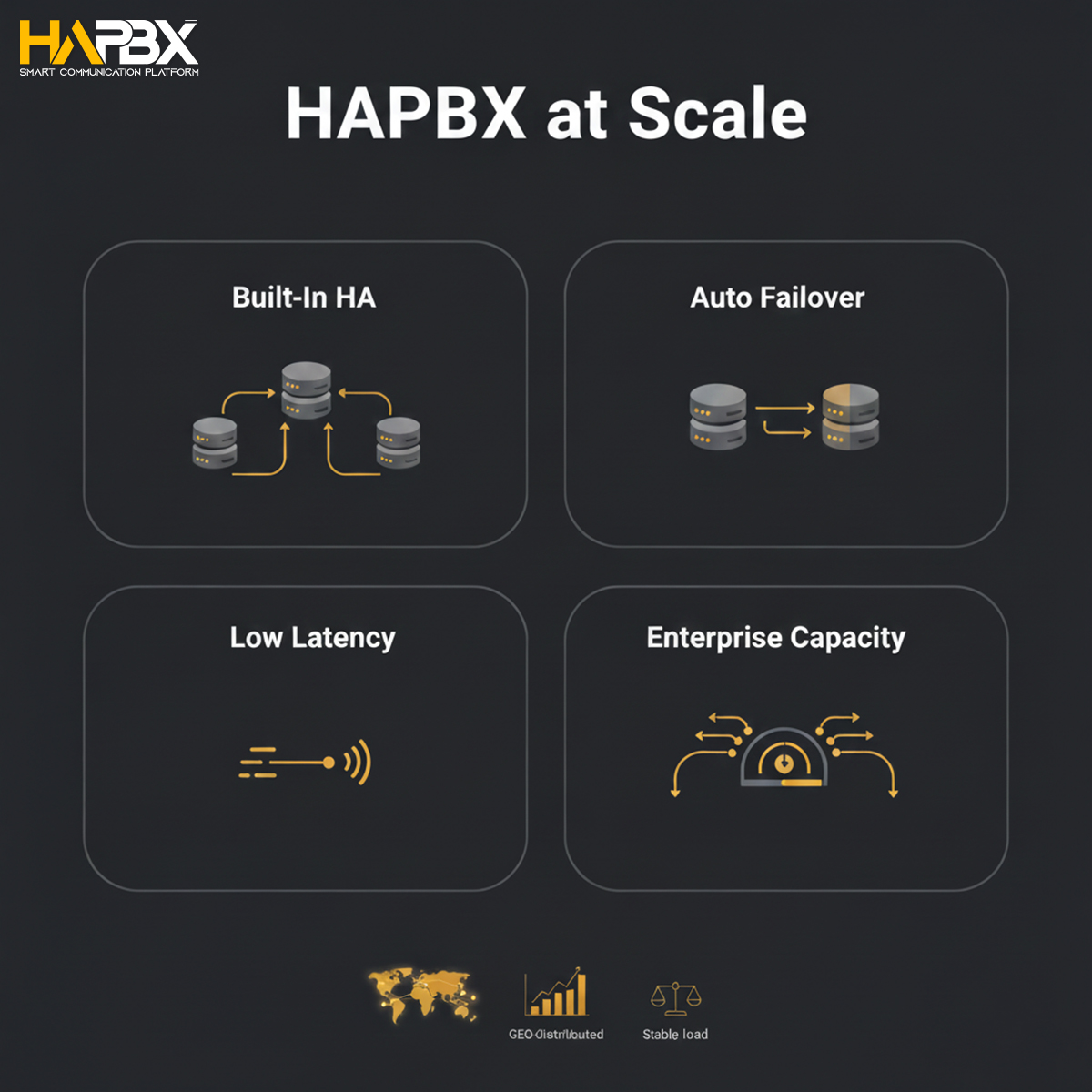
HAPBX includes built-in Active/Active or Active/Passive clustering with automated failover. Its global cluster infrastructure is designed to maintain service continuity even during node or region-level failures. Latency is consistently optimized, typically around 50ms and rarely exceeding 150ms under normal conditions.
The platform is engineered to support 100–200+ concurrent calls, making it suitable for enterprises and call centers without requiring frequent infrastructure changes.
HAPBX vs FreePBX: Technical Comparison
| Category | FreePBX | HAPBX |
| Deployment model | Self-hosted | Managed Cloud |
| Architecture | Single server (default) | Dedicated Instance |
| High availability | Manual, complex | Native HA |
| Global cluster | No | Yes |
| Concurrent calls | Server-dependent | 100–200+ stable |
| Latency | Host-dependent | ~50ms target |
| Scaling | Manual upgrades | Built-in scalability |
| Call center tools | Basic | Enterprise suite |
| Operational overhead | High | Minimal |
| SLA & support | Community-based | SLA-driven |
While FreePBX is often perceived as “low-cost” due to its open-source nature, the pricing structure of HAPBX reflects a different operational philosophy. Instead of charging based on the number of users, extensions, or simultaneous calls, HAPBX uses package-based pricing tied to dedicated infrastructure capacity. This approach implicitly emphasizes predictable performance and stability over fluctuating usage-based costs. For businesses, it reduces uncertainty in long-term planning compared to FreePBX environments, where infrastructure upgrades, paid modules, and operational labor often introduce variable and less predictable expenses.
Which Businesses Is HAPBX Better Suited For?
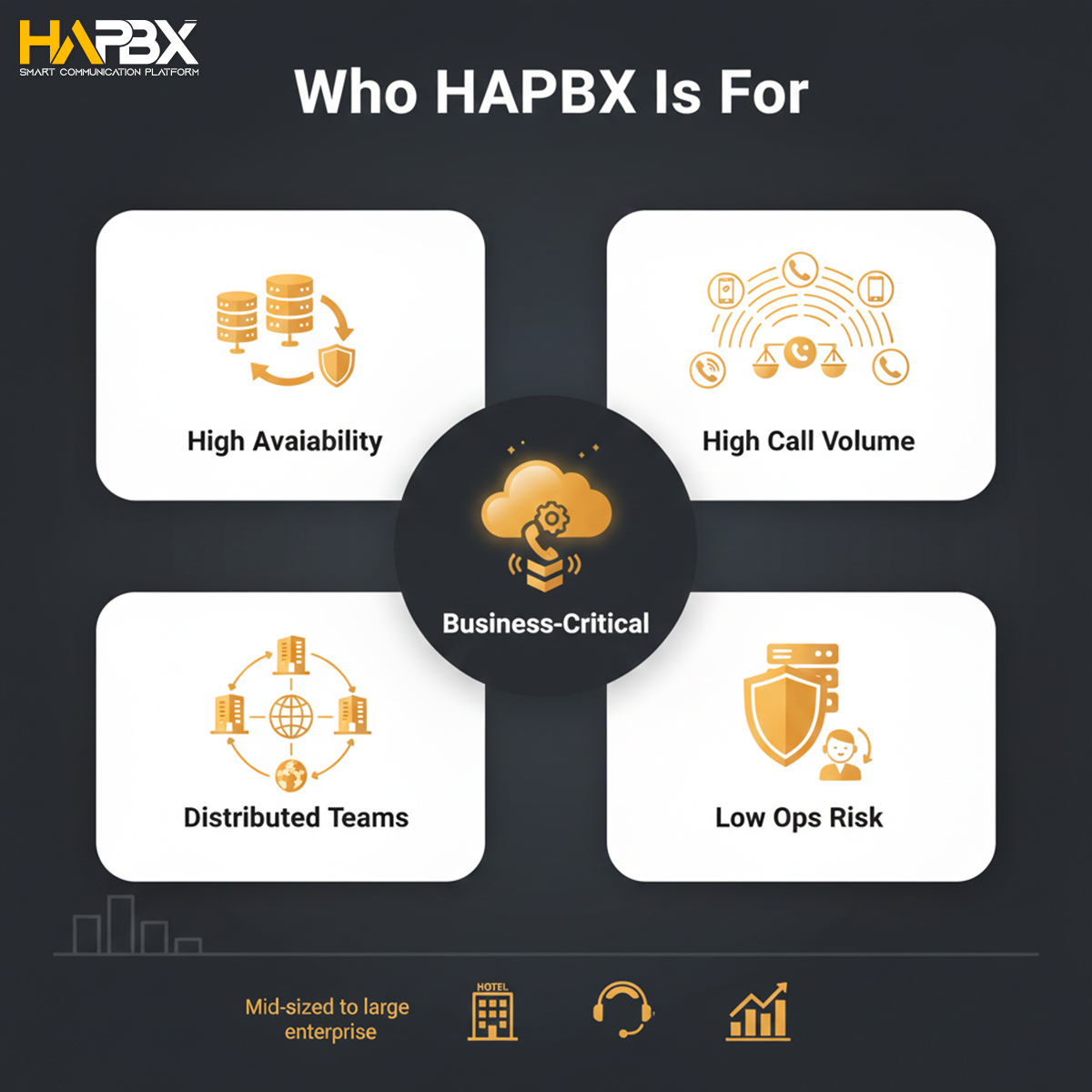
From a practical business standpoint, HAPBX is best suited for organizations that have moved beyond experimental or self-managed PBX deployments and require a communication system that is stable by default, predictable at scale, and operationally low-risk.
HAPBX is particularly relevant for businesses that can no longer afford PBX downtime. In environments where missed calls translate directly into lost revenue, reduced customer satisfaction, or disrupted internal workflows, reliance on self-managed systems like FreePBX becomes increasingly risky. HAPBX’s native high-availability architecture is designed to address this concern without requiring internal teams to design, maintain, or troubleshoot complex failover setups.
Another key profile includes companies with clear and growing call volume. Organizations operating sales teams, customer support departments, or internal service desks often experience consistent or peak call loads that demand predictable performance. HAPBX is engineered to handle stable, high concurrent call volumes on dedicated infrastructure, avoiding the performance variability commonly seen in self-hosted or shared environments.
HAPBX is also a strong fit for mid-sized to large enterprises with distributed teams. As companies expand across departments, locations, or regions, maintaining consistent call quality and system availability becomes more challenging with single-server PBX deployments. By operating on a geo-aware cluster infrastructure, HAPBX reduces dependency on a single location and supports more resilient communication across teams.
From an organizational perspective, HAPBX is especially valuable for businesses with limited in-house VoIP or telephony expertise. Instead of allocating internal resources to manage PBX servers, apply security patches, monitor system health, and plan capacity upgrades, companies can shift these responsibilities to a managed platform. This allows IT teams to focus on core systems and business priorities rather than day-to-day PBX operations.
Finally, HAPBX is well suited for decision-makers who prioritize long-term operational stability over maximum configurability. While platforms like FreePBX offer extensive low-level customization, that flexibility often comes with increased complexity and maintenance overhead. HAPBX takes a different approach by emphasizing reliability, consistency, and predictable behavior—qualities that are often more critical as organizations scale.
In summary, HAPBX aligns best with businesses that:
- Require high availability without managing HA infrastructure themselves
- Operate stable or growing call volumes
- Support multiple teams or locations
- Prefer predictable performance and costs over ongoing PBX maintenance
- View communication systems as critical business infrastructure rather than technical experiments
This positioning reflects a shift from PBX as a tool to PBX as a dependable operational platform, which is where HAPBX delivers the most value.
Frequently Asked Questions
Is FreePBX cheaper than HAPBX?
FreePBX has lower upfront costs, but total cost of ownership can increase as infrastructure, maintenance, and scaling requirements grow.
Can FreePBX be used at enterprise scale?
It is possible, but it requires advanced VoIP knowledge, custom high-availability setups, and ongoing operational effort.
Is HAPBX suitable for small businesses?
HAPBX is better suited for organizations that anticipate growth or rely heavily on consistent call performance.
Conclusion
FreePBX remains a flexible and capable freepbx pbx solution for organizations that value control and customization. However, it was not designed to address enterprise-level demands such as built-in high availability, global redundancy, or predictable scaling.
HAPBX fills these gaps with a cloud-native architecture focused on stability, performance, and operational simplicity. In a VoIP platform comparison, the decision between FreePBX and HAPBX ultimately comes down to whether a business priori==tizes self-management or long-term reliability.
If your organization is reaching the limits of self-managed PBX systems, HAPBX provides a practical upgrade path—delivering predictable performance and enterprise-grade reliability without the complexity of maintaining FreePBX at scale.
👉 Explore HAPBX to see how a managed Cloud PBX can support your next stage of growth.