
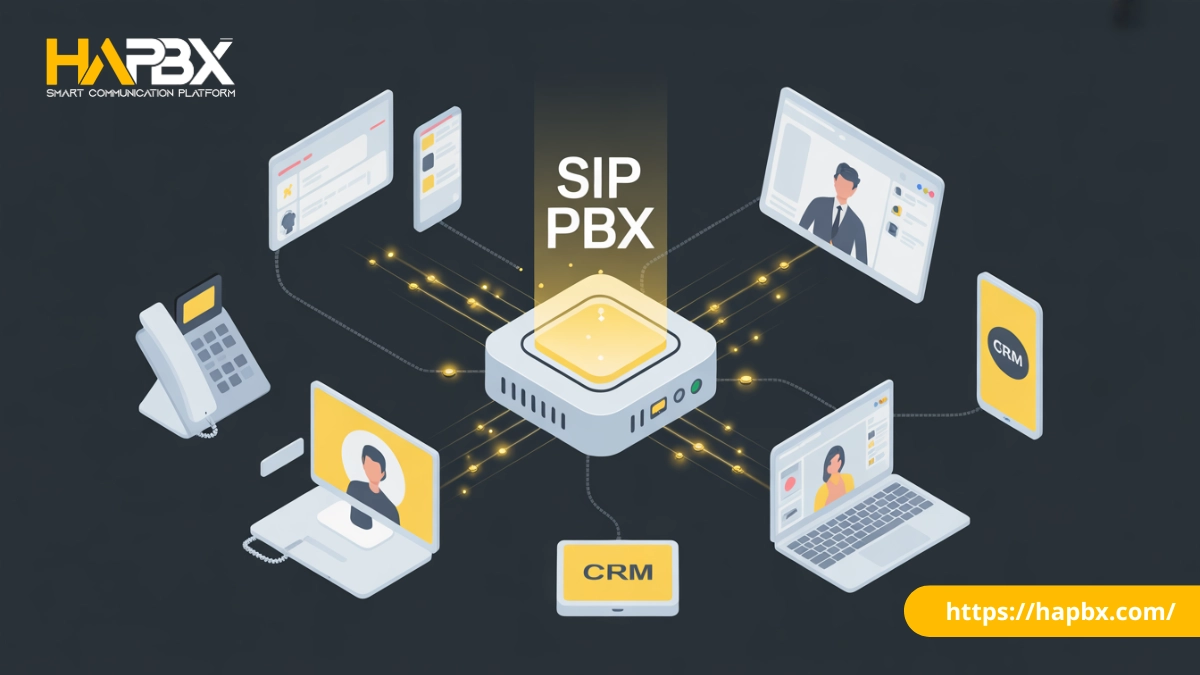
In the world of business communication, the era of the “hardware box in the closet” is effectively dead. The modern office no longer runs on copper wires and circuit boards; it runs on software.
At the heart of this transformation is the SIP PBX.
While you may have heard terms like VoIP or Cloud Phone System, the SIP PBX (Session Initiation Protocol Private Branch Exchange) is the actual engine powering these technologies. It is the central hub that manages every call, video conference, and instant message in a modern enterprise.
If you are evaluating a new phone system or trying to upgrade your legacy infrastructure, understanding the mechanics of a SIP PBX is crucial. This guide will break down the architecture, compare the differences between standard IP PBX and modern Dedicated Cloud solutions like HAPBX, and help you choose the right engine for your business.
What is a SIP PBX?
To understand this technology, we must first decode the acronyms that dominate the telecom industry.
Decoding the Acronyms
- PBX (Private Branch Exchange): This is the “brain” of your phone system. It is responsible for routing internal calls (Extension 101 to Extension 102) and connecting internal users to the outside world.
- SIP (Session Initiation Protocol): This is the “language” or signaling protocol that digital devices use to establish, maintain, and terminate communication sessions.
- SIP PBX: Therefore, a SIP PBX is a phone system (either software or hardware) that natively uses the SIP standard to manage communication.
IP PBX vs. SIP PBX: What Are the Differences?
These terms are often used interchangeably, but there is a technical nuance.
- IP PBX: This is a broad category referring to any phone system that uses the Internet Protocol (IP) to transmit voice.
- SIP PBX: This is a specific type of IP PBX.
While all SIP PBXs are IP PBXs, not all IP PBXs are SIP-based. In the early days of VoIP, manufacturers like Cisco or Avaya used proprietary protocols (like SCCP or H.323) that only worked with their specific phones. Today, SIP is the global industry standard. A modern SIP IP PBX is hardware-agnostic, meaning you can use almost any SIP-compatible phone (Poly, Yealink, Grandstream) with the system.
The Role of the SIP Server
Under the hood, a SIP PBX functions as a SIP Server (often called a SIP Proxy or Registrar).
When you plug a phone into the network, it sends a “Register” request to the SIP Server. The server stores the phone’s IP address in a database.
When someone calls that extension, the SIP Server acts as the traffic controller, establishing the digital handshake. Advanced platforms like HAPBX take this further by hosting this server on a Dedicated Instance, ensuring this handshake happens instantly without the latency found in shared environments.
How a SIP Trunk IP PBX Ecosystem Works?
A SIP PBX does not operate in a vacuum. It is the centerpiece of a three-part ecosystem that replaces the traditional telephone network.
1. SIP Endpoints
These are the devices your employees actually use. Because SIP is a digital standard, an endpoint isn’t just a plastic desk phone. It can be:
- Hardphones: Physical IP phones that plug into an Ethernet port.
- Softphones: Software applications installed on a laptop or desktop (Windows/Mac).
- Mobile Clients: Apps on iOS or Android that turn a smartphone into a business extension.
2. The SIP PBX Server
This is the software logic. It holds the rules for how calls are handled.
- If extension 101 is busy, route to voicemail.
- If a call comes in after 5:00 PM, play the ‘Closed’ message.
- If a caller presses ‘1’ for Sales, ring the sales group.
3. The SIP Trunk
The PBX handles internal traffic perfectly, but it needs a path to reach the outside world (mobile numbers, landlines, international clients).
This is the role of the SIP Trunking. It connects the SIP PBX Server to the Public Switched Telephone Network (PSTN) via the internet.
When User A dials a number:
- The SIP Endpoint sends a signal to the SIP PBX Server.
- The Server determines if the call is internal or external.
- If external, the Server sends the digital packets through the SIP Trunk IP PBX interface.
- The call traverses the internet and reaches the destination.
Deployment Models: On-Premise vs. Cloud SIP PBX
The biggest decision an IT manager must make is not if they should use SIP, but where the PBX should live. There are two primary deployment models, each with distinct advantages.
On-Premise SIP PBX
In this model, the SIP server software is installed on a physical machine located in your office server room.
- How it works: You buy the hardware/software, configure the firewall, and purchase a separate SIP Trunk service to plug into it.
- Pros: You have total control over the data and configuration. There are usually no recurring monthly subscription fees per user (only for the trunking).
- Cons:
- High Maintenance: You are responsible for security patches, software updates, and hardware failure.
- Connectivity Risks: If your office loses power or internet, your entire phone system goes down.
- Security Burden: You must configure your own Session Border Controller (SBC) and firewall rules to prevent toll fraud.
Hosted / Cloud SIP PBX
In this model, the PBX exists as a service hosted in a provider’s data center.
- How it works: You subscribe to a service. The provider manages the server, the security, and the connectivity. You simply connect your phones via the internet.
- Pros: Zero hardware to maintain. Automatic updates. Built-in redundancy.
- Cons: Most standard cloud providers use “Multi-tenant” environments. This means your business shares a server instance with hundreds of other companies. If a “noisy neighbor” on the same server gets hit with a DDoS attack or uses too much bandwidth, your call quality can suffer.
This limitation of standard shared cloud hosting is leading many enterprises to seek a more advanced solution: the Dedicated Instance.
IP PBX vs SIP PBX
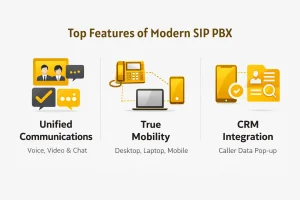
Top Features That Define a Modern SIP PBX
Why are businesses migrating from analog or older IP systems to fully native SIP phone systems? It is because SIP unlocks features that old wires simply cannot support.
Unified Communications (UC)
A SIP PBX handles more than voice. Because SIP is a multimedia protocol, the server can natively manage:
- Video Calling: Initiating a video conference is as easy as dialing an extension.
- Instant Messaging (IM): Corporate chat is built into the phone system app.
- Presence: Seeing if a colleague is “Available,” “Busy,” or “Away” in real-time.
True Mobility
With a legacy PBX, your extension is tied to a wire in the wall. With a SIP IP PBX, your extension is a set of credentials. You can log in to a desk phone in the office, a laptop at a cafe, or a mobile phone at the airport, and you remain reachable on the same number.
Software Integration (CRM)
SIP headers can carry metadata. When a customer calls, the SIP PBX can query your CRM (like Salesforce or HubSpot) and display the caller’s account details on your screen before you even answer the phone.
Top Features of Modern SIP PBX
HAPBX: The Evolution of the Cloud SIP PBX
We mentioned the dilemma between the control of On-Premise systems and the ease of Cloud systems. Many businesses are stuck choosing between the two.
HAPBX was engineered to eliminate this compromise.
We position HAPBX not merely as a provider, but as a next-generation SIP PBX platform. We solve the architecture flaws of standard hosting to deliver a solution that is “Built for You.”
Why We Built a Dedicated SIP Ecosystem?
Standard cloud sip pbx services rely on shared resources. HAPBX provides a Dedicated Instance SIP PBX.
This means your business runs on its own isolated virtual infrastructure. You get the security, privacy, and performance guarantees of an on-premise server, but with the “hands-off” management of the cloud.
By isolating your instance, we ensure latency remains stable around 50ms (guaranteed not to exceed 150ms). This prevents the jitter and robotic voice common in shared environments.
Native SIP Trunking Integration
With HAPBX, you do not need to be a systems integrator.
If you build an on-premise server, you have to go out and buy a separate SIP Trunk IP PBX service and configure the two to talk to each other.
HAPBX is a Turnkey Solution. The SIP connectivity is natively integrated into the PBX platform. There are no trunking credentials to configure, no NAT traversal issues to solve, and no firewall ports to forward. We handle the entire ecosystem from the server to the PSTN.
High Availability (The “HA” Factor)
The “HA” in our name stands for High Availability.
A single on-premise SIP server is a single point of failure. If the motherboard fries, your phones are dead.
HAPBX operates on a Global Cluster Infrastructure. Your SIP PBX is replicated across multiple nodes. If the primary node experiences an issue, the system instantly fails over to a synchronized instance. This architecture delivers almost no downtime, ensuring your business is always open.
Conclusion
The SIP PBX is the non-negotiable standard for modern business communication. It has transformed the corporate phone system from a static piece of hardware into a dynamic, software-driven asset.
Whether you are considering building your own server or subscribing to a cloud service, understanding the core SIP architecture ensures you make a future-proof choice. However, as 2026 approaches, the burden of managing server security and updates is becoming too high for many IT teams.
Don’t get stuck managing server updates.
Switch to HAPBX, the Dedicated Cloud SIP PBX that guarantees uptime, security, and crystal-clear audio. We combine the power of a dedicated SIP server with the simplicity of the cloud.
Contact HAPBX today to see how a Dedicated Instance can transform your business communication.