

VoIP and PBX are often compared as competing business phone solutions, but in modern communication systems, they serve very different roles. VoIP defines how voice is transmitted over IP networks, while PBX defines how calls are controlled, routed, and managed across an organization.
As businesses expand across locations and adopt remote or hybrid work models, traditional PBX and basic VoIP services often fall short. This has led to the rise of VoIP-based PBX systems, which combine structured call management with the flexibility of cloud communication.
In this article, we’ll explain the key differences between VoIP and PBX, how they work together in modern business phone systems, and why enterprise platforms like HaPBX are designed to deliver reliable, scalable communication for organizations.
VoIP and PBX Explained: How Modern Phone Systems Work
To understand how modern business phone systems operate today, it’s important to look at PBX and VoIP not as competing solutions, but as complementary components. In most enterprise environments, PBX provides the call control and system logic, while VoIP delivers the technology that carries voice communication.
What Is a PBX System?
A PBX (Private Branch Exchange) is a private telephone system used by businesses to manage internal and external calls within a single organization. Instead of every employee needing a direct phone line from a telecom provider, a PBX allows multiple users to share centralized calling resources.
At its core, a PBX system is responsible for:
- Routing inbound calls to the correct extension or department
- Managing internal extension-to-extension calls
- Handling outbound calls through shared trunks
- Providing features such as call transfer, voicemail, auto-attendant (IVR), call queues, and conferencing
Historically, PBX systems were hardware-based and installed on-site, relying on analog or digital phone lines connected to the public switched telephone network (PSTN). While these systems offered reliability and control, they were expensive to scale and difficult to adapt to multi-location or remote work environments.
Modern PBX platforms have evolved beyond physical hardware. Today, PBX functionality can be delivered through IP-based and cloud architectures, making the system more flexible, software-driven, and easier to manage across distributed teams.
What Is VoIP Technology?
VoIP (Voice over Internet Protocol) is the technology that enables voice communication over IP networks instead of traditional phone lines. Rather than transmitting calls through dedicated circuits, VoIP converts voice into digital data packets and sends them over the internet or private IP networks.
When a VoIP call is made:
- Voice is digitized and compressed using codecs
- Data packets are transmitted across an IP network
- The packets are reassembled and converted back into audio in real time
Because VoIP is network-based, it allows calls to be made from a wide range of devices, including desk phones, computers, mobile apps, and web-based softphones. This flexibility is what enables remote work, global calling, and rapid system expansion without physical telephony infrastructure.
On its own, however, VoIP is not a complete phone system. It defines how voice is transmitted, but not how calls are managed. That role belongs to the PBX.
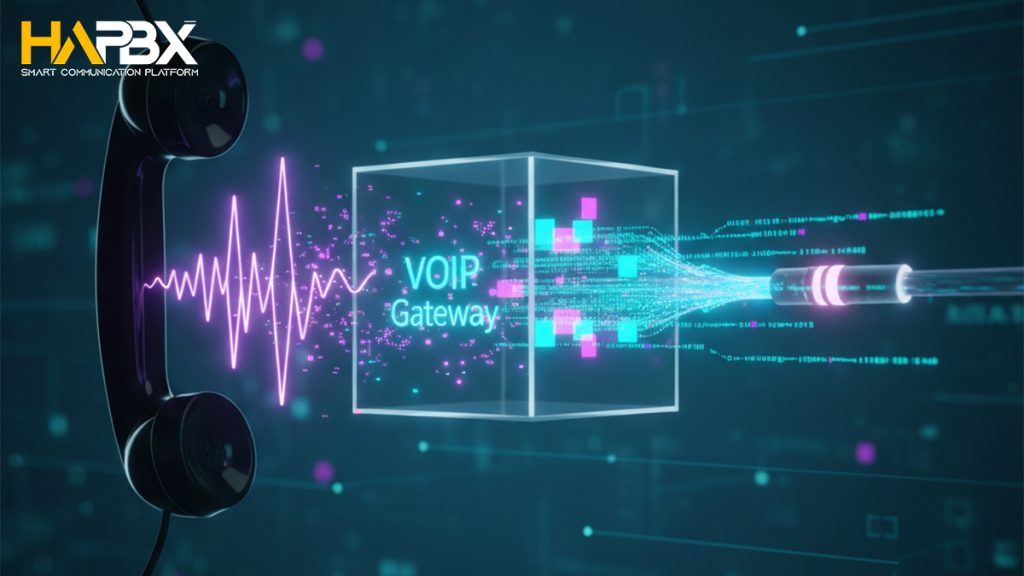
How PBX Systems Are Powered by VoIP Today
In modern business communications, PBX and VoIP work together as a single system.
Instead of relying on physical phone lines, today’s PBX platforms use VoIP as the underlying transport layer. This model is commonly referred to as IP PBX or VoIP-based PBX.
In this architecture:
- The PBX handles call logic (routing, extensions, IVR, call queues, permissions)
- VoIP carries the voice traffic over IP networks using SIP and related protocols
- External calls connect through SIP trunks or cloud gateways rather than PSTN lines
This shift allows businesses to retain the structured call management of a PBX while gaining the flexibility and scalability of VoIP. Cloud-based PBX systems take this a step further by hosting PBX functionality in secure data centers, eliminating the need for on-site hardware altogether.
Enterprise-grade platforms like HaPBX are built entirely around this model. By running PBX services on dedicated cloud infrastructure and using VoIP over private IP networks, businesses get centralized control, high availability, and consistent call quality – without the limitations of legacy PBX systems or the unpredictability of shared public VoIP environments.
In practice, this means modern phone systems are no longer a choice between PBX or VoIP. They are PBX systems powered by VoIP, designed to support growth, mobility, and enterprise-level reliability.
VoIP and PBX: Key Differences Explained
PBX and VoIP are often presented as competing solutions, but in reality they play different roles in modern business communications. PBX defines how calls are managed and controlled, while VoIP defines how voice is transmitted. Understanding their differences helps businesses choose an architecture that delivers the right balance of control, reliability, and scalability.
| Criteria | Traditional PBX | VoIP |
| Technology | Hardware-based system using physical phone lines (PSTN) | Software-based voice transmission over IP networks |
| Call Control | Managed locally through on-premise infrastructure | Managed through cloud or provider platforms |
| Upfront Costs | High (hardware, installation, cabling) | Low (software setup, compatible devices) |
| Ongoing Maintenance | Requires in-house IT resources | Maintenance handled by the provider |
| Pricing Model | Ownership-based, high long-term costs | Subscription-based with predictable monthly fees |
| Call Quality | Stable in fixed locations, independent of internet | Depends on network quality and infrastructure design |
| Reliability & Uptime | Vulnerable to hardware failures | Varies by provider; enterprise platforms like HaPBX offer high availability and ~50ms latency |
| Scalability | Limited; expansion requires new hardware | Easily scalable through software |
| Remote Work Support | Designed mainly for on-site teams | Built for multi-site and remote teams |
| Security Model | PSTN-based isolation and physical controls | IP-based security with encryption |
| System Isolation | Dedicated by default | Often shared; HaPBX uses dedicated instances and private IP networks |
What This Means for Modern Businesses
The choice between PBX and VoIP is no longer about old versus new technology. Traditional PBX systems offer control and stability, while VoIP delivers flexibility, scalability, and lower operational costs. Most organizations today combine these strengths through VoIP-based PBX architectures, where PBX call control runs on VoIP infrastructure.
Enterprise platforms like HaPBX are designed around this model, providing centralized PBX functionality on dedicated cloud infrastructure. This allows businesses to move beyond the PBX or VoIP debate and adopt a communication system that is reliable today and ready to scale tomorrow.
IP PBX: The Bridge Between VoIP and PBX
As business phone systems evolve, IP PBX has emerged as the point where traditional PBX functionality meets modern VoIP technology. Instead of choosing between PBX or VoIP, IP PBX combines both – delivering structured call control while using IP networks to carry voice traffic.
What Is an IP PBX?
An IP PBX is a PBX system that uses VoIP technology to manage and route calls over IP networks rather than traditional phone lines. It provides all core PBX functions – extensions, call routing, IVR, call queues, and voicemail – while replacing PSTN connections with SIP and IP-based communication.
In simple terms, IP PBX is a PBX system powered by VoIP, making it more flexible, easier to scale, and better suited for modern business environments.
How IP PBX Works
In an IP PBX architecture, voice calls are transmitted as digital data over an IP network. When a call is placed:
- The user’s voice is converted into data packets using VoIP codecs
- The IP PBX applies call logic such as routing, permissions, or queuing
- Calls are delivered internally over the IP network or externally via SIP trunks or cloud gateways
This approach removes the need for dedicated phone lines and allows businesses to manage all communication through software, whether users are in the office, at home, or in different locations.

Cloud PBX vs On-Premise IP PBX
On-premise IP PBX
An on-premise IP PBX is installed and managed within the organization’s own infrastructure. It offers greater direct control but requires upfront hardware investment, ongoing maintenance, and in-house IT expertise. Scaling often involves additional equipment and manual configuration.
Cloud PBX
A Cloud PBX hosts IP PBX functionality in the provider’s data centers and delivers it over secure IP connections. This model eliminates on-site hardware, simplifies management, and allows businesses to scale users and locations quickly. Reliability, security, and performance depend heavily on the provider’s infrastructure design.
Cloud PBX removes the burden of on-site hardware and simplifies system management, but not all cloud solutions are built for enterprise requirements.
HaPBX represents a next-generation Cloud PBX model, delivering PBX functionality on enterprise-grade cloud infrastructure with global availability, low-latency routing, and strong system isolation. This allows businesses to benefit from cloud scalability while retaining the performance, stability, and control traditionally associated with on-premise PBX systems.
Together, these models show why IP PBX acts as the true bridge between VoIP and PBX – bringing structured call management into the era of IP-based communication.
IP PBX Guide: How It Works, Benefits and Setup for Businesses
Choosing the Right VoIP-Based PBX for Your Business
Choosing a VoIP-based PBX is a strategic decision that directly affects how reliably your business communicates today and how easily it can scale tomorrow. Rather than focusing on individual features, organizations should evaluate whether a system can deliver consistent call quality, strong control, security, and long-term flexibility – especially in multi-location and enterprise environments.
Key Decision Factors
When evaluating a VoIP-based PBX solution, consider the following factors:
- Reliability and availability
Look for an architecture designed to eliminate single points of failure. High availability, geographic redundancy, and stable routing are critical for business-critical voice communication.
- Call quality and latency
Consistent voice quality depends on more than internet access. Optimized routing, controlled infrastructure, and low latency – especially for US and Europe traffic – play a major role.
- Security and system isolation
A business PBX should protect signaling and voice traffic through encryption, controlled network paths, and clear separation between customers to reduce exposure to shared-environment risks.
- Scalability and performance
The system should support growth without hardware changes, handling increasing numbers of users, extensions, and concurrent calls without degradation.
- Multi-site and remote support
Native support for distributed teams, multiple offices, and remote users ensures consistent call handling regardless of location.
- Operational simplicity and cost transparency
Predictable pricing, centralized management, and minimal operational overhead make long-term planning easier and reduce IT burden.
When a Cloud PBX Is the Best Option
A Cloud PBX is often the best choice for businesses that want to modernize communications without managing on-site infrastructure. It is particularly well suited for organizations that:
- Operate across multiple locations or regions
- Support remote or hybrid workforces
- Require fast deployment and easy scaling
- Want to reduce hardware dependency and maintenance effort
- Need enterprise-level reliability without building their own infrastructure
Enterprise-grade Cloud PBX platforms like HaPBX are built specifically for these scenarios. By combining high availability architecture, low-latency routing, strong security controls, and scalable cloud design, HaPBX delivers a VoIP-based PBX solution that supports business growth while maintaining the stability and control expected from an enterprise communication system.
In practice, the right VoIP-based PBX is not just a phone system – it is a foundation for reliable, secure, and future-ready business communication.

HaPBX: An Enterprise VoIP-Based PBX Built for Reliability and Scale
HaPBX is an enterprise VoIP-based PBX designed for businesses that require stable, predictable communication across multiple locations. It combines traditional PBX call control with modern VoIP technology, delivering a cloud-based system optimized for organizations operating in the US and different regional markets.
Built with High Availability by design, HaPBX uses Global cluster architecture to eliminate single points of failure and maintain consistent performance. Region-optimized routing ensures low latency (around 50ms) and reliable call quality, even at high call volumes.
HaPBX also emphasizes security, system isolation, and operational control, reducing the risks of shared VoIP environments while supporting enterprise compliance needs. With scalable architecture and centralized management, HaPBX enables businesses to grow and adapt without the complexity of on-site PBX infrastructure.
For companies seeking a VoIP-based PBX that balances reliability, performance, and scalability, HaPBX provides a future-ready foundation for business communication.
Final Verdict: VoIP Is the Technology, PBX Is the System
VoIP and PBX are not opposing choices – they serve different purposes within the same communication stack. VoIP defines how voice is transmitted, while PBX defines how calls are controlled, routed, and managed. Modern business phone systems bring these two together through VoIP-based PBX architectures that combine flexibility with structured control.
As organizations scale, operate across regions, or support remote teams, the limitations of legacy PBX and generic VoIP platforms become more apparent. Reliability, call quality, security, and predictability matter just as much as cost and features. This is why many businesses are moving toward enterprise-grade Cloud PBX solutions designed specifically for performance and long-term growth.
HaPBX is built around this modern model – delivering a VoIP-based PBX with high availability, low-latency routing, strong security controls, and scalable architecture. Designed for businesses in the US and Europe, HaPBX provides a reliable communication foundation without the complexity of on-site infrastructure or the risks of shared VoIP environments.
If your business is evaluating VoIP, PBX, or the transition between them, HaPBX offers a clear, enterprise-ready path forward.
Explore how HaPBX can support your communication strategy – or request a free demo to see how a modern VoIP-based PBX should work.