

The era of the traditional landline is officially over. As we navigate the business landscape of 2026, the “PSTN Switch Off” is no longer a distant warning—it is a global reality. For enterprises, this shift presents a critical challenge: how to modernize communication infrastructure without disrupting operations.
Many organizations still rely on powerful Private Branch Exchange (PBX) systems that serve as the “brain” of their internal communications. However, these systems are often tethered to the outside world by obsolete ISDN or copper lines. This creates a bottleneck, limiting features and inflating costs.
The solution lies in PBX SIP Trunking.
This technology acts as the digital bridge, connecting your business phone system directly to the global network via the internet. In this guide, we will demystify the relationship between your PBX and SIP connectivity, explore the critical differences between hosted PBX vs sip trunking, and help you decide whether to upgrade your existing hardware or migrate to a fully managed cloud solution.
Understanding PBX and SIP Trunking
To make an informed infrastructure decision, it is essential to distinguish between the system that manages your calls and the method used to connect them.
What is PBX?
A Private Branch Exchange (PBX) is the internal telephone network used within a company. It is the “brain” responsible for routing calls between extensions, managing voicemail, setting up conference bridges, and handling IVR menus.
Historically, PBXs were massive analog hardware boxes. Today, most modern enterprises utilize an IP PBX (Internet Protocol PBX) or a cloud PBX platform like HAPBX, which handles voice data as digital packets.
What is SIP Trunk?
If the PBX is the brain, the SIP Trunk is the nervous system that connects it to the rest of the world.
A PBX SIP trunk is a virtual version of a traditional phone line. Instead of using physical wires to connect your PBX to the Public Switched Telephone Network (PSTN), a SIP trunk utilizes your existing internet connection. It establishes a virtual pathway that supports voice, video, and messaging sessions.
It is important to understand that a SIP trunk is a service you purchase to enable external connectivity for your PBX. It is not the phone system itself.
For a deeper dive into the technical definition of SIP trunk, please refer to our comprehensive guide on What Is SIP Trunking?
How They Work Together: The IP PBX SIP Trunking Connection
When you combine these two technologies into an IP PBX SIP trunking architecture, the call flow transforms:
- Initiation: An employee dials a number from their desk phone or softphone.
- Processing: Your IP PBX processes the request and converts the voice audio into digital packets.
- Transmission: The PBX sends these packets through your firewall and onto the SIP trunk.
- Routing: The SIP trunk provider carries the data over the internet to the PSTN, connecting the call to the recipient’s mobile or landline.
This synergy allows businesses to keep the internal functionality of their PBX while leveraging the cost savings and flexibility of the internet.
Hosted PBX vs. SIP Trunking for Your On-Premise PBX
This is the crossroads where most IT managers and business owners find themselves. You know you need to modernize, but which path do you take? Do you simply add a digital connection to your existing hardware, or do you replace the system entirely?
To make the right choice, we must analyze the difference between hosted pbx and sip trunking deployment models.
Option 1: Enhancing Your Existing On-Premise PBX with SIP Trunking
In this scenario, your business retains ownership and control of the physical PBX hardware located in your server room. You simply cancel your legacy ISDN/PRI contracts and purchase a PBX trunk service from a SIP provider to connect that hardware to the internet.
This model is ideal for:
- Enterprises that have recently invested significant capital in a modern, on-premise IP PBX.
- Organizations with strict regulatory requirements demanding data to remain physically on-site.
- Teams with a robust in-house IT department capable of managing complex telephony configurations.
Pros:
- Asset Utilization: Maximizes the ROI on hardware you have already purchased.
- Granular Control: Your IT team has full access to the backend configuration.
Cons:
- Maintenance Burden: You are responsible for all hardware maintenance, software patches, and security updates.
- Scalability Limits: Scaling up often requires buying new hardware modules or licenses in addition to adding trunk channels.
- Disaster Recovery Risks: If your office loses power or the local internet fails, your entire phone system goes offline unless you have expensive redundancy measures in place.
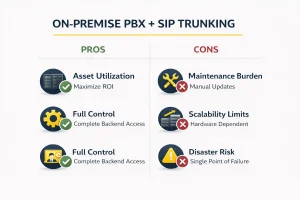
On-Premise PBX with SIP Trunking Pros and Cons
Option 2: Migrating to a Hosted or Cloud PBX Solution
In the hosted PBX vs sip trunking debate, this option represents a shift from “owning” to “subscribing.” Here, the entire PBX system is moved off-site. The service provider hosts the PBX functionality in their data center (the cloud), and the SIP connectivity is inherently built into the service—a model exemplified by HAPBX’s Dedicated Instance solution.
This model is ideal for:
- Agile businesses wanting to eliminate hardware dependency.
- Organizations prioritizing High Availability (HA) and disaster recovery—the core philosophy behind the HAPBX architecture.
- Companies needing enterprise-grade security without the complexity of on-site maintenance.”
Pros:
- Zero Hardware Hassle: No on-premise servers to maintain, cool, or power.
- Simplified Management: The provider handles all security patches, updates, and infrastructure maintenance.
- Elastic Scalability: Users and features can be added instantly via a web portal.
- Built-in Connectivity: You don’t need to configure a separate pbx sip trunk; the connectivity is part of the package.
Cons:
- OpEx Shift: Moves costs entirely to a monthly subscription model (though this is often preferred for cash flow).
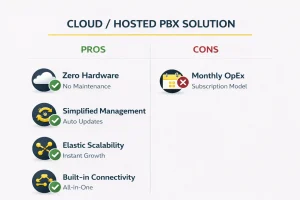
Hosted or Cloud PBX Solution Pros & Cons
To summarize the cloud pbx vs sip trunking confusion:
- SIP Trunking is a connectivity pipe. It is a component you buy to connect a PBX you already manage (whether that PBX is in your closet or in a private cloud).
- Hosted SIP PBX (Cloud PBX) is a complete communication solution. It includes the PBX features and the connectivity.
Think of it this way: SIP Trunking is like buying gas for a car you own. Hosted PBX is like using a premium ride-sharing service where the car, gas, and driver are all provided for you.
Key Benefits of Adopting a PBX SIP Trunking Strategy
Whether you choose to maintain an on-premise system or migrate to the cloud, the underlying move to IP PBX SIP trunking delivers undeniable advantages over legacy telephony. By decoupling your voice services from physical copper wires, you unlock a level of efficiency and agility that old PRI lines simply cannot match.
Here are the primary pbx sip trunk benefits driving this global migration:
Significant Cost Reduction
The most immediate impact is financial. Traditional ISDN/PRI lines require businesses to purchase channels in rigid blocks (typically 23 at a time). If you need 24 channels, you pay for 46
PBX SIP trunking eliminates this waste through:
- Precision Scalability: Pay only for the exact number of concurrent call paths you need.
- Lower Call Rates: SIP providers leverage the internet to route calls, drastically reducing per-minute costs for long-distance and international dialing.
- Infrastructure Consolidation: By converging voice and data onto a single internet connection, you eliminate the maintenance and rental costs of separate physical phone networks.
Enhanced Scalability and Flexibility
In the modern business environment, agility is currency. IP pbx sip trunking advantages include the ability to scale instantly.
- On-Demand Capacity: Adding new lines to a traditional system used to take weeks of installation. With SIP, you can provision additional channels during peak seasons (like Black Friday or tax season) in minutes via a software portal.
- Global Mobility: Because SIP trunks are virtual, they are not tied to a specific geographic location. You can assign local numbers (DIDs) from London or Tokyo to your office in New York, establishing a local presence without physical expansion.
Improved Reliability and Business Continuity
One of the critical voip pbx setup benefits is built-in redundancy. Copper lines are susceptible to local physical damage—a severed cable can cut off a business for days.
SIP trunks are location-agnostic. In the event of a local power outage or internet failure at your office, calls can be automatically re-routed at the network level to mobile devices, secondary office locations, or voicemail, ensuring your business never goes silent.
Access to Advanced Features and UC Integration
SIP trunking transforms your PBX from a simple telephone into a Unified Communications hub. It supports the transmission of multimedia sessions, enabling:
- High-Definition (HD) Voice quality.
- Video conferencing and screen sharing.
- Seamless integration with CRM systems (like Salesforce) to log calls and pop up customer data instantly.
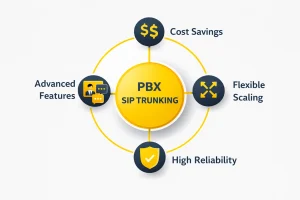
Key Benefits of Adopting a PBX SIP Trunking
Configuration Considerations for IP PBX SIP Trunking
While the benefits are clear, the actual implementation of ip pbx sip trunking configuration requires technical precision. Unlike plugging in an analog phone, connecting a SIP trunk to an IP PBX involves configuring your network ecosystem to handle real-time voice traffic securely.
If you are managing an on-premise system, here are the critical technical factors to consider.
Core Requirements for a Successful Setup
- SIP-Compatible IP PBX:
Ensure your existing PBX hardware or software supports standard SIP protocols. Most modern systems (like Asterisk, 3CX, or Avaya IP Office) are natively compatible. If you have a legacy analog PBX, you may need a VoIP Gateway to translate the SIP signal. - Sufficient Internet Bandwidth:
Voice traffic is sensitive. While we covered bandwidth in detail in our “What Is SIP Trunking?” guide, the rule of thumb is to ensure your internet connection has low latency and sufficient upload speed to handle your peak concurrent call volume (approx. 100kbps per call). - Firewall and Router Configuration:
This is the most common stumbling block in a voip pbx setup. Your network security must be configured to allow voice traffic to pass through without inspection delays.- Port Forwarding: You typically need to open UDP port 5060 for SIP signaling and a range of UDP ports (often 10000-20000) for RTP media (audio) traffic.
- Disable SIP ALG: Most commercial routers have a setting called “SIP ALG” (Application Layer Gateway) enabled by default. While intended to help, it frequently corrupts SIP packets, causing dropped calls or one-way audio. Always disable SIP ALG.
Common Setup Challenges
Even with the right hardware, IT teams often encounter:
- NAT Traversal Issues: Network Address Translation (NAT) can obscure the internal IP address of your PBX, preventing the SIP provider from sending audio back to you. This results in “one-way audio” where the caller can hear you, but you cannot hear them.
- Codec Mismatches: Your PBX and your SIP provider must “speak the same language” (Codecs like G.711 or G.729) to compress audio. Mismatches lead to failed calls or poor quality.
- E911 Configuration: Unlike landlines, a SIP trunk doesn’t automatically know your physical location. You must manually register your physical address with the provider for emergency services to work key.
Note: These technical complexities—managing firewalls, NAT rules, and security patches—are the primary reason many businesses are moving away from DIY SIP trunking configurations toward fully managed environments like HAPBX, which handle these backend settings automatically.
HAPBX: A Superior Evolution Beyond Basic PBX SIP Trunking
Many businesses find themselves at a crossroads: should they invest resources into managing an on-premise PBX with separate SIP trunks, or transition to a fully managed system? While standard SIP trunking offers connectivity, it still leaves the heavy lifting of hardware maintenance and security configuration on your shoulders.
HAPBX (High Available Private Branch Exchange) represents the optimal evolution. It bridges the difference between hosted pbx and sip trunking by offering a unified, enterprise-grade platform where the connectivity is inherent, not an add-on.
Bridging the Gap: From “PBX + SIP Trunk” to Integrated Cloud PBX
In a typical cloud pbx vs sip trunking comparison, standard cloud providers often put your business on a shared server, leading to performance fluctuations. HAPBX changes the paradigm. We provide a Hosted SIP PBX solution that doesn’t just connect you; it protects you.
By integrating the SIP connectivity directly into a managed platform, HAPBX removes the need for you to configure firewalls, manage NAT traversal, or worry about codec mismatches. We deliver a “Total Internal Switchboard System” that is safe, sound, and ready for scale.
Dedicated Instance Infrastructure
Security and stability are the primary casualties in shared hosting environments. HAPBX mitigates this through our Dedicated Instance model.
- Zero “Noisy Neighbors”: Unlike multi-tenant platforms where another client’s traffic spike can degrade your call quality, HAPBX isolates your resources. This ensures your latency (ping) is maintained strictly around 50ms (max not exceeding 150ms), guaranteeing smooth voice quality that outperforms the industry average (>150ms).
- Enterprise-Grade Security: Your dedicated environment is fortified with TLS/SRTP encryption, DDoS mitigation, and SIP hardening. You receive a private IP and private domain, drastically reducing the surface area for attacks compared to generic public cloud PBX services.
High Availability & Unmatched Scalability
The “HA” in HAPBX stands for High Availability, and we back this claim with rigorous infrastructure metrics.
- Global Cluster Infrastructure: We don’t rely on a single server. Our platform runs on a Global Cluster, ensuring that if one node encounters an issue, traffic is instantly synchronized to another. This architecture eliminates single points of failure, delivering on our promise of almost no downtime.
- Power for Scale: While legacy PBX setups struggle to expand, a default HAPBX configuration is engineered to handle 100+ concurrent calls and supports unlimited extensions. Whether you are a growing SME or a large call center, your system can expand instantly without the need for expensive hardware upgrades or complex migration projects.
Conclusion
As we move further into 2026, the distinction between the “phone system” and the “phone line” is vanishing. While PBX SIP Trunking remains a viable connection method for legacy hardware, the future belongs to integrated, managed solutions that prioritize resilience.
The choice is no longer just about hosted pbx vs sip trunking; it is about choosing between a system you have to maintain and a system that empowers you.
Why struggle with the complexities of DIY configuration, firewall rules, and hardware maintenance? HAPBX offers the robust connectivity of SIP trunking wrapped in a secure, high-availability Dedicated Instance. We handle the infrastructure, the security, and the uptime, so you can focus entirely on your core business development.
Ready to modernize your communication infrastructure?
Stop managing complex PBX configurations. Contact HAPBX today to explore a truly unified, secure, and highly available communication platform. Let us build a foundation that is always safe, sound, and ready for any scale.