

In today’s cloud-driven economy, communication is no longer just a phone line – it’s the backbone of customer experience, team productivity, and business growth. As companies shift away from costly hardware and outdated landlines, virtual PBX for business has emerged as the new standard, offering flexibility, mobility, and enterprise-level capabilities without enterprise-level costs.
Built for modern workflows, HaPBX brings this transformation to businesses with high-availability infrastructure, ultra-low latency, and real-time scalability suited for fast-growing teams. Whether you’re replacing legacy systems, enabling hybrid work, or streamlining customer communication, HaPBX provides the performance, reliability, and simplicity today’s organizations demand.
Why Virtual PBX Matters for Modern Businesses
Business communication has changed rapidly as companies move away from hardware-based phone systems toward flexible, cloud-driven solutions. Traditional PBX systems were built for a time when teams worked from a single office and customer expectations were simpler. Today, businesses operate across multiple locations, rely on remote and hybrid teams, and require communication tools that can scale quickly without expensive infrastructure or maintenance. Legacy systems can’t keep up with the speed, mobility, and efficiency that modern organizations demand.
Virtual PBX has become the new industry standard because it aligns with how businesses operate today. It eliminates the limitations of physical hardware, supports seamless communication across devices, and offers enterprise-grade capabilities through the cloud. With features like IVR, mobile access, and real-time analytics, Virtual PBX gives businesses the flexibility to grow, adapt, and deliver better customer experiences – all while reducing operational complexity.
What Is Virtual PBX? The Complete 2026 Guide to Modern Business Phone Systems
How Virtual PBX Fits Into a Business Communication Strategy
A Virtual PBX enhances modern communication strategies by offering a flexible, cloud-based system that supports multiple devices and remote access. It provides a unified platform for sales teams, support departments, managers, and field staff – allowing everyone to communicate consistently without relying on location-bound hardware. This makes it easier for businesses to maintain clear customer interactions and internal coordination as they grow.
Scalability and mobility are especially important for SMEs and companies adopting hybrid work models. With Virtual PBX, businesses can add new users instantly, and employees can handle calls from laptops, mobile apps, or softphones regardless of location. Cloud communications not only improve team collaboration but also ensure continuity across distributed teams, making Virtual PBX a practical foundation for any modern communication strategy.
How a Virtual PBX Works in a Business Environment
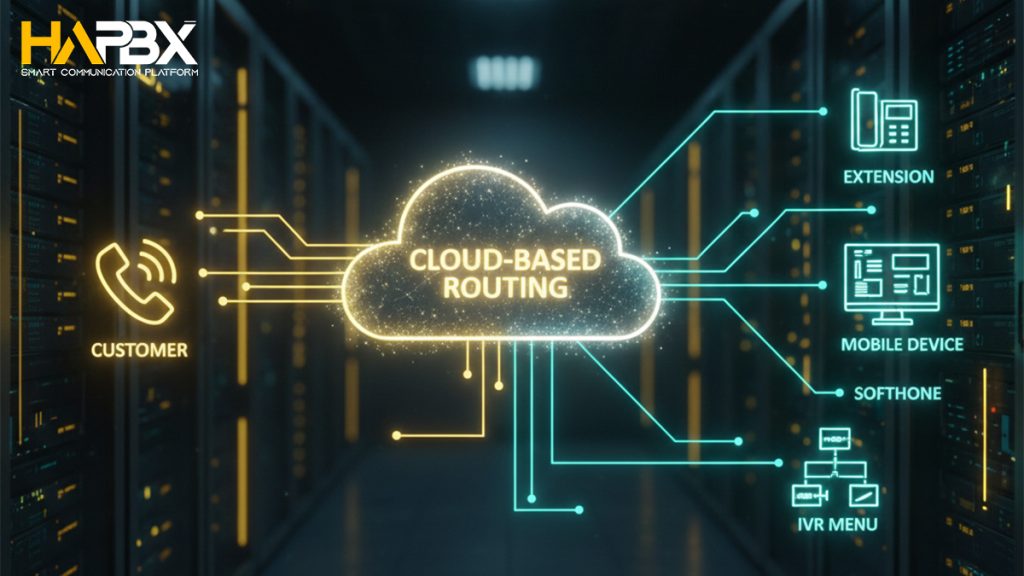
In a business setting, a Virtual PBX manages calls through cloud infrastructure rather than on-site hardware. When a customer dials your number, the system uses cloud-based routing to determine where the call should go – whether that’s an extension, a mobile device, a softphone, or an IVR menu. Behind the scenes, the platform handles call distribution, forwarding rules, voicemail routing, and queue management, ensuring every call reaches the right person or team quickly and efficiently.
For internal operations, businesses can manage extensions, call flows, and routing logic through a web dashboard. Administrators can create rules for business hours, set up IVR menus, adjust call queues, or enable remote access for team members working outside the office. Because everything runs in the cloud, employees can use the system from anywhere and on any device.
Virtual PBX also integrates smoothly with essential business tools such as CRM systems, helpdesk software, and workflow platforms. This allows calls to automatically log into customer records, trigger support tickets, or sync with calendars and contact lists. Instead of functioning as a standalone phone system, Virtual PBX becomes part of a broader communication ecosystem – streamlining operations, improving response times, and giving leaders visibility into team performance.
Virtual PBX vs Other Business Phone Systems
For growing businesses, choosing the right phone system is crucial for scalability, cost control, and flexibility. Traditional PBX (on-premise analog or legacy systems) relies on physical hardware and copper lines, while on-premise PBX (often IP-based) keeps everything installed at your location. Hosted PBX (also called cloud PBX) shifts management to a provider’s servers but may still involve some shared infrastructure dependencies.
HaPBX stands out as a true enterprise-grade Virtual PBX solution, offering high availability, unlimited scalability, advanced features, and predictable pricing – designed specifically for modern businesses that need seamless remote work, rapid growth, and uninterrupted service.
| Category | Traditional PBX (Analog/Legacy) | On-Premise PBX (IP-Based) | Hosted PBX (Provider-Managed) | HaPBX (Virtual PBX) |
| Deployment | On-site hardware with physical lines (PSTN) | On-site servers/hardware installed at your location | Provider-hosted servers, accessed via internet | Fully cloud-native, dedicated global redundant infrastructure |
| Upfront Cost | High (hardware, wiring, installation) | Very high (servers, gateways, IT setup) | Low (no hardware required) | Low – No hardware or upfront investment; predictable usage-based pricing |
| Ongoing Maintenance | High (repairs, upgrades, dedicated staff) | High (IT team, patches, hardware maintenance) | Low (provider handles everything) | Minimal – Fully managed by HaPBX with responsive support and personalized onboarding |
| Scalability | Limited (requires new hardware/lines) | Moderate (add hardware/cards, but costly/time-consuming) | High (add users quickly via dashboard) | Unlimited – Instant scaling for growing teams, multi-location, and remote workers |
| Reliability & Uptime | Dependent on local power/lines; prone to outages | Good internally, but vulnerable to power/internet issues | High (provider redundancies), but depends on internet | Superior – Global clusters with automatic failover, 99.99%+ uptime, low-latency calls |
| Remote & Mobility Support | Poor (limited to office phones) | Moderate (requires VPN/setup) | Excellent (mobile apps, softphones) | Excellent – Seamless multi-device access, remote teams, no new equipment needed |
| Features & Control | Basic call routing, limited advanced tools | Advanced, but requires in-house expertise | Enterprise features, provider-managed | Enterprise-level – Advanced routing, IVR, analytics, full control via web dashboard |
| Best For | Legacy businesses with fixed locations | Large enterprises needing full control & compliance | SMBs wanting ease & flexibility | Growing businesses – Fast scaling, cost savings, high reliability, and modern features |
This comparison highlights why many growing companies are moving to Virtual PBX solutions like HaPBX. It combines the best of cloud flexibility with enterprise-grade performance, eliminating the drawbacks of traditional and on-premise systems while delivering superior value for businesses focused on agility and growth.
PBX Phone System: Complete Guide for Business Communication (2026)
Business-Focused Benefits of Virtual PBX
A Virtual PBX offers practical advantages that directly impact business performance, starting with reduced cost and zero hardware complexity. Because everything is cloud-based, companies eliminate the expense of on-site equipment, maintenance, and IT support. This makes Virtual PBX especially attractive for SMEs that want enterprise-level communication without the heavy upfront investment.
As organizations evolve, they also benefit from flexible scaling as your team grows. New users, numbers, and locations can be added instantly – no wiring, no hardware upgrades, no disruptions. This agility translates into smoother operations and faster response times, contributing to an enhanced customer experience with smart routing that ensures callers always reach the right department or agent.
In today’s hybrid work environment, businesses also need remote-friendly communication for distributed workforces. Virtual PBX enables teams to handle calls from any device, anywhere, keeping communication consistent across offices, homes, and field locations. Because the platform is cloud-based, companies also gain stronger business continuity & disaster recovery, ensuring operations remain stable during outages or unexpected disruptions.
Finally, Virtual PBX brings enterprise-grade features without enterprise pricing, giving businesses access to smart call handling, IVR, analytics, and mobility tools typically reserved for large corporations. This combination of affordability and capability makes Virtual PBX a powerful communication foundation for modern organizations.
Essential Features That Businesses Actually Use
Modern businesses rely on practical features that improve daily operations, not just technical add-ons. IVR menus help streamline customer-facing operations by guiding callers to the right department instantly, while call queues and ring groups ensure support and sales teams handle high call volumes efficiently. These tools reduce wait times and create a more professional customer experience.
For internal productivity, features like voicemail-to-email and call recordings support quality assurance and training by keeping important conversations accessible and easy to review. Meanwhile, softphones and mobile apps give remote and hybrid workers the flexibility to stay connected from any device. To support smarter decision-making, analytics and reporting provide valuable insights into call performance, customer behavior, and team efficiency – helping businesses improve operations with real data.
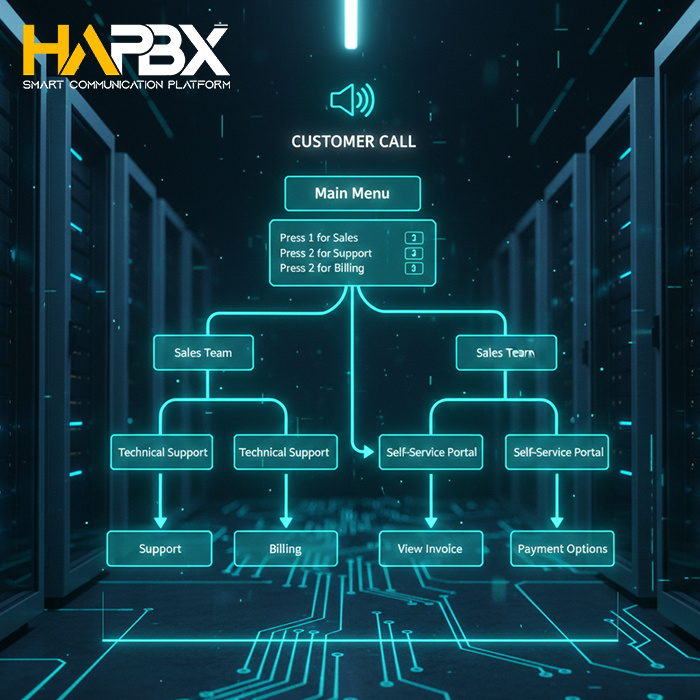
IVR menu
Real Use Cases of Virtual PBX for business
Virtual PBX adapts to a wide range of industries and business needs. Here are some of the most common real-world scenarios:
- Retail & SMBs – Professional communication with minimal cost
Small businesses and retail shops use Virtual PBX to appear more professional, streamline customer interactions, and maintain low operational expenses.
- Customer service teams – Handling call volume with efficiency
Features like IVR, call queues, and analytics help support teams manage large call volumes, reduce wait times, and maintain consistent service quality.
- Multi-branch operations – Unified system across locations
Companies with multiple offices or branches benefit from a single cloud-based system that keeps all locations connected and easy to manage.
- Startups & SaaS companies – Fast deployment, no hardware
Growing teams appreciate instant setup, zero hardware requirements, and the ability to scale communication capabilities as the business expands.
- Healthcare & education – Secure, flexible communication
These sectors rely on Virtual PBX for secure messaging, remote workflows, and efficient handling of patient or student communication while meeting compliance needs.
Why Choose HaPBX for Your Business?
As more companies move their communication systems to the cloud, the choice of provider becomes critical. HaPBX is designed specifically for modern businesses that demand reliability, scalability, and world-class performance – without the complexity or cost of legacy systems. Built on a globally distributed cloud cluster with high availability and ultra-low latency, HaPBX delivers communication infrastructure that meets the expectations of today’s fast-moving organizations.
What Makes HaPBX Different
Global cluster infrastructure for maximum uptime
HaPBX is not self-hosted or dependent on local servers. Instead, it operates on a high-availability global cloud cluster designed to eliminate downtime and keep communication stable – even under heavy load.
Strong security through cluster separation
HaPBX isolates workloads using a multi-cluster design, reducing risk exposure and ensuring that each environment maintains maximum security and compliance.
High performance with no user or extension limits
Unlike many providers that restrict the number of users, extensions, or concurrent calls, HaPBX offers true scalability – supporting 100-200 concurrent calls effortlessly, making it ideal for growing teams or high-volume operations.
Enterprise-grade reliability without enterprise cost
With an infrastructure roadmap focused on expanding US-based clusters, HaPBX offers top-tier performance typically associated with expensive enterprise systems – while keeping pricing accessible for SMEs and growth-focused companies.
Fast deployment with personalized onboarding
Businesses can get fully operational in hours, not days. HaPBX provides guided onboarding to configure routing, IVR, and extensions so teams can start communicating immediately.
Transparent pricing based on real usage
No hidden fees. No per-user penalties. You only pay for what you actually use, making HaPBX one of the most cost-efficient cloud PBX solutions for businesses at any scale.
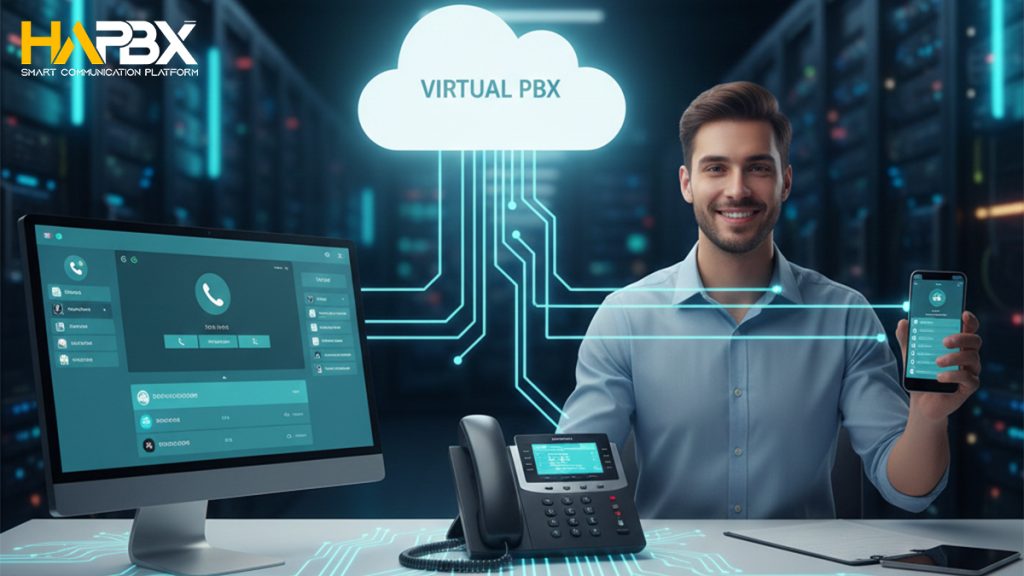
HaPBX Feature Advantages
- Advanced IVR builder tailored for SMEs: Create intelligent call flows and self-service experiences without technical complexity, allowing smaller teams to operate with enterprise professionalism.
- Superior call quality with optimized VoIP routing: With a geographically optimized network and intelligent routing, HaPBX consistently maintains low latency (~50ms), enabling high-quality, delay-free calls for both inbound and outbound communication.
- Multi-device access (deskphone, softphone, mobile): Teams can operate seamlessly across devices, supporting remote, hybrid, and on-site workflows without limitations.
- Business analytics designed for support and sales teams: HaPBX provides actionable insights – call performance, agent metrics, customer behavior – to help teams increase conversion rates and improve service quality.
HaPBX vs Other Providers
| Category | Other Providers / Traditional PBX | HaPBX (Why Choose Us) |
| Features | Most offer only basic calling and IVR Advanced routing | Enterprise-level features at SMB pricing
|
| Cost & Value |
|
|
| Service, Support & Customizability |
|
|
How to Get started with HaPBX
Getting started with HaPBX is simple, structured, and designed to help businesses go live quickly with minimal technical effort. Whether you’re transitioning from a legacy PBX, migrating from another VoIP provider, or setting up your phone system for the first time, HaPBX provides a smooth onboarding process to ensure everything works exactly the way your teams need.
Step-by-Step Onboarding Process
- Initial Consultation: A HaPBX specialist reviews your communication goals, call flow requirements, and current system to design the right setup strategy.
- Account Creation & Infrastructure Setup: Your dedicated instance is deployed on our high-availability cluster, ensuring secure, isolated performance from day one.
- Call Flow & IVR Configuration: We help you build customized routing logic, IVR menus, business hour rules, and extension structures aligned with your operations.
- Device & User Setup: Teams receive access credentials for deskphones, softphones, or mobile apps. Adding users or devices requires only a few clicks.
- Testing & Quality Assurance: Audio quality, call routing, voicemail, and analytics dashboards are tested to ensure everything performs reliably at scale.
- Go Live & Training: Your system is activated, and your team receives training materials for daily operations, reporting, and configuration updates.

HaPBX operates on a high-availability global cloud cluster infrastructure
FAQs
1. Is Virtual PBX suitable for small businesses?
Yes. Virtual PBX is ideal for small businesses because it offers professional communication features without expensive hardware or IT maintenance. It scales easily as the business grows, making it a cost-effective option for teams of any size.
2. Can Virtual PBX replace my entire phone system?
Absolutely. A Virtual PBX can fully replace traditional phone systems by handling all calling, routing, voicemail, IVR, and multi-device communication through the cloud. Most businesses transition completely without needing on-site equipment.
3. How secure is Virtual PBX?
Modern Virtual PBX platforms use encrypted communication, secure data centers, and strict access controls. With HaPBX specifically, your system runs on a Dedicated Instance, ensuring isolated security, high availability, and enterprise-grade protection.
4. How much does Virtual PBX cost for a business?
Costs vary based on usage and features. Virtual PBX typically reduces expenses because it eliminates hardware, maintenance, and per-user licensing fees. HaPBX uses transparent, usage-based pricing, making it more affordable for scaling teams compared to traditional PBX or fixed plans.
5. Can Virtual PBX support remote teams?
Yes. Virtual PBX is built for remote and hybrid teams. Users can handle calls, messages, and voicemails from softphones, mobile apps, or desktop devices, keeping communication consistent from any location.
6. Does HaPBX work with my existing devices/software?
In most cases, yes. HaPBX supports standard SIP deskphones, softphones, and mobile apps. It also integrates with popular business tools such as Salesforce, HubSpot, Zendesk, Slack, and more – making it easy to fit into your existing workflow.
Conclusion
The future of business communication is firmly cloud-based, giving organizations the flexibility and speed needed to support modern work. Virtual PBX empowers SMEs and growing companies by removing hardware limitations, enabling remote teams, and improving customer interactions through smarter, more efficient call routing.
HaPBX strengthens this advantage with a high-availability, dedicated infrastructure designed for reliability, performance, and effortless scalability. For businesses looking to modernize their communication and prepare for long-term growth, HaPBX offers a trusted, future-ready solution that elevates every aspect of how teams connect and serve customers.